

J&J to Acquire Firefly Bio for $1 Billion, Strengthening Next-Generation KRAS Cancer Pipeline
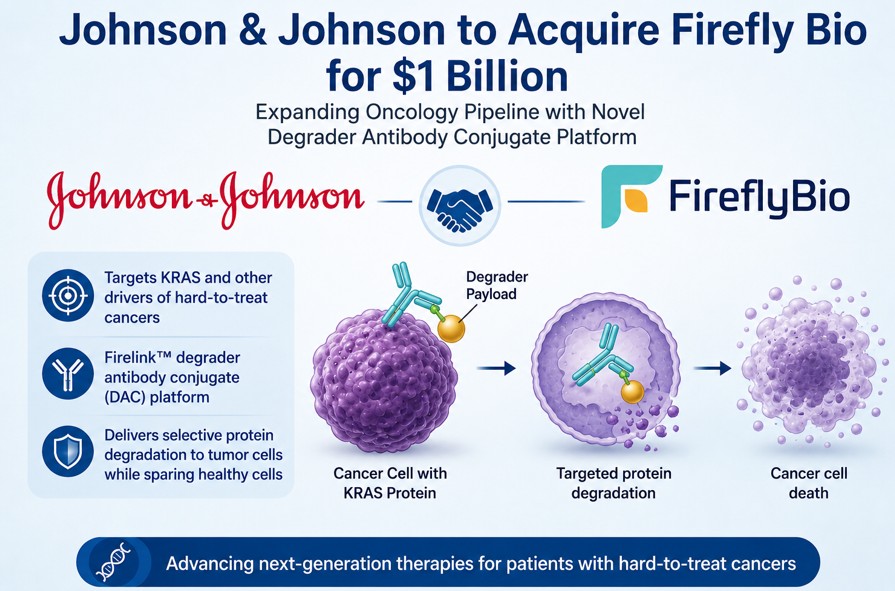
New Brunswick, NJ: Johnson & Johnson has announced a definitive agreement to acquire biotechnology company Firefly Bio, Inc. for $1 billion in cash, expanding its oncology pipeline with a novel antibody-based protein degradation platform designed to target some of the most difficult-to-treat cancers.
The acquisition brings Firefly Bio’s proprietary Firelink™ degrader antibody conjugate (DAC) platform into Johnson & Johnson’s oncology portfolio, strengthening the company’s efforts to develop targeted therapies against KRAS-driven tumors and other major drivers of solid cancers.
KRAS mutations are among the most common genetic alterations in cancer and are frequently found in pancreatic, colorectal, and lung cancers. Despite decades of research, KRAS has long been regarded as one of oncology’s most challenging drug targets, earning the reputation of being “undruggable.”
Firefly’s technology seeks to overcome this challenge through a new therapeutic approach that combines the targeting precision of antibodies with the protein-degrading capabilities of targeted degraders.
Moving Beyond Traditional Antibody Therapies
Antibody-based medicines have transformed cancer treatment over the past three decades, evolving from conventional monoclonal antibodies to bispecific antibodies and antibody-drug conjugates (ADCs).
The Firelink™ platform represents a new generation of engineered antibody therapeutics known as degrader antibody conjugates. Rather than simply blocking or killing cancer cells, these molecules are designed to selectively deliver protein degraders into tumor cells, triggering the destruction of disease-causing proteins while minimizing effects on healthy tissues.
This approach could potentially address limitations associated with existing therapies, including drug resistance and inadequate targeting of intracellular cancer drivers.
“KRAS has notoriously been considered an undruggable target and patients with KRAS-driven cancers continue to face limited treatment options with survival measured in months, not years,” said John Reed, Executive Vice President, Innovative Medicine, Research & Development at Johnson & Johnson.
“We believe the proprietary Firelink™ platform will overcome the limitations of current treatments and diversify our pipeline with preclinical candidates for treating multiple types of solid tumors.”
Expanding Johnson & Johnson’s Oncology Strategy
The acquisition aligns with Johnson & Johnson’s broader strategy of investing in emerging oncology technologies and advanced therapeutic modalities.
Over the past several years, the company has expanded its presence across antibody engineering, cell therapies, targeted oncology drugs, and precision medicine platforms. Firefly Bio’s degrader antibody conjugate technology complements these capabilities and provides access to a potentially transformative modality for targeting previously inaccessible cancer proteins.
While the Firelink™ platform remains in the preclinical stage, the technology offers opportunities to develop therapies against a range of KRAS-driven and other difficult-to-target cancers.
The Growing Interest in Targeted Protein Degradation
Protein degradation has emerged as one of the most active areas in drug discovery. Unlike conventional drugs that inhibit protein activity, degraders eliminate disease-causing proteins altogether, potentially offering more durable therapeutic effects.
Several biotechnology and pharmaceutical companies have invested heavily in targeted protein degradation technologies over the last decade. Firefly’s approach extends this concept by combining degradation with antibody-mediated tumor targeting, creating a potentially more selective therapeutic strategy.
If successful, degrader antibody conjugates could represent a significant evolution beyond current antibody-drug conjugates, which typically deliver cytotoxic payloads to cancer cells.
Transaction Details
Under the terms of the agreement, Johnson & Johnson will acquire Firefly Bio for $1 billion in cash. The transaction is expected to close later this year, subject to regulatory approvals and customary closing conditions.
The acquisition further reinforces the growing trend of large pharmaceutical companies investing in innovative biotechnology platforms that offer new ways to tackle historically challenging cancer targets.
Why This Matters
- Expands Johnson & Johnson’s oncology pipeline with a novel therapeutic modality.
- Strengthens efforts to target KRAS-driven cancers, one of oncology’s biggest unmet needs.
- Highlights growing industry interest in targeted protein degradation technologies.
- Could accelerate development of next-generation therapies for hard-to-treat solid tumors.
Source: Johnson & Johnson Press Release, June 8, 2026.
Garlic Compound Improves Muscle Function in Aging Mice Through Fat-Brain Signaling