

How do insect pollinators survive in the mountains under environmental change?
Research Summary: Montane insect pollinators like hoverflies are predicted to migrate upslope as the climate warms. Our study showed contrasting effects of elevation and temperature that could impact their survival under environmental change.
Researcher Spotlight

Gauri Gharpure aims to understand how insects, particularly pollinators, survive in light of climate change and human impacts on their fragile habitats at high elevations. She is also passionate about science communication and equitable science.
Linkedin: Dr. Gauri Gharpure (https://www.linkedin.com/in/gauri-gharpure-48792b273/)
Twitter: @gauri_gharpure (https://x.com/gauri_gharpure)
Instagram: @gharpure.gauri
Lab: Dr. Shannon B. Olsson, the echo network study: National Centre for Biological Sciences, TIFR
Lab social media: @odorobjects, https://www.facebook.com/odorobjects/, https://www.linkedin.com/in/shannon-b-olsson/
What was the core problem you aimed to solve with this research? Our research aimed to assess physiological (average heart rate and antennal sensitivity) and morphological (body length and volume, thoracic flight muscle volume) parameters of pollinating hoverfly Eristalis tenax across an elevational gradient. These baseline data are useful to predict their survival in light of upslope migration due to environmental change.
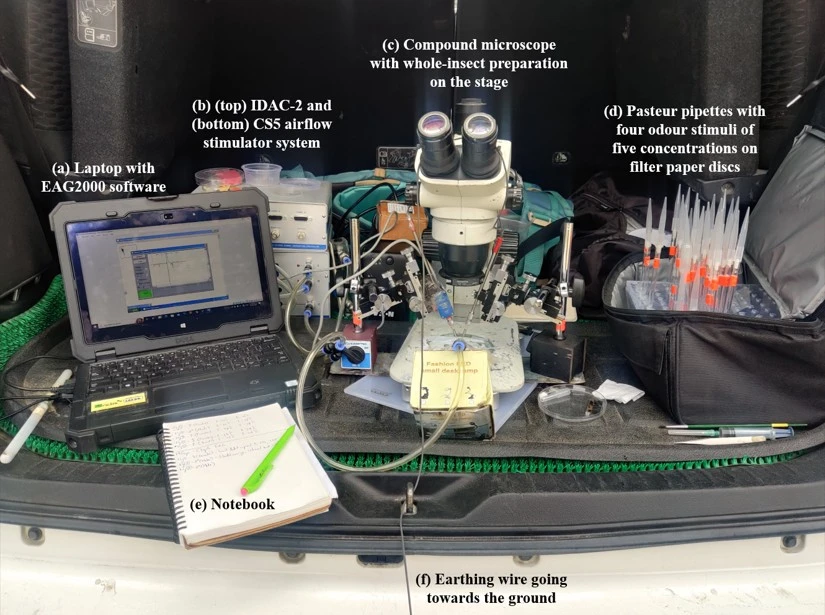
How did you go about solving this problem? We adopted a lab-in-field in situ approach, where we standardized a portable rig to (a) dissect insects to record heart rate and (b) measure electrophysiological response of olfactory sensory neurons of restrained animals using a whole insect preparation directly in the mountain habitats themselves and at the specific elevations. We also collected wild individuals, fixed and stained them in the field, followed by scanning the whole animals using micro-computed tomography.
“Our future is inextricably tied to the survival of insects. How human changes to the planet impact insect survival is essential for understanding how we can preserve our own future existence.” – Dr. Shannon B. Olsson
How would you explain your research outcomes (Key findings) to the non-scientific community?
Our study is the first-of-its-kind approach to assess the physiological status of insects directly in high altitudes like the Himalayas. Using this unique approach, we could show how the same environmental factor can have opposing effects on hoverfly physiology: while morphologies did not seem to be impacted, increasing elevation reduced antennal sensitivity but had no effect on average heart rate, while increasing temperature increased heart rate but not antennal sensitivity. Smell is one of the primary senses that insects use to find food, mates, places to lay eggs, and avoid predators and toxins. This means that as insects shift their ranges to lower temperatures at higher elevations to escape a warming climate, they will be less efficient at detecting olfactory cues, potentially leading to increased foraging times and reduced efficiencies in locating food sources or avoiding danger. At the same time, insects remaining at lower altitudes will experience higher heart rates as temperatures rise, which could impact their survival as well. It is a double-edged sword.
What are the potential implications of your findings for the field and society? Insects are one of the most important animal groups on the planet, providing essential services like pollination, nutrient cycling, population control, and many others. Their survival is important for our human survival. Our results provide important baseline data about how insects survive in biodiversity-rich regions like the tropical Himalayan mountains as our planet changes due to human impacts like land use and climate change. These data will be critical not only to understand the survival of insect pollinators in high-altitudes, but also help to predict impacts of these events on the survival of future populations. It shows that we must move beyond general population studies and assess the complexity of how our organisms can survive under these changing conditions.
What was the exciting moment during your research? The electrophysiology rig took a lot of time and effort to be standardized in the field, where we set up and dismantled the rig every day. So when we could successfully record the first antennal responses from the hoverflies, it was the culmination of several months of hard work and the most exciting since we were probably the first people in the world who were able to see such a response in high-altitude mountains.
Paper reference: Gharpure, G., Vedamurthy, J., Priya, S. et al. Surviving in the mountains: temperature and elevation have contrasting physiological effects and no effect on morphology of the hoverfly Eristalis tenax in the Himalayas. J Comp Physiol B 196, 119–130 (2026). https://doi.org/10.1007/s00360-025-01642-z
Interview no 417
Explore more
🎤 Career – Real career stories and job profiles of life science professionals. Discover current opportunities for students and researchers.
💼 Jobs – The latest job openings and internship alerts across academia and industry.
🛠️ Services – Regulatory support, patent filing assistance, and career consulting services.