
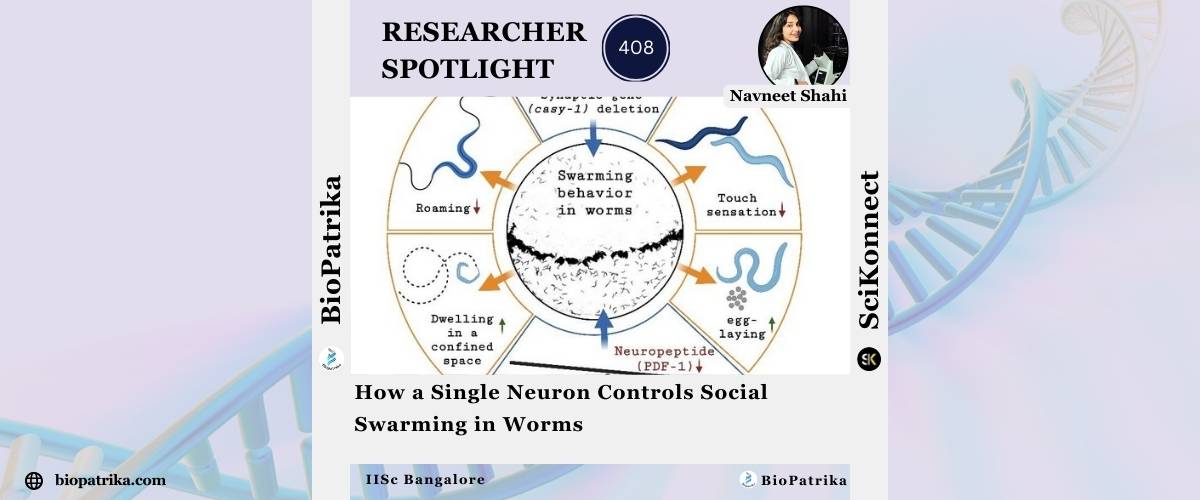
Research summary: This study shows that disrupting the gene casy-1 alters serotonin and PDF-1 signaling in C. elegans, triggering swarm-like group feeding. Activating a single neuron with light can switch worms between aggregation and dispersal.
Researcher Spotlight
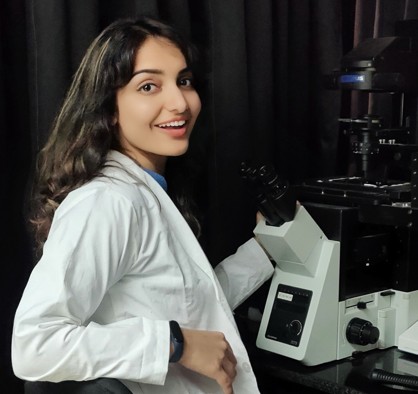
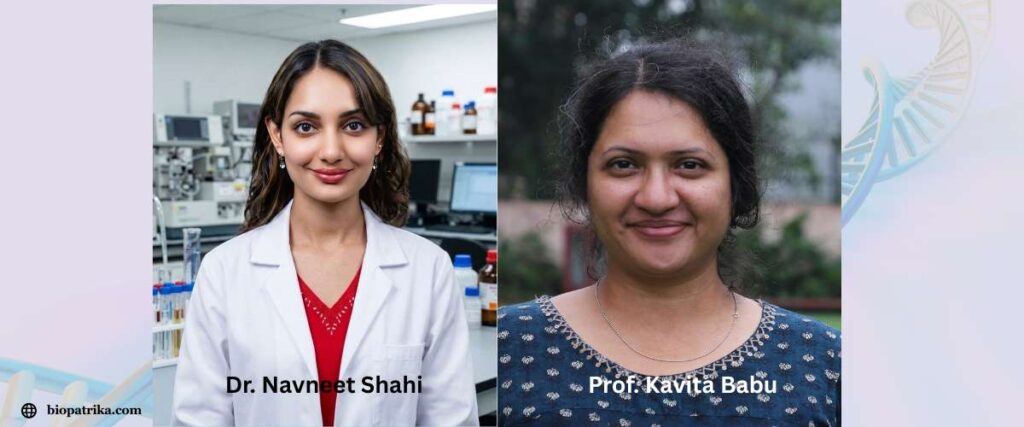
Dr. Navneet Shahi is a Senior Research Associate at the Centre for Neuroscience, Indian Institute of Science, Bangalore.
PhD Supervisor: Prof. Kavita Babu
Twitter: @Navneetshahi7
Linkedin: www.linkedin.com/in/navneet-shahi-phd-b96800149
Instagram: @nav_art
BSKY: https://bsky.app/profile/navneetshahi.bsky.social
Lab: Prof. Kavita Babu, Centre for Neuroscience, Indian Institute of Science, Bangalore
Bluesky: @kavita-babu.bsky.social
Linkedin: https://www.linkedin.com/in/kavita-babu-062a68/
How would you explain your paper’s key results to the non-scientific community?
In this paper, we describe a distinct collective behavior in which tiny worms start feeding in dense groups and do not disperse, even when spreading out would allow better access to food and prevent delayed development. This aggregation is not caused by common environmental triggers such as pheromones or low oxygen levels. Instead, it arises from changes in chemical signaling within the nervous system.
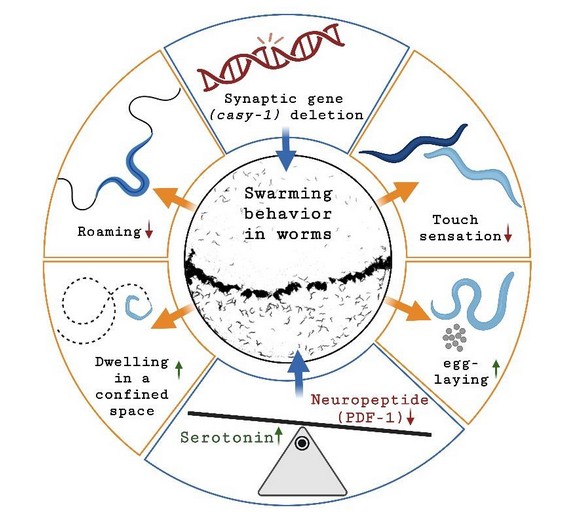
We found that disruption of a conserved gene called casy-1 changes the balance between two signaling pathways: serotonin and a neuropeptide called PDF-1. When serotonin activity increases and opposing PDF-1 signaling decreases, worms enter a prolonged group-feeding state. We also show that activating a single neuron using light pulse stimulation can temporarily shift the animals from aggregation to dispersal, indicating that this pathway can act as a behavioral switch.
At the level of individual worms, this signaling imbalance reduces movement, weakens their response to touch from nearby animals, and increases local crowding. Together, these individual changes lead to coordinated swarm-like group formation.
In this schematic, we illustrate how deletion of casy-1 disrupts the balance between serotonin & PDF-1 signaling, leading to swarming behavior. This is accompanied by decreased roaming, increased dwelling, reduced touch responsiveness to neighboring worms, and increased egg-laying by the individual worms.
What are the possible consequences of these findings for your research area?
A key question in biology is what makes an organism “social.” While social behavior in humans is shaped by many complex factors, its basic foundations may arise from simpler biological mechanisms. By identifying how genetic changes alter neuromodulatory balance and group behavior in worms, our work offers a framework for studying how similar molecular imbalances may affect social coordination in higher organisms. This helps bridge the gap between genes, neural signaling, and collective behavior.
Because molecules such as serotonin are conserved across species, understanding how their activity is regulated in a simple model can provide insight into how similar signaling systems function in more complex animals. Disruptions in these pathways are linked to changes in mood, motivation, and social interaction.
By studying how these organisms integrate environment and intrinsic signals to stay connected provides insight into how species-wide social interactions might adapt or not, during ecological stress.
What was the exciting moment (eureka moment) during your research?
The most exciting moment was realizing that we could control whether the worms gathered together or spread out simply by using a pulse of light to activate or inhibit a single neuron. We did not expect the behavior to be so dynamic or so precisely controlled.
Seeing all the worms disperse almost instantly after one light pulse was unforgettable. It showed us that a single neuron could influence the behavior of the entire group. That was truly the eureka moment of the project.
What do you hope to do next?
One exciting next step is to understand how individual neural states scale into collective behaviour. We’ve shown that neuromodulatory pathways can bias group-level outcomes, but a key next step is to dissect how variability between individuals, such as differences in sensory sensitivity or internal state, adds up to a coordinated group response.
Another important direction is to explore context dependence. Social behaviours are rarely fixed; they change with environment, experience, and physiological state. Understanding how neuromodulatory systems like serotonin integrate these factors could reveal why the same genetic perturbation produces different behavioural outcomes under different conditions.
Finally, a broader goal is to test how general these principles are across systems. Rather than focusing on one behaviour or one organism, future work can ask whether similar neuromodulatory logic operates in other forms of social coordination, helping bridge molecular mechanisms with collective behaviour across species.
Where do you seek scientific inspiration?
I seek scientific inspiration primarily from observation. Many of my research questions have not started from a predefined hypothesis, but from noticing something that did not quite make sense. In this case, I serendipitously observed worms displaying unusual behavioral patterns and decided to pursue the question despite not having prior expertise in that area. There was no clear path, no expected answer, only a behavior that refused to make sense.
I am also inspired by connecting different levels of science. I find it deeply motivating to understand how a molecular change inside a single neuron can scale up to influence the behavior of an entire group. Despite setbacks, that curiosity and drive to find answers keeps me going.
Finally, I draw inspiration from simplicity. Working with a model organism like C. elegans reminds me that it is ultimately about asking the right questions. Revealing fundamental rules of behavior does not always require a complex system.
How do you intend to help Indian science improve?
I believe improving Indian science requires strengthening both scientific rigor and scientific culture. One way I hope to contribute is through mentorship. Many talented students in India have curiosity and potential but may lack early exposure to structured research training. I have joined platforms like Vigyanshala’s She-for-STEM initiative to mentor students, help them develop independence, and encourage them to ask bold yet well-grounded questions.
Another area I care about is science communication. Making research accessible to the public and to students can build trust in science and inspire future researchers. Platforms like BioPatrika are good examples of how we can bridge this gap.
Finally, I believe collaborations, both within India and internationally, are essential. Sharing resources, ideas, and expertise can accelerate progress and help Indian research become more globally integrated while still addressing locally relevant scientific questions.
Reference: https://www.pnas.org/doi/10.1073/pnas.2520029123
Explore more
🎤 Career – Real career stories and job profiles of life science professionals. Discover current opportunities for students and researchers.
💼 Jobs – The latest job openings and internship alerts across academia and industry.
🛠️ Services – Regulatory support, patent filing assistance, and career consulting services.