
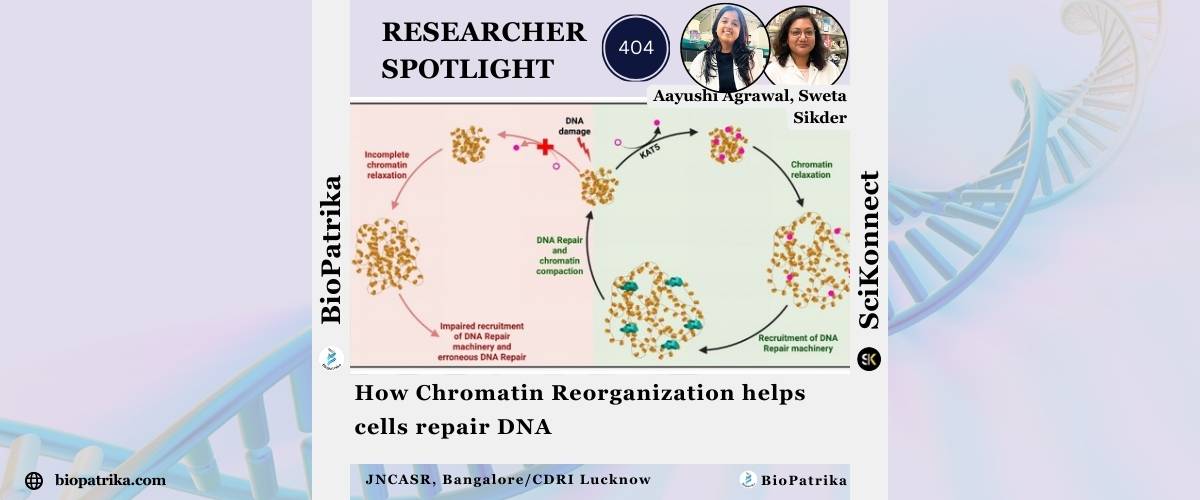
Research Summary: We discovered a new way cells repair DNA: the chromatin organizer protein PC4 is modified by KAT5, facilitating DNA reorganization and repair upon damage —crucial for aging and cancer prevention.
Researcher Spotlight
First authors: Aayushi Agrawal and Sweta Sikder.
Linkedin www.linkedin.com/in/aayushi-agrawal-15977624a
Twitter https://x.com/aayushiagr2
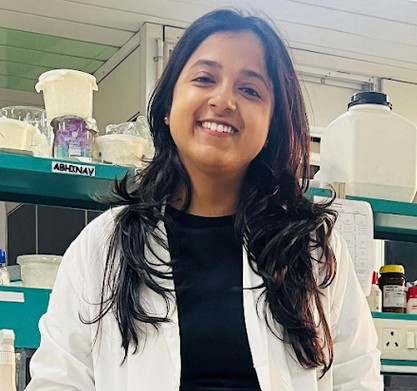
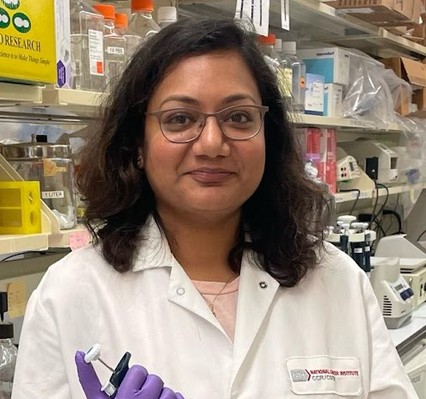
Lab: Prof. Tapas K.Kundu, Jawaharlal Nehru Centre for Advanced Scientific Research (JNCASR) and Central Drug Research Institute (CDRI) (Ex-Director)
What was the core problem you aimed to solve with this research?
PC4 is a multifunctional chromatin protein with diverse cellular roles, including transcriptional coactivation, heterochromatin formation, autophagy regulation, and B-cell differentiation. Previous studies have indicated its involvement in the DNA repair pathway; however, the mechanism regulating its function was not explored. While histone modifications in DNA repair are well studied, not much is known about the role of non-histone chromatin proteins and their post-translational modifications in influencing DNA repair. Therefore, the central problem we aimed to address was whether PC4, a non-histone chromatin protein, is post-translationally modified in response to DNA damage and, if so, how this modification is important for its DNA repair function. Given that PC4 is a chromatin-associated protein, we hypothesized that it might regulate or coordinate the structural transitions in chromatin that occur immediately after DNA damage. Our study was designed to uncover this regulatory mechanism and define how modified PC4 contributes to efficient DNA repair.
How did you go about solving this problem?
We first identified PC4 as a substrate of the Tip60 (KAT5) acetyltransferase. Previously, PC4 was known to be acetylated only by p300, which is important for its role as a transcriptional coactivator. Since Tip60 is a DNA-damage–responsive acetyltransferase and is strongly implicated in repair pathways, we next mapped the Tip60-specific acetylation site on PC4 by performing in vitro acetylation assays and generating a site-specific antibody against the acetylated residue. To further investigate whether this modification is specific to Tip60 acetyltransferase activity and also to evaluate the functional significance of this modification in regulating the DNA damage repair response, we generated acetylation-defective PC4 mutant cell lines and performed a series of cell-based assays, including confocal imaging and comet assays.
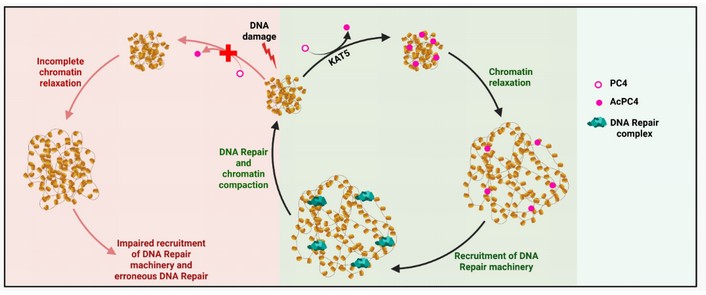
Once we confirmed that PC4 acetylation by Tip60 is not a universal event but rather a conditional response triggered specifically by DNA damage, we next explored its impact on chromatin dynamics. We assessed chromatin accessibility in the DNA damage context and found that the acetylated PC4 promotes a more open chromatin configuration, thereby enabling more efficient recruitment of the DNA repair machinery. To further characterise these chromatin-level changes and deeply explore the possibility of PC4 acetylation in regulating chromatin organisation in response to DNA damage, we employed high-resolution imaging approaches, including electron microscopy and atomic force microscopy, which allowed us to visualise the structural consequences of PC4 acetylation on chromatin organisation.
How would you explain your research outcomes (Key findings) to the non-scientific community?
Every cell in our body experiences thousands of tiny injuries to its DNA every day due to sunlight, pollution, stress, and even normal life processes. If these damages are not repaired properly, they can lead to premature ageing and diseases such as cancer.
If a thread snaps within a tightly wound ball, we first need to carefully unwind it to tie and fix it. Similarly, DNA in our cells is packaged as chromatin threads, which must unwind if broken before being repaired. We have found that an enzyme called Tip60 (KAT5) adds a small chemical tag, called an acetyl group, to the chromatin organizing protein called PC4. This modification empowers PC4 to “unwrap” the DNA, much like untangling a ball of thread, enabling efficient repair of the genetic material. This repair mechanism is often disrupted in diseases associated with genomic instability.
Therefore, our work opens new possibilities for understanding how our cells protect our genetic material and what goes wrong in diseases like cancer. This work can help in the development of new therapeutics for the treatment of diseases caused by DNA damage, such as cancer, neurodegeneration, and premature ageing.
What are the potential implications of your findings for the field and society?
Our findings broaden the current understanding of chromatin regulation beyond histones and show how non-chromatin proteins can efficiently orchestrate the DNA repair mechanism. This work establishes PC4 as a critical epigenetic regulator in genome maintenance under stress conditions. Defects in DNA repair mechanisms and impaired chromatin regulation are the major causes of many neurogenetic diseases, ageing-related disorders and also cancer. Therefore, these advances in understanding the DNA repair mechanism contribute to long-term benefits to public health, from cancer prevention, precision medicine, disease management, to ageing research.
What was the exciting moment during your research?
The most exciting moment during this journey was when I first visualized the classic “beads-on-string” structure of chromatin using atomic force microscopy. I could actually see the DNA in all its stages, from beads-on-string to the solenoid, globular and the highly compacted forms. It was as if the textbook diagrams had come to life before my eyes. In that instant, I realized that all the stress, long hours, and PhD frustrations had been truly worth it.
Explore more
🎤 Career – Real career stories and job profiles of life science professionals. Discover current opportunities for students and researchers.
💼 Jobs – The latest job openings and internship alerts across academia and industry.
🛠️ Services – Regulatory support, patent filing assistance, and career consulting services.