
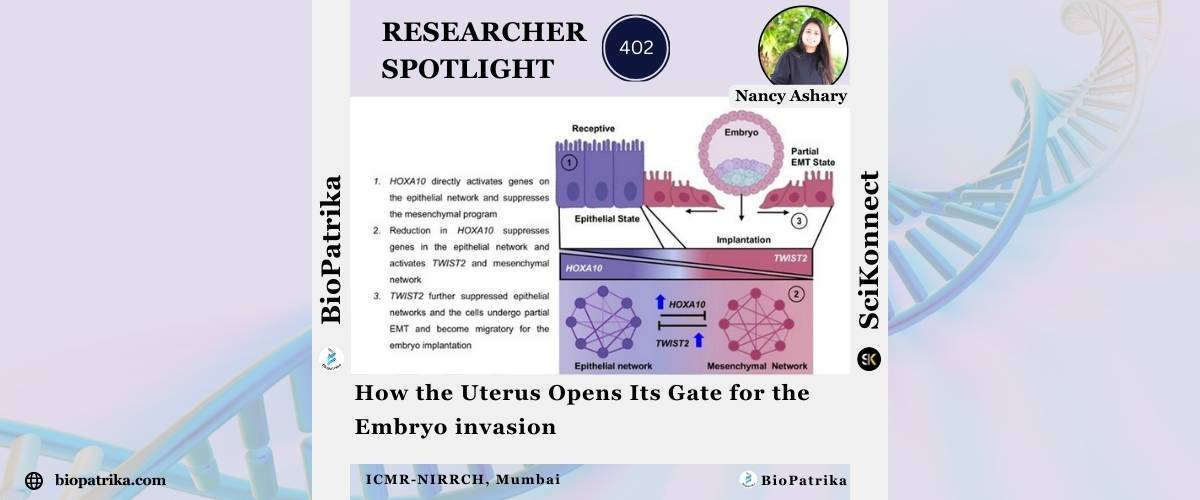
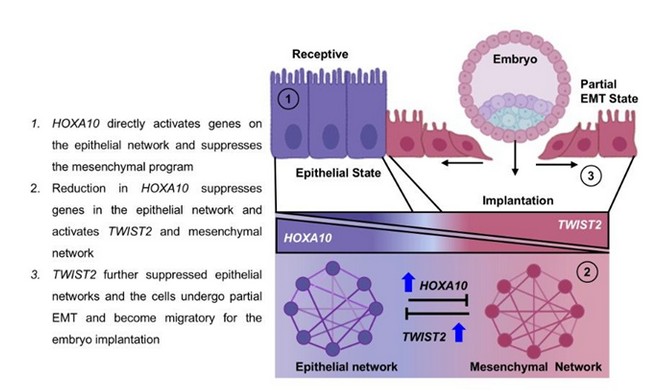
Research Summary: We discovered that embryo implantation requires a regulated partial epithelial to mesenchymal transition (pEMT) of uterine epithelial cells, controlled by HOXA10–TWIST2 antagonism, enabling epithelial remodeling without tissue damage.
Researcher Spotlight

Nancy Ashary is a PhD researcher exploring how the uterus dynamically remodels itself to allow embryo implantation and how failures in this process contribute to infertility and IVF failure. She completed her MSc at St. Xavier’s College, Mumbai, and is currently pursuing her PhD at the Indian Council of Medical Research – National Institute for Research in Reproductive and Child Health (ICMR-NIRRCH), Mumbai, where she investigates the molecular mechanisms driving implantation failure and early pregnancy loss.
Twitter: https://x.com/NancyS98870489?s=09
Instagram: https://www.instagram.com/nancy_ashary?igsh=MXZ6emFqZXgwd2Nkbw==
Lab: Dr. Deepak Modi, Molecular and Cellular Biology Laboratory, ICMR-NIRRCH,Mumbai.
Lab website: https://nirrch.res.in/department/molecular-and-cellular-biology/
What was the core problem you aimed to solve with this research?
Despite decades of research, we still do not understand how a healthy embryo crosses the uterine lining to initiate pregnancy. This knowledge gap is particularly important because many embryos generated through in vitro fertilization (IVF) fail to implant even when they are genetically normal. Our goal was to uncover how the uterine epithelium transiently relaxes its tightly sealed barrier to allow embryo entry and successful implantation.
How did you go about solving this problem?
We approached implantation as a problem of epithelial biology. Using animal models, human endometrial epithelial cells, genome-wide sequencing, chromatin mapping, and functional assays, we examined how changes in gene regulation alter epithelial behavior specifically at implantation sites.
How would you explain your research outcomes (Key findings) to the non-scientific community?
For pregnancy to begin, the uterus must briefly “soften” its surface so the embryo can enter. We discovered that uterine cells temporarily change their identity not fully, but just enough to become flexible. A gene called HOXA10 normally keeps the surface rigid, but when it switches off locally, another gene (TWIST2) allows cells to move aside and let the embryo in safely.
What are the potential implications of your findings for the field and society?
Our work shifts the focus of implantation failure from the embryo to the uterus. This insight is especially important for IVF, where good quality embryos often fail to implant. Understanding uterine readiness at the molecular level could improve diagnosis, timing, and therapeutic strategies in assisted reproduction.
“This study reveals how the uterus transiently unlocks its epithelial barrier to enable implantation without compromising tissue integrity.” -Dr. Deepak Modi
What was the exciting moment during your research?
The most exciting moment was seeing, for the first time, clear in vivo evidence that uterine epithelial cells undergo a physiological partial epithelial-to-mesenchymal transition during implantation. Realizing that this was not a disease-related phenomenon but a normal reproductive process and that it was conserved across species was a major breakthrough for our study.
Paper reference:
1. Ashary, N., Suresh, S., Bhide, A. et al. HOXA10-TWIST2 antagonism drives partial epithelial-to-mesenchymal transition for embryo implantation. Cell Death Discovery. 11, 516 (2025). https://doi.org/10.1038/s41420-025-02799-w. https://www.nature.com/articles/s41420-025-02799-w#citeas
2. Ashary N, Sharma R, Patil S et.al, Loss of HOXA10 activates NLRP3 for epithelial plasticity and pyroptosis in endometrium during embryo implantation, Reproduction, Volume 171, Issue 1, January 2026, xaaf007, https://doi.org/10.1093/reprod/xaaf007.
Explore more
🎤 Career – Real career stories and job profiles of life science professionals. Discover current opportunities for students and researchers.
💼 Jobs – The latest job openings and internship alerts across academia and industry.
🛠️ Services – Regulatory support, patent filing assistance, and career consulting services.