

IIT Gandhinagar Researchers Synthesise Porous Carbon For Sustainable CO2 Capture Using Cow Dung As A Step Towards An Affordable Climate Solution
- Researchers proposed a scalable nitrogen-doped porous carbon derived from an abundant biomass source, cow dung.
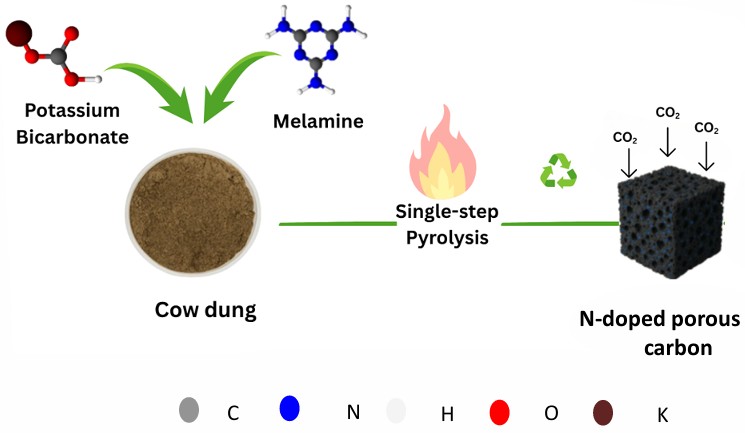
- The team engineered nitrogen-doped porous carbon, NDPC-1, which was doped with 2.95% nitrogen and had a very large surface area of 1153 square meters per gram and performed 58% better than pristine carbon.
- This sustainable, scalable approach effectively integrates waste valorisation and green chemistry to meet the urgent need for an eco-friendly solution to carbon capture for tackling fossil fuel emissions and global warming.
Gandhinagar | March 17, 2026: Researchers from the Indian Institute of Technology Gandhinagar (IITGN) have proposed low-cost, sustainable, and scalable porous carbons derived from cow dung. Their findings were recently published in the journal Surfaces and Interfaces. Cow dung is renewable, inexpensive, and available in large quantities daily in countries like India, where cattle are widely raised. In this study, it emerges as a high-value biomass precursor for producing advanced functional materials aimed at environmental remediation.
Climate change is one of the most pressing global challenges in the present times. Increasing carbon dioxide (CO2) concentrations in the atmosphere are a major factor contributing to this phenomenon. Activities such as the burning of fossil fuels for daily use release significant amounts of CO2, trapping heat and contributing to global warming.
Carbon capture, use, and storage (CCUS) is one of the programs that tackles fossil fuel emissions. The program explores various ways to capture CO₂ so that it does not enter the atmosphere. A promising strategy is the use of porous carbons as CO₂ adsorbents. They contain tiny pores that can trap CO₂ on their surfaces. But, the development of these adsorbents involves the use of corrosive and toxic materials, generates wastewater, and requires careful management to prevent environment contaminants.
As an effort to address this issue, IITGN researchers engineered a material called nitrogen-doped porous carbon. “To make it, we mixed cow dung with melamine (which provides nitrogen) and potassium bicarbonate. Nitrogen incorporated into carbon improves the material’s ability to attract CO₂, and potassium bicarbonate is a green, less corrosive, and effective activating agent to create a high surface area in the material,” explained Mr Ranjeet Kumar and Sree Harsha Bharadwaj H, PhD students in the Departments of Chemical Engineering and Materials Engineering at IITGN.
According to Dr Chinmay Ghoroi, “The best-performing nitrogen-doped porous carbon, NDPC-1, performed 58% better than pristine carbon, which is pyrolysed cow dung without any activation. NDPC-1 also exhibited excellent cyclic stability, which is the ability of the porous carbon to maintain its initial CO2 capture capacity after 10 adsorption-desorption cycles.” Dr Ghoroi is a Professor in the Department of Chemical Engineering and the Principal Investigator at the ChemiGlyphic Lab.
In the words of Dr Raghavan Ranganathan, “Our work includes the combination of reactive molecular dynamics computational simulation and Grand Canonical Monte Carlo simulations with experiments to elucidate the structure-property relationship governing CO₂ adsorption. This framework provides a deeper mechanistic understanding of nitrogen functionality and pore architecture, among other features.” Dr Ranganathan is an Associate Professor in the Department of Materials Engineering and the Principal Investigator at the Computational Molecular Engineering Group.
Such ‘single-step’ solutions can play a crucial role in reducing global warming. Decent adsorption capacity at low temperature and excellent regeneration stability make NDPC-1 a suitable candidate for large-scale deployment. The CO₂ adsorption at low temperature (30°C) is a significant upgrade over most solid adsorbents that selectively adsorb CO2 at high temperatures (400–700°C). Further, minimal wastewater generation makes the process environmentally sustainable. Importantly, this study aligns with the United Nations Sustainable Development Goal 13, centred on Climate Action, which encourages the world to transform its systems and deliver solutions to ‘preserve a livable planet.’ The study is also in line with India’s National Action Plan on Climate Change, aiming for net-zero emissions by 2070.
The researchers acknowledged the Department of Scientific and Industrial Research-IITGN Common Research & Technology Development Hub, Science and Engineering Research Board, and the Department of Science and Technology (Mission Innovation Challenge (IC3) – Carbon Capture, Utilisation, and Storage (CCUS) scheme), Government of India, for providing financial support. They also acknowledged IITGN’s Central Instrumentation Facility and Param Ananta supercomputing facility.
Explore more
🎤 Career – Real career stories and job profiles of life science professionals. Discover current opportunities for students and researchers.
💼 Jobs – The latest job openings and internship alerts across academia and industry.
🛠️ Services – Regulatory support, patent filing assistance, and career consulting services.