

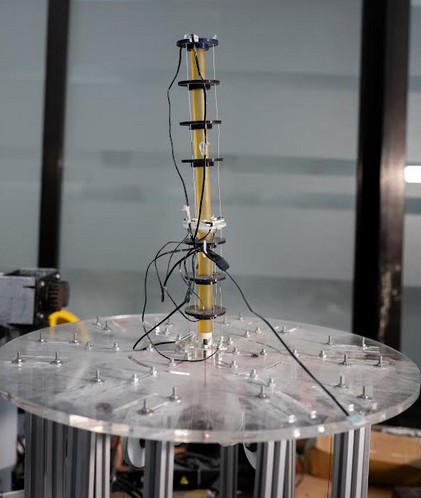
IIT Gandhinagar researchers proposed a novel control framework for flexible continuum robots, unlocking their potential in surgical robotics and industrial automation.
Researchers proposed the concept of virtual actuation space (VAS) for Tendon-driven Continuum Robots (TDCRs).
This framework can significantly reduce computational demands, improve tracking precision, and reduce the complexity of controlling multi-section robots.
The scalability of this method can unlock potential in applications, such as minimally invasive surgical procedures and confined-space inspections, like in aircraft engines.
Gandhinagar | March 30, 2026: Researchers from the Indian Institute of Technology Gandhinagar (IITGN) have proposed the concept of virtual actuation space (VAS) for Tendon-driven Continuum Robots (TDCRs). This framework can handle multiple sections of a robot with ease, significantly reduce computational demands and improve tracking precision. Their findings were recently published in Robotica.
We often imagine robots as machines with rigid arms, rotating joints and targeted mechanical movements. However, such robots would be unable to function in confined and cramped environments. Imagine trying to perform a surgery inside the human body. It would be challenging because of the presence of delicate organs and soft tissue. Stiff robots would not be able to navigate such places without causing damage, as they would require larger openings to move around.
Enter continuum robots (CRs) with flexible bodies to effectively navigate cluttered spaces! The tendon-driven continuum robot (TDCR) is a type of CR known for its compact, lightweight design, precise control, and cost-effectiveness. It has thin wires (tendons) that help it to smoothly and accurately bend in different directions. The tendons are attached along a flexible backbone, and when pulled, appear to mimic animal appendages to create the required motion.
However, predictions involving TDCRs are challenging. “While a rigid robot may have a fixed number of joints that would limit its movement, a TDCR can bend in infinite ways. The situation is further complicated by its multiple sections,” explained Dr Madhu Vadali, Associate Professor, Department of Mechanical Engineering, who co-heads the IITGN Robotics Lab.
The VAS proposed by IITGN researchers is a step towards solving this problem. It imagines a simple representation of the robot’s motion instead of directly controlling its physical tendons and enables independent control of its individual sections. This feature reduces the complexity of controlling multi-section robots.
According to Md Modassir Firdaus and Dr Shail Jadav, “To estimate this method’s effectiveness, we developed a robotic arm with two sections having six tendons. Small LED markers allowed a camera to track the robot’s position. Later, a computer compared the actual position with the robot’s desired position and adjusted the attached motors accordingly.” While Mr Firdaus is a PhD scholar in the Department of Mechanical Engineering, Dr Jadav is a former PhD scholar in the same department. Currently, he is a postdoctoral research fellow at the Technical University of Vienna.
The error margin for movement in experimental tasks was less than one per cent, highlighting remarkable precision. Further, the two sections of the robot could operate independently based on the situation. To understand it better, imagine moving one’s fingers while keeping one’s wrist straight and then doing the opposite.
In essence, the VAS framework can significantly improve the accuracy of TDCR. The scalability of this method extends to TDCRs with additional sections, opening doors to practical applications, such as surgeries, industrial automation and confined-space inspections, like in aircraft engines.
This study aligns with India’s National Strategy on Robotics, which aims to position India as a global leader in robotics by 2030. It builds upon Make in India 2.0, which identified robotics as a sub-sector to enhance the country’s integration in the global value chain. In the words of Dr Vadali, “At IITGN, we have built an enthusiastic and engaging culture surrounding robotics. Robotics is becoming a domain where curiosity drives cutting-edge and societally-relevant innovation”
The researchers have filed a patent (number 202421002550) related to this work with the Office of the Controller General of Patents, Designs and Trade Marks, Government of India. They acknowledged the Gujarat Council on Science and Technology for providing financial support. They also acknowledged feedback from the IITGN Robotics Lab team.
Explore more
🎤 Career – Real career stories and job profiles of life science professionals. Discover current opportunities for students and researchers.
💼 Jobs – The latest job openings and internship alerts across academia and industry.
🛠️ Services – Regulatory support, patent filing assistance, and career consulting services.