
Can Viruses Help Reverse Memory Loss? Study Uncovers New Path to Treat Alzheimer’s and Cognitive Decline
In a surprising twist, scientists are turning to viruses for answers to one of medicine’s most pressing challenges—cognitive decline. A new study published in Science (2026) reveals that a viral protein can reverse memory loss and restore brain function in models of Alzheimer’s disease, aging, and other neurological disorders.
The work highlights a central biological mechanism—the integrated stress response (ISR)—as a key driver of cognitive dysfunction, and demonstrates how shutting it down can dramatically improve brain performance.
The Stress Response That Harms the Brain
The integrated stress response is a fundamental cellular system that helps cells cope with stress by adjusting protein production. In the brain, it also plays a critical role in learning and memory.
However, when persistently activated, the ISR becomes harmful.
Researchers found that chronic ISR activation:
- Disrupts protein synthesis in neurons
- Impairs synaptic plasticity
- Leads to memory loss and cognitive dysfunction
Such sustained activation has been increasingly linked to conditions like Alzheimer’s disease, Down syndrome, and age-related cognitive decline.
Modeling Human Cognitive Disorders
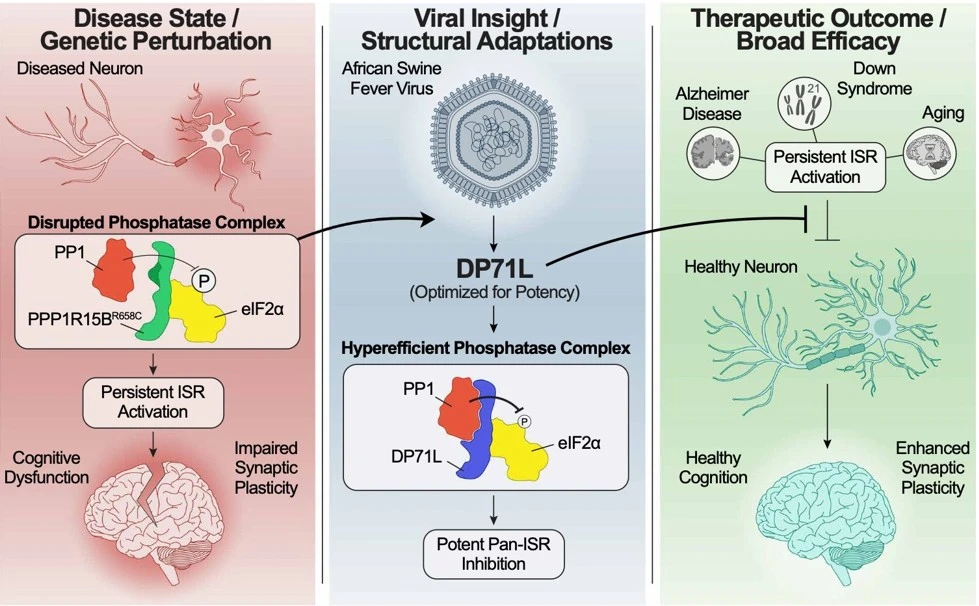
To understand the mechanism, scientists developed a mouse model carrying a mutation in the PPP1R15B gene, known to be associated with intellectual disability in humans.
This mutation caused:
- Persistent activation of ISR
- Elevated stress-related signaling in brain cells
- Significant impairments in long-term memory
Importantly, when researchers inhibited the ISR in these mice, cognitive function was restored—directly confirming the pathway’s role in memory loss.
Learning from Viruses: The DP71L Breakthrough
The most striking finding came from studying a viral protein called DP71L, derived from African swine fever virus.
Viruses often evolve mechanisms to manipulate host cells for their survival. In this case, DP71L acts as a powerful inhibitor of the ISR.
When introduced into mouse models:
- Memory deficits were reversed
- Synaptic function improved
- Brain plasticity was restored
The effect was observed across multiple models, including Alzheimer’s disease, aging, and Down syndrome.
Even more remarkably, the treatment enhanced memory and learning in healthy mice, suggesting broader potential beyond disease treatment.
Resetting the Brain’s Molecular Balance
At a molecular level, DP71L works by restoring normal protein synthesis in neurons, counteracting the effects of prolonged stress signaling.
By effectively “resetting” the ISR, the brain shifts from a maladaptive state back to one that supports learning and memory.
This represents a new therapeutic concept—not just targeting disease symptoms, but correcting underlying cellular stress pathways.
Implications for Alzheimer’s and Beyond
The findings open up promising avenues for treating neurodegenerative diseases, particularly those where no effective therapies currently exist.
If similar effects can be replicated in humans, ISR-targeting therapies could:
- Slow or reverse cognitive decline
- Improve memory function in aging populations
- Offer new strategies for neurodevelopmental disorders
Looking Ahead
While the results are based on animal models, they provide strong proof-of-concept for targeting the ISR as a therapeutic strategy.
Future research will focus on developing safe, clinically viable ISR inhibitors and understanding long-term effects in humans.
By borrowing strategies from viruses, scientists are uncovering new ways to combat some of the most complex brain disorders.
The study underscores a powerful idea: sometimes, nature’s most unexpected systems—even viruses—can hold the key to solving human disease.
Source: Science (2026), DOI: 10.1126/science.aea8782
Explore more
🎤 Career – Real career stories and job profiles of life science professionals. Discover current opportunities for students and researchers.
💼 Jobs – The latest job openings and internship alerts across academia and industry.
🛠️ Services – Regulatory support, patent filing assistance, and career consulting services.