
World’s Smallest QR Code Sets Record, Paving Way for Ultra-Durable Data Storage
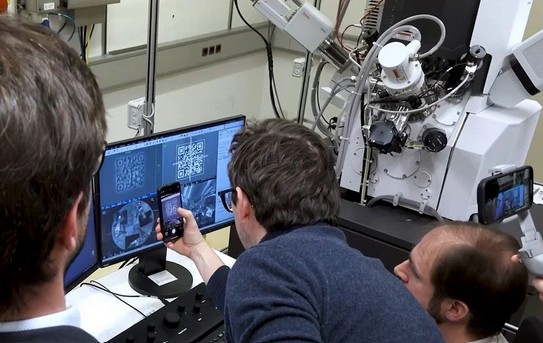
Vienna: In a breakthrough that blends nanotechnology with the future of data storage, researchers at TU Wien, in collaboration with industry partner Cerabyte, have created the world’s smallest QR code—so tiny it can only be read using an electron microscope.
Measuring just 1.98 square micrometres, the QR code is smaller than most bacteria and has now been officially recognized by Guinness World Records. Beyond the record, the achievement signals a major step toward long-term, energy-efficient data storage solutions.
Invisible to the Eye, Visible to the Future
The newly developed QR code is far beyond the limits of optical visibility. Its individual pixels measure just 49 nanometres, nearly ten times smaller than the wavelength of visible light.
As a result, the structure cannot be detected using conventional optical microscopes. Instead, researchers relied on advanced electron microscopy to reliably read the encoded information.
While nanoscale patterning is not new, the challenge has always been stability. At such scales, atoms can shift over time, potentially corrupting stored information. The team overcame this by embedding the QR code in thin ceramic films, ensuring both durability and readability.
Ceramics: A Material Built for Time
The choice of ceramic materials proved critical. Known for their stability under extreme conditions—such as those encountered in high-performance cutting tools—ceramics offer a robust platform for preserving information over extended periods.
Unlike conventional storage systems, which degrade over years or decades, ceramic-based storage has the potential to last centuries or even millennia without losing data integrity.
This approach echoes ancient methods of preserving knowledge—such as inscriptions on stone—that have survived thousands of years, but now adapted for the digital age.
High Density, Low Energy
One of the most striking aspects of this technology is its storage density. Researchers estimate that more than 2 terabytes of data could be stored on an area the size of a single A4 sheet using this method.
Equally important is its energy efficiency. Unlike modern data centers, which require continuous power for cooling and maintenance, ceramic storage systems can preserve data without any energy input.
This could significantly reduce the environmental footprint of data storage, which is currently a growing contributor to global carbon emissions.
From Record to Real-World Applications
The QR code was fabricated using focused ion beam technology, a precise method for sculpting materials at the nanoscale. The project was carried out with verification from independent observers, including the University of Vienna.
Researchers emphasize that this achievement is just the beginning. Future work will focus on:
- Increasing writing speeds
- Scaling up manufacturing processes
- Expanding beyond QR codes to more complex data structures
The ultimate goal is to transition from laboratory demonstrations to industrial-scale applications.
A New Era for Data Preservation
In an age where vast amounts of digital information are stored on relatively short-lived media, this innovation offers a compelling alternative.
By combining nanoscale engineering with durable materials, scientists are reimagining how humanity preserves knowledge—potentially ensuring that today’s data remains accessible for generations to come.
Source: TU Wien & Cerabyte Research Findings
Explore more
🎤 Career – Real career stories and job profiles of life science professionals. Discover current opportunities for students and researchers.
💼 Jobs – The latest job openings and internship alerts across academia and industry.
🛠️ Services – Regulatory support, patent filing assistance, and career consulting services.