
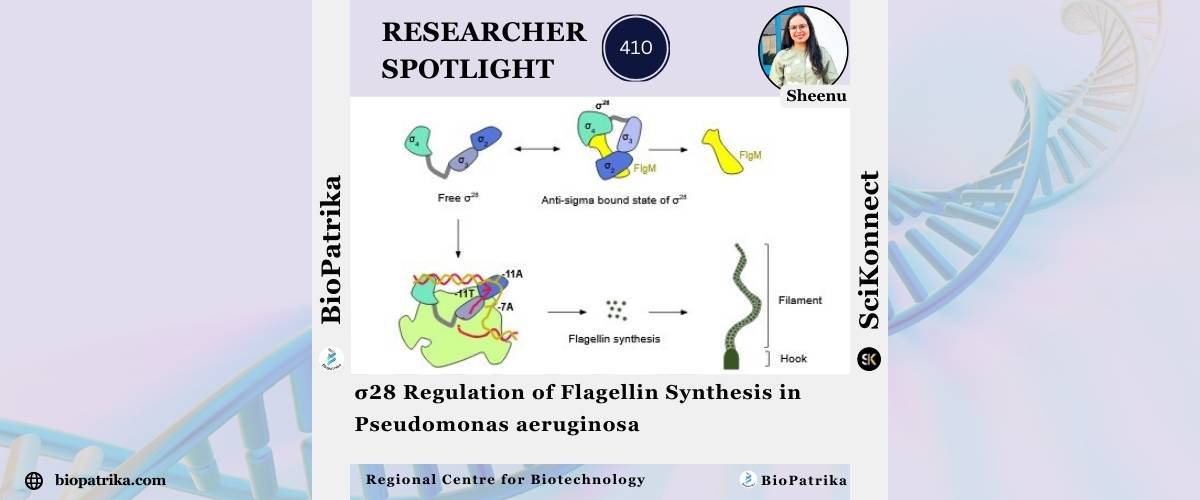
Flagellin synthesis in Pseudomonas aeruginosa by σ28: Transcription initiation and Regulation
Research Summary: This study provides structural, biochemical and functional insights into transcription initiation by the σ28-RNAP complex and its regulation by the cognate anti-sigma factor.
Researcher Spotlight

Sheenu is a PhD. Scholar at Regional Centre for Biotechnology. She works on a flagellar sigma factor called σ28 to delineate its molecular mechanism of transcription initiation and regulation of flagellin synthesis in P. aeruginosa by utilizing biophysical, biochemical, in vitro and in vivo approaches.
Linkedin– linkedin.com/in/sheenu-kakkar-3186911b2
Twitter– https://x.com/sheenu_kakkar
Instagram– instagram.com/sheenu_kakkar_?
Lab: Prof. Deepti Jain, Regional Centre for Biotechnology
Lab social media: https://x.com/deepjxtal
What was the core problem you aimed to solve with this research?
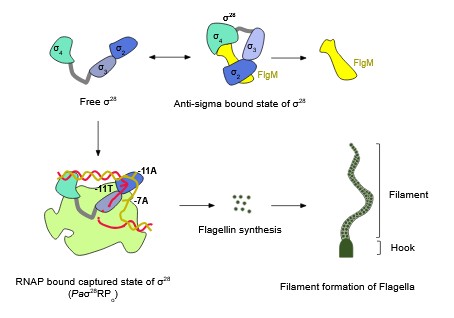
Pseudomonas aeruginosa is an opportunistic human pathogen in which flagella play a crucial role in motility and virulence. Therefore, we sought to elucidate the structural and molecular mechanisms underlying flagellin synthesis (the main component of flagella) mediated by σ28. Additionally, we aimed to investigate the regulatory mechanism underlying σ28 inhibition by its cognate anti-sigma factor, FlgM.
How did you go about solving this problem?
We employed a combination of structural biology tools such as X-ray crystallography, Cryo-EM and various biophysical and biochemical approaches to achieve our objectives. The σ28-FlgM complex was resolved using X-ray crystallography, and the structural findings were validated through in vitro transcription assays. The structure of σ28 RNAP open promoter complex was determined using cryo-electron microscopy. Residues identified as mediating novel promoter interactions were subsequently mutated and functionally evaluated through in vitro and in vivo assays.
X-ray and Cryo-EM snapshots reveal the atomic details of the “on” and “off” states of the molecular switch that regulates motility in Pseudomonas aeruginosa – Prof. Deepti Jain
How would you explain your research outcomes (Key findings) to the non-scientific community?
In this study, we discovered how a human pathogenic bacterium, Pseudomonas aeruginosa, controls the production of its motility structure (flagellum), which helps it cause infection.
A protein called σ28 acts as a genetic “switch” to turn on flagellum-building genes, while another protein, FlgM, keeps this switch off until needed. We captured this switch in both its “off” and “on” states, revealing how it activates movement. This knowledge is important for developing new ways to reduce bacterial infections.
What are the potential implications of your findings for the field and society?
Our study has provided detailed structural insights into how the group 3 sigma factor switches between an active and inactive state in P. aeruginosa. By uncovering how σ²⁸ recognizes promoter DNA and forms the transcription open complex, we highlight mechanistic differences from the canonical σ⁷⁰ system. The high-resolution structures of the σ²⁸-FlgM complex and the σ²⁸-RNAP open complex may serve as valuable frameworks for studying structure-based novel anti-microbial strategies and combating antibiotic resistance.
What was the exciting moment during your research?
We faced a prolonged challenge in obtaining good crystals of the σ28-FlgM complex. After many failed attempts, we finally solved a low-resolution structure, which revealed regions that needed deletion. Based on that insight, we redesigned the construct, and the new crystals diffracted to 1.95 Å, allowing us to solve the high-resolution structure. This was an incredibly rewarding breakthrough moment. Another deeply satisfying moment was seeing clear DNA density in the cryo-EM structure of the open complex- it confirmed that we had successfully captured the transcriptionally engaged state.
Paper reference: Sheenu, Kumar, V., Sahoo, P. K., Kandiah, E., & Jain, D. (2026). Structural insights into σ28-dependent transcription initiation and its regulation by anti-sigma factor in Pseudomonas aeruginosa. Nucleic acids research, 54(1), gkaf1414. https://doi.org/10.1093/nar/gkaf1414
Explore more
🎤 Career – Real career stories and job profiles of life science professionals. Discover current opportunities for students and researchers.
💼 Jobs – The latest job openings and internship alerts across academia and industry.
🛠️ Services – Regulatory support, patent filing assistance, and career consulting services.