

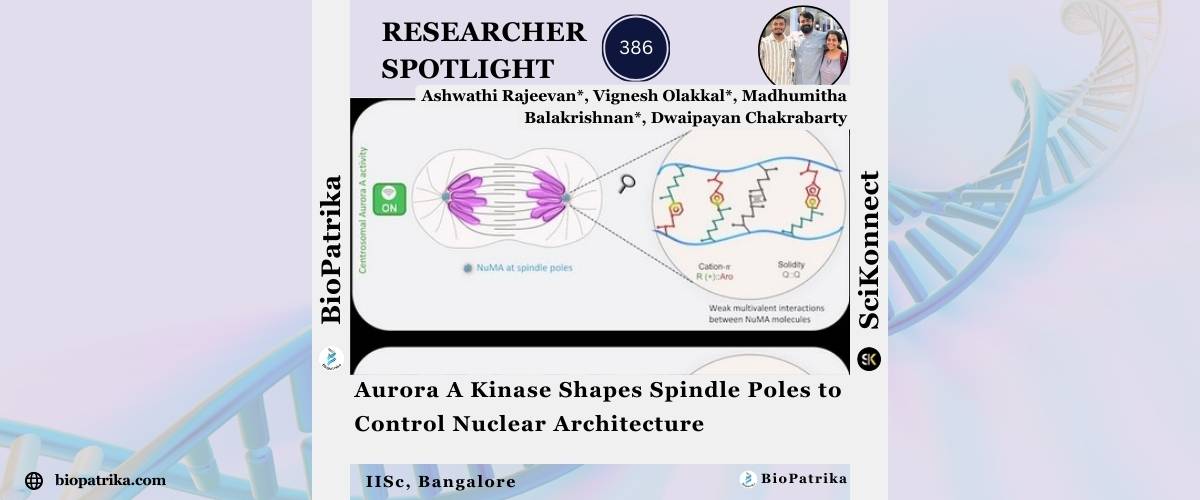
Aurora A kinase regulates material properties of spindle poles to organize 3-D nuclear architecture
Research Summary: Our study shows that during anaphase, Aurora A kinase keeps spindle pole-localized NuMA in a dynamic state, which is critical for proper nuclear shape organization at mitotic exit.
Researcher Spotlight

First authors: Ashwathi Rajeevan*, Vignesh Olakkal*, Madhumitha Balakrishnan*, Dwaipayan Chakrabarty* (*equal co-first authors)
Vignesh Olakkal, Madhumitha Balakrishnan and Dwaipayan Chakrabarty are graduate students in the Department of Microbiology and Cell Biology at the Indian Institute of Science, Bangalore. Their work focuses on studying the role of Aurora A kinase in spindle assembly and nuclear organization.
Vignesh Olakkal: Linkedin | Twitter
Madhumitha Balakrishnan: Linkedin | Twitter
Dwaipayan Chakrabarty: Linkedin | Twitter
Lab: Prof. Sachin Kotak, Indian Institute of Science (IISc), Bangalore
Lab social: https://x.com/Sachin_mitosis
https://kotakcellbiology.wixsite.com/spindlebehaviour
What was the core problem you aimed to solve with this research?
Aurora A is a well-studied serine/threonine kinase during the earlies stages of mitosis. But we hardly understand any role of this kinase post-mitosis. We aimed to study the function of Aurora A at mitotic exit and how it regulates the physical properties of the spindle poles for proper nuclear organization.

How did you go about solving this problem?
In this study, we utilized chemical and genetic approaches in combination with fixed and live-cell imaging, to investigate the post-mitotic function of Aurora A kinase. Towards this aim, we generated an ingenious tool based on cyclin B to rapidly degrade Aurora A kinase at anaphase onset to demonstrate that its activity is essential to maintain NuMA in a dynamic state at the poles.
“When cells exit mitosis, the spindle poles disassemble. What is the relevance of spindle pole disassembly? What will happen if spindle poles don’t disassemble? – the mechanisms, and relevance of these are not well understood, and we wanted to understand that” — Prof. Sachin Kotak
How would you explain your research outcomes (Key findings) to the non-scientific community?
When the cells divide, Aurora A plays a major role in ensuring that the spindle poles dissolve at the right time. Without the activity of this enzyme, the poles remain ‘solid’, causing the chromosomes to bend abnormally around them and leading to a distorted nuclear shape.
What are the potential implications of your findings for the field and society?
Being amplified in several cancers, Aurora A is considered as a promising target for cancer therapy. Our work reveals a novel function of Aurora A at mitotic exit in nuclear organization, suggesting that Aurora A inhibitors may have unforeseen post-mitotic effects if not carefully assessed.
What was the exciting moment during your research?
The most exciting moment was while working with the anaphase specific Aurora A degron to see the bending of chromosome ensembles around the spindle poles, eventually leading to nuclear shape defect.
Paper reference: Rajeevan A*, Olakkal V*, Balakrishnan M*, Chakrabarty D*, Charon F, Noordermeer D, Kotak S (2025) Aurora A regulates the material property of spindle poles to orchestrate nuclear organization at mitotic exit. EMBO J 44: 6797–6831. https://doi.org/10.1038/s44318-025-00564-4. (*equal co-first authors)
Explore more
🎤 Career – Real career stories and job profiles of life science professionals. Discover current opportunities for students and researchers.
💼 Jobs – The latest job openings and internship alerts across academia and industry.
🛠️ Services – Regulatory support, patent filing assistance, and career consulting services.