

BAP1: Orchestrating the Transition from Pluripotency to neuronal differentiation
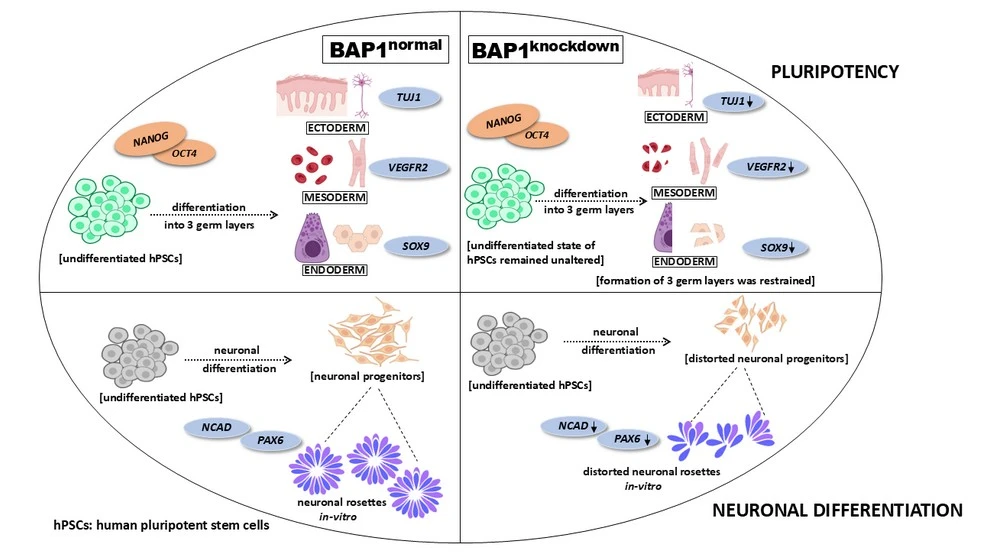
Research Summary: We demonstrate that BAP1, a histone H2A deubiquitinase is essential for steering human pluripotent stem cells to neuronal progenitor cells formation, but does not regulate the pluripotency network.
Researcher Spotlight

Dharitree Samal is a Senior Research Fellow who joined the PhD program in 2021, under Dr. Prasad Pethe at Symbiosis Centre for Stem Cell Research (SCSCR), Pune.
LinkedIn: https://www.linkedin.com/in/dharitree-samal-7a1b101b1/
Instagram: https://www.instagram.com/mamunijun_96/
ResearchGate: https://www.researchgate.net/profile/Dharitree-Samal
Lab: Dr. Prasad Pethe, Associate Professor, Symbiosis Centre for Stem Cell Research (SCSCR), Symbiosis International (Deemed University) Pune, Maharashtra (India)
Lab website: www.stemcellsscience.info
What was the core problem you aimed to solve with this research?
A major challenge in developmental biology is understanding early human brain development, which is highly complex and cannot be directly studied using human embryos because of obvious ethical constraints. Studying early neuronal development can provide insights into later brain development and we can then deduce how disruptions in early developmental processes may lead to neurodevelopmental disorders. Studies till date pertaining to developmental studies particularly in neuronal development are mostly in mice, Drosophila and other lower organisms. In our earlier work, we showed that RING1B regulates the neuronal genes in human pluripotent stem cells (hPSCs) and based on this this data we hypothesized that eraser of this repressive histone mark such as BAP1 and USP16 might also be essential for neuronal development. However, till then there were no reports on histone H2A deubiquitinase BAP1. In our study we tried to shed light on the importance of histone modifiers during early human development especially in early human neuronal progenitor cell formation.
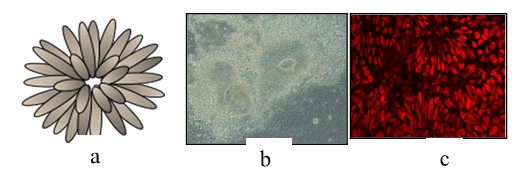
b: Bright field image of a neuronal rosette showing a central lumen & cells radiating from center towards periphery
c: Immunofluorescence showing staining of rosette with PAX6 (red), an important early neuronal transcription factor
How did you go about solving this problem?
We generated human pluripotent stem cell lines that harbored doxycycline inducible BAP1 specific shRNA. We then differentiated human pluripotent stem cells into neuronal progenitor cells, and during this process we knocked down the BAP1 protein and studied the consequence on neuronal differentiation. We employed several molecular biology techniques such as immunolocalization, western blotting, qRT-PCR and bulk mRNA sequencing to determine the role of BAP1 in human neuronal progenitor cell formation.
We also looked at BAP1’s role in controlling other lineage specification pertaining to the formation of the three germ layers viz., ectoderm, mesoderm and endoderm and interestingly all lineages were severely affected due to its knockdown.
How would you explain your research outcomes (Key findings) to the non-scientific community?
Imagine your DNA is a massive instruction manual for building a human body. In a young stem cell, many pages are “stapled shut” by a specific chemical mark (called H2AK119ub1) so the cell can’t read them. Our research focuses on a protein called BAP1, which acts like an eraser. It removes those “staples,” allowing the cell to finally open the manual and read the instructions it needs to grow into a specialized cell, like a brain cell. We also discovered that while a cell is still a “blank slate” (a stem cell), it doesn’t need much BAP1 to stay as it is. It can survive and remain a stem cell even if BAP1 levels are very low. However, the moment that cell tries to specialize or “form a specialized cell” it needs BAP1 to unlock the right instructions. Without enough BAP1, the cell gets “stuck” and cannot transform into cells that will become neurons but can become cells that eventually can form skin cells. By showing exactly how BAP1 controls these early life decisions in a cell, we hope to provide a map for future treatments that can correct these “wrong turns” before they lead to a disorder.
What are the potential implications of your findings for the field and society?
Prior to our work on BAP1, there were reports on BAP1’s role in tumor predisposition syndrome. We show that BAP1 is required for EMT to occur in neuronal progenitor cell formation. Thus, we hypothesize that histone modifiers might be important in developmental processes that require cell movement or migration. Our work has implications in studies involving early human development Understanding BAP1’s role in early cell fate can help identify how these cancers “misuse” developmental pathways to survive and spread.
What was the exciting moment during your research?
Witnessing the formation of neuronal rosettes—those floral-like structures that mark the onset of early neuronal differentiation—was an unforgettable moment of joy and satisfaction. After months of careful optimization, seeing the cells organize themselves so gracefully felt almost like watching a sculptor shape raw clay into art. Another thrilling milestone was successfully performing the knockdown of the BAP1 gene. The ability to precisely control its expression made the experiment especially rewarding, since the switch to activate or repress was in my hands!! Having studied these processes during my Master’s and now carrying them out in the lab myself made the experience truly meaningful. Below is the representation of the same.
Paper reference
- Samal, D., & Pethe, P. (2026). Knockdown of histone H2A deubiquitinase BAP1 in human embryonic stem cells restricts their differentiation repertoire but is dispensable for maintaining their undifferentiated state. Biochemical and biophysical research communications, 799, 153260. https://doi.org/10.1016/j.bbrc.2026.153260
- Samal, D., Kale, V., & Pethe, P. (2026). Histone H2A deubiquitinase BAP1 is required for human neuronal progenitor cell formation. Differentiation; research in biological diversity, 149, 100957. Advance online publication. https://doi.org/10.1016/j.diff.2026.100957
Explore more
🎤 Career – Real career stories and job profiles of life science professionals. Discover current opportunities for students and researchers.
💼 Jobs – The latest job openings and internship alerts across academia and industry.
🛠️ Services – Regulatory support, patent filing assistance, and career consulting services.