
From Waste Toner to Smart Biosensors: A New Magnetic SELEX Tool
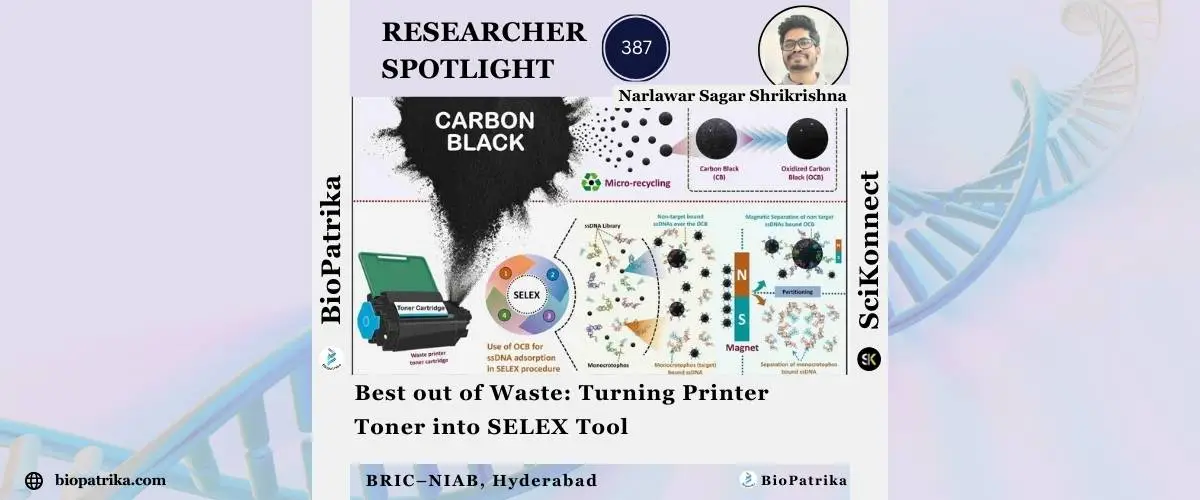
Research Summary: We micro-recycled carbon black from waste printer toner and converted it into oxidized carbon black to develop magnetic SELEX, enabling efficient aptamer generation and sensitive biosensing of the pesticide monocrotophos.
Researcher Spotlight

Narlawar Sagar Shrikrishna is a PhD student at BRIC–National Institute of Animal Biotechnology who recently submitted his thesis, with research interests in aptamer selection, biosensors, waste-derived nanomaterials, and best-out-of-waste strategies.
Linkedin: https://www.linkedin.com/in/sagar-narlawar-2611b823b/
Instagram: Saga_r_searcher
Lab: Dr. Sonu Gandhi, BRIC–National Institute of Animal Biotechnology, Hyderabad
Website: https://www.niab.res.in/peoplegandhi/
Twitter: https://x.com/GandhiSonu2
What was the core problem you aimed to solve with this research?
A key bottleneck in Systematic Evolution of Ligands by Exponential Enrichment (SELEX), particularly for small molecule targets, is the inefficient separation of target-bound DNA from non-binding sequences. Many existing SELEX strategies rely on multiple centrifugation steps, immobilization chemistries, or costly nanomaterials, which can complicate the process, reduce selection efficiency, and limit accessibility. At the same time, large amounts of functional materials such as carbon black from waste printer cartridges are discarded without being explored for high-value scientific applications. Our aim was to address both these issues by simplifying the SELEX partitioning step while simultaneously developing a sustainable, waste-derived material for aptamer selection.
How did you go about solving this problem?
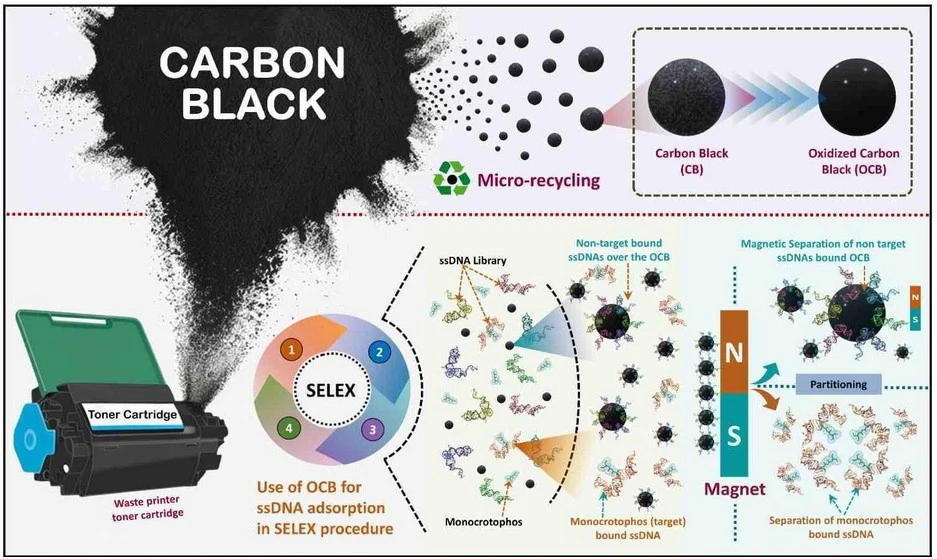
We developed a simple and sustainable strategy by micro-recycling carbon black from waste printer toner cartridges and converting it into oxidized carbon black with hydrophilic and magnetic properties. This material was used to design a new SELEX approach, termed OCB-SELEX, where unbound single-stranded DNA is selectively adsorbed onto the material and removed using a magnet. This eliminated the need for complex separation steps and enabled efficient recovery of target-bound DNA. Using this approach, we successfully generated a monocrotophos-specific aptamer and demonstrated its practical utility by fabricating a sensitive fluorescence-based biosensor.
How would you explain your research outcomes (Key findings) to the non-scientific community?
We showed that waste material from used printer toner cartridges can be transformed into a useful scientific tool. By modifying this waste carbon, we created a material that helps isolate specific DNA molecules more efficiently. Using SELEX, we developed a highly selective DNA-based biosensing element that can detect extremely small amounts of a harmful pesticide in real samples such as water, soil, and food. In simple terms, our work turns discarded waste into a low-cost technology that can help monitor environmental pollution and improve food safety.
“This work demonstrates how simple observations and waste materials can lead to practical innovations in SELEX and environmental biosensing.” — Dr. Sonu Gandhi
What are the potential implications of your findings for the field and society?
For the research community, this work offers a simpler and more sustainable alternative to existing SELEX methods, particularly for small molecule targets that are otherwise difficult to handle. The use of a waste-derived, magnetically separable material can reduce cost, time, and experimental complexity, making aptamer generation more accessible to many laboratories. For society, the study highlights how electronic waste can be converted into high-value materials for environmental monitoring. The developed sensing strategy can support early detection of toxic pesticides, contributing to safer agriculture, cleaner water, and improved public health.
What was the exciting moment during your research?
The most exciting moment came unexpectedly during a routine day in the lab. Our printer stopped working, and while checking the toner cartridge, residual black ink spilled onto the desk. As I was cleaning it, I noticed the particles getting attracted to the magnetic strap of my watch. That instant observation made me realize the material was magnetic. This sparked the idea that the waste toner particles could be used for magnetic separation. With further experimentation, it became clear that these particles could also adsorb single-stranded DNA, which led to the concept of developing a magnetic SELEX platform using waste printer toner.
Figure Caption: Waste printer toner cartridge ink, primarily composed of carbon black (CB), was micro-recycled and converted into oxidized carbon black (OCB) to enhance its dispersibility in aqueous media which is a key requirement for SELEX. The graphical illustration highlighted the OCB-driven SELEX process and demonstrated efficient magnetic partitioning of non-target-bound ssDNA from target-bound ssDNA.
Paper reference: Shrikrishna, N. S., Prakashan, D., Sarup, S., & Gandhi, S. (2025). Micro‐Recycled Carbon Black from Waste Printer Cartridge: A Promising Magnetic Material for Single Stranded DNA Adsorption in SELEX. Small, 2500329. DOI: https://doi.org/10.1002/smll.202500329. https://onlinelibrary.wiley.com/doi/abs/10.1002/smll.202500329?
Explore more
🎤 Career – Real career stories and job profiles of life science professionals. Discover current opportunities for students and researchers.
💼 Jobs – The latest job openings and internship alerts across academia and industry.
🛠️ Services – Regulatory support, patent filing assistance, and career consulting services.