

Brain Circuit Links Stress to Itch Suppression, Offering New Targets for Chronic Itch
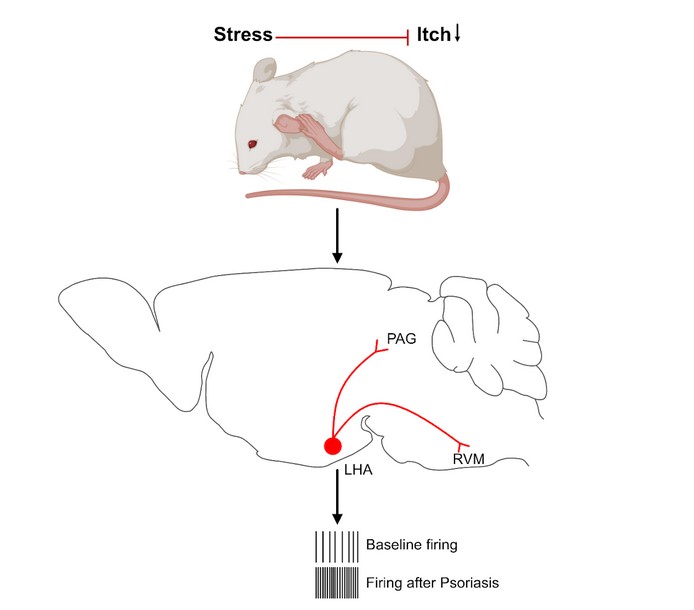
Research Summary: This study demonstrates that stress-sensitive neurons in the lateral hypothalamus regulate both acute and chronic itch through their axonal projections to brainstem circuits.
Researcher Spotlight

Dr. Jagat Narayan Prajapati worked on the featured study as a part of his Ph.D. research, supervised by Dr. Arnab Barik, at the Centre for Neuroscience, Indian Institute of Science, Bengaluru.
Linkedin https://www.linkedin.com/in/jagat-narayan-prajapati-96ba52123
Twitter https://x.com/JagatNarayanPr4
Lab: Dr. Arnab Barik, Indian Institute of Science, Bengaluru
Lab website: https://sites.google.com/view/molecules-cells-and-circuits/home?authuser=0
What was the core problem you aimed to solve with this research?
Acute itch, such as that caused by a mosquito bite, is a protective sensation that alerts us to potentially harmful irritants on the skin and triggers scratching behavior to remove them. However, chronic itch- such as that associated with psoriasis- is a pathological condition that persists without providing any protective benefit and significantly reduces quality of life. Current treatments for chronic itch primarily target the skin or immune system and often provide limited relief. Importantly, sensory perception can be dynamically modulated by internal states such as stress. Although it is well known that acute stress can suppress itch, the neural circuits through which stress modulates itch perception have remained largely unknown. Therefore, the central problem addressed in this study was to identify the brain circuits that link stress to itch modulation, with the goal of revealing potential neural targets for developing more effective therapies for chronic itch.
Identifying this stress–itch neural circuit opens opportunities to target brain pathways and improve treatment of stress-induced worsening of chronic itch. – Dr. Arnab Barik
How did you go about solving this problem?
To address this problem, we used a combination of genetic tools, behavioral experiments, and brain-circuit mapping in mice. First, we used specially engineered mice that allowed us to visually identify stress-responsive neurons in the lateral hypothalamus by labeling them with fluorescent proteins. We then selectively turned these neurons on or off using chemogenetic tools to determine their causal role in acute and chronic itch modulation. Next, to understand how these neurons influence itch, we performed circuit tracing and found the axonal projections of these neurons in the brainstem’s nuclei, PAG (periaqueductal gray), and RVM (rostral ventromedial medulla). Finally, projection-specific circuit manipulations and behavioral assays allowed us to identify the LHA-to-PAG and LHA-to-RVM pathways as two key brain circuits through which stress modulates itch.
How would you explain your research outcomes (Key findings) to the non-scientific community?
Most people have experienced itching, and we usually scratch to relieve it. But have you noticed that when we are under intense stress or focused on something urgent like an exam or a presentation, we sometimes don’t feel the itch as strongly? Our research tried to understand how the brain controls this interaction between stress and itch. Here are the major findings of our research.
(1) We discovered a specific group of neurons in a brain region called the lateral hypothalamus. These neurons become active during acute stress, and when they are activated, they act like a brake on itch, reducing scratching behavior.
(2) In contrast to this activation, when we switched these neurons off, stress no longer reduced itching. This showed that these neurons are both necessary and sufficient for stress-induced itch suppression.
(3) We also found that these neurons send signals to other brain areas involved in processing itch sensations, such as the PAG and RVM. Through these two pathways, the brain can reduce the urge to scratch.
(4) These lateral hypothalamic stress-responsive neurons are potentiated by chronic psoriatic itch and become more excitable.
What are the potential implications of your findings for the field and society?
Our findings identify a previously unrecognized brain circuit that links stress and itch perception. Traditionally, research on itch- particularly in conditions such as psoriasis- has focused mainly on processes occurring in the skin, including inflammation, immune responses, and peripheral nerve activity. However, our study shows that the brain is not merely a passive receiver of itch signals but an active regulator that can suppress or enhance itch through specific neural circuits. We discovered a population of stress-activated neurons in the lateral hypothalamus that project to key brainstem regions involved in itch modulation, including the periaqueductal gray and rostral ventromedial medulla, thereby regulating scratching behavior. These findings provide a mechanistic explanation for how emotional states such as stress influence sensory perception, an interaction that has remained poorly understood in itch neuroscience. Importantly, we also show that these stress-responsive neurons display altered activity and increased excitability under chronic itch conditions, suggesting that neural plasticity within stress–itch circuits may contribute to the worsening of itch during chronic stress.
Psoriasis affects approximately 2.8% of the Indian adult population. It significantly impairs quality of life, yet most existing treatments primarily target skin inflammation or immune responses. Our results suggest that neural circuits in the brain that regulate itch could serve as new therapeutic targets, enabling treatments that modulate brain pathways rather than focusing solely on the skin. By revealing how stress-sensitive neurons regulate itch perception, this work also suggests that strategies aimed at managing stress or modulating neural activity- such as behavioral interventions or neuromodulation approaches- could help reduce symptoms in chronic itch disorders.
What was the exciting moment during your research?
There were several exciting moments during this research. One of the most memorable was seeing these neurons clearly under the microscope for the first time and then being able to manipulate their activity using chemogenetic and optogenetic tools. It was fascinating to observe that simply shining a beam of light could switch these neurons off and produce a measurable change in scratching behavior in mice. Techniques such as optogenetics allow scientists to precisely control the activity of specific neurons using light, making it possible to directly link neural activity to behavior. In addition, recording the real-time calcium activity of neurons while the mice were scratching was incredibly thrilling, because it allowed us to watch the neurons become active at the exact moment the behavior occurred.
Paper reference: Prajapati, Jagat Narayan, Aynal Hoque, Manojeet Pattanayak, Giriraj Sahu, and Arnab Barik. 2026. “Lateral Hypothalamus Directs Stress-Induced Modulation of Acute and Psoriatic Itch.” Cell Reports 45 (3): 117025.
Link- https://doi.org/10.1016/j.celrep.2026.117025
Interview no 415
Explore more
🎤 Career – Real career stories and job profiles of life science professionals. Discover current opportunities for students and researchers.
💼 Jobs – The latest job openings and internship alerts across academia and industry.
🛠️ Services – Regulatory support, patent filing assistance, and career consulting services.