
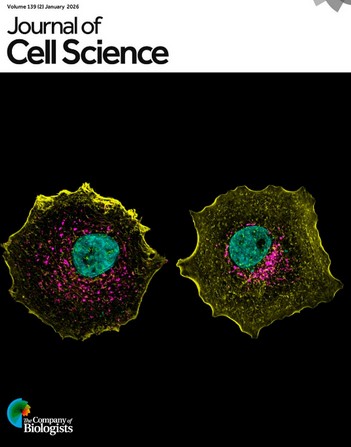
Golgi Senses Tumor Stiffness: New Insight into Breast Cancer Cell Behavior
Research Summary: We show that ECM stiffness regulates Golgi organization in breast cancer cells through differential AXL expression and Arf1 activity, linking extracellular mechanics to intracellular organization.
Researcher Spotlight

Arnav Saha and Tushar Manik Sherkhane are co-first authors who carried out this work at IISER Pune. Arnav is a PhD student studying ECM adhesion and organelle mechanobiology in cancer, while Tushar is now a PhD student at ETH Zurich investigating how cells sense and decode ECM cues.
Linkedin Arnav – https://www.linkedin.com/in/arnav-saha-1795751b1/, Tushar – https://www.linkedin.com/in/tusharsherkhane/
Twitter – @ArnavSaha19, @Tush96rkhane
Instagram – Arnav – saha_ar_nav, Tushar – tushar.sherkhane
Lab: Prof. Nagaraj Balasubramanian, IISER Pune
Lab social media: Twitter – @AdhesionLab
What was the core problem you aimed to solve with this research?
Breast tumor progression is accompanied by increased extracellular matrix (ECM) stiffness, which is known to influence cancer cell behaviour. While mechanotransduction has been extensively studied at the cell surface and cytoskeleton, it remained unclear whether intracellular organelles such as the Golgi apparatus also respond to mechanical cues. We aimed to determine whether the Golgi senses ECM stiffness and to identify the molecular mechanisms underlying this response.
How did you go about solving this problem?
We cultured breast cancer cell lines with differing invasive potential on substrates of defined stiffness to mimic physiologically relevant mechanical environments. Using quantitative imaging, we examined changes in Golgi organization across conditions. We then investigated the roles of AXL and Arf1 by analyzing their expression and activity, and by perturbing these pathways to test their contribution to stiffness-dependent Golgi reorganization.
“This work establishes the Golgi as a mechanoresponsive organelle, with its organization regulated by AXL-Arf1 signaling in response to ECM stiffness.” – Prof. Nagaraj Balasubramanian
How would you explain your research outcomes (Key findings) to the non-scientific community?
In breast cancer, the tissue surrounding cells often becomes abnormally stiff. While scientists knew that cells can sense these mechanical changes, it was unclear whether this could influence internal structures like the Golgi.
In our study, we show that cancer cells can “feel” how stiff their environment is and reorganize their Golgi accordingly. In more aggressive cancer cells, the Golgi becomes compact in stiff environments and more dispersed in softer ones. In contrast, less aggressive cells do not show this adaptability.
We also identified a key molecule, AXL, that links stiffness sensing to these internal changes. When AXL is inhibited, this response is lost, and restoring it brings the response back.
Overall, our findings reveal that the stiffness of the tumor environment can directly control how cells organize and function internally through a specific signaling pathway.
What are the potential implications of your findings for the field and society?
Our study identifies the Golgi as a previously underappreciated component of the cellular response to mechanical cues. By linking ECM stiffness to Golgi organization through AXL-Arf1 signaling, we provide a new framework for understanding how physical changes in tumors influence cell behaviour. These insights could inform future strategies aimed at targeting mechanotransduction pathways in cancer.
What was the exciting moment during your research?
One particularly exciting moment was when expressing AXL in MCF7 cells- which naturally lack it, led to a striking reorganization and compaction of the Golgi, along with reduced cell spreading. Observing such a clear phenotypic shift was deeply satisfying and strongly reinforced AXL’s role in regulating Golgi organization. Equally memorable was confirming stable AXL expression through a clear western blot signal. Achieving this after an initial unsuccessful attempt was both technically rewarding and a significant confidence boost, making the overall finding even more meaningful.
Paper reference – Saha, A., Sherkhane, T. M., and Balasubramanian, N. (2026). Differential AXL expression and Arf1 regulation control stiffness-dependent Golgi organization in breast cancer cells. Journal of Cell Science. https://journals.biologists.com/jcs/article/139/2/jcs263956/370558/Differential-AXL-expression-and-Arf1-regulation
Explore more
🎤 Career – Real career stories and job profiles of life science professionals. Discover current opportunities for students and researchers.
💼 Jobs – The latest job openings and internship alerts across academia and industry.
🛠️ Services – Regulatory support, patent filing assistance, and career consulting services.