

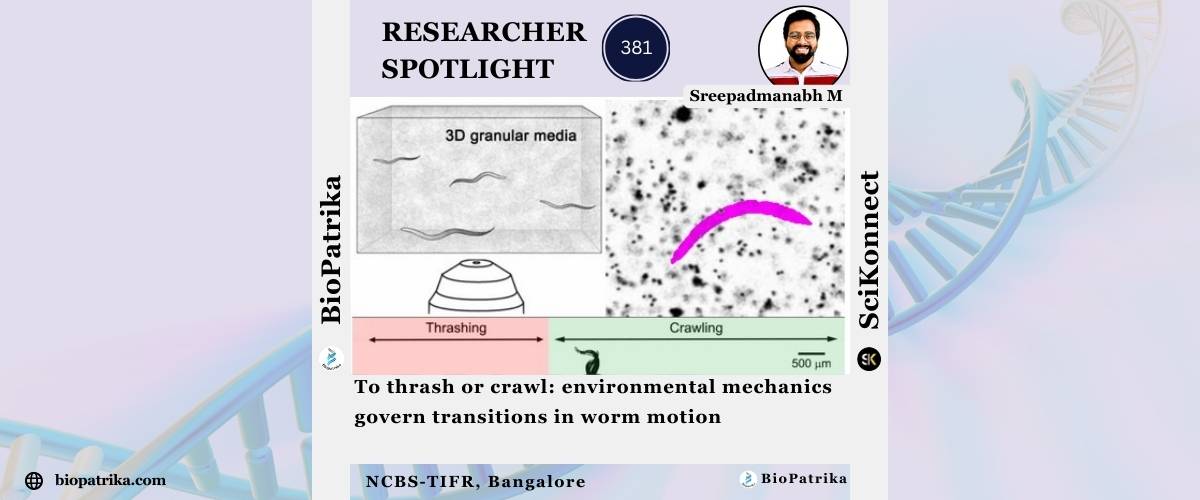
How Environmental Mechanics Shape Worm Locomotion
Research Summary: Within viscoelastic 3D granular matrices, C. elegans transition from inefficient thrashing under low confinement to efficient crawling under high confinement – a response dictated by the worm’s physical interaction with its environment, without involving soft-touch mechanosensation.
Researcher Spotlight

Sreepadmanabh M is a final year graduate student with Dr. Tapomoy Bhattacharjee at NCBS, Bangalore. He works at the interface of soft matter biophysics, mechanobiology, and bioengineering. His PhD research pioneers an understanding of complex environments as active regulators of living matter across biological scales.
Linkedin: https://www.linkedin.com/in/sreepadmanabh/
Twitter: @padmanabh97
Instagram: @the_critical_hippo
Lab: Dr. Tapomoy Bhattacharjee, National Centre for Biological Sciences, Tata Institute of Fundamental Research
Linkedin: https://www.linkedin.com/in/tapomoy-bhattacharjee-1858932b/
Twitter: @tapomoy89 and @ESoftbio
Instagram: @tapomoyb
What was the core problem you aimed to solve with this research?
Undulatory motion is a common locomotory mechanism, manifesting from worms to snakes. The mechanics of this have long fascinated physicists and biologists, given the immense complexities of efficiently achieving energetically-expensive bodily contortions while simultaneously exerting neuro-muscular control that also takes into account environmental feedback. A classic model for studying undulatory motion is the C. elegans – by itself a workhorse for development biology and neurobiology. On flat agar pads and in liquids, this worm typically exhibits either crawling-like or thrashing-like swimming behaviors, which are achieved via muscular activity leading to undulations of its body. While the neuronal basis for these behaviors has been very well characterized, how more complex mechanical regimes – especially granular and viscoelastic 3D environments such as soil, where C. elegans naturally reside – influence its motion remain insufficiently understood.
How did you go about solving this problem?
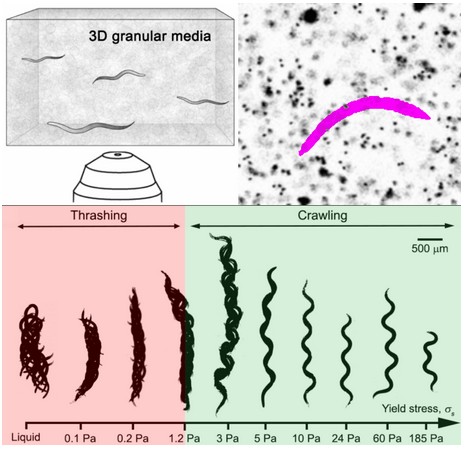
By engineering a mechanically tunable 3D medium which spans over three orders of magnitude in its degree of confinement, we achieve the first-such systematic interrogation of worm motion within granular viscoelastic systems. Intriguingly, we start observing a distinct non-monotonic dependence of the worm swimming speeds on the mechanical properties of the environment – as the degree of confinement increases, worms initially speed up before slowing down. Combining slender body theory and quantitative experiments to construct a non-dimensionalized phase space, we find that worms optimize for the efficiency of motion as the degree of physical confinement increases. Crucially, we capture a smooth transition from thrashing-like behavior under low confinement to crawling-like behavior under higher confinement – which is unprecedented across such a broad mechanical regime. This work holds significant interest towards exploring how complex mechanical environments alter behavioral outcomes, as well as raises interesting future questions concerning the neuromuscular basis of tradeoffs between optimal speeds and optimal efficiency of motion.
How would you explain your research outcomes (Key findings) to the non-scientific community?
From snakes to worms to sperms, undulatory motion using rhythmic body waves is a common locomotory strategy among limbless lifeforms. Given the intricate neuro-muscular feedbacks underlying this process, physicists and biologists have long been fascinated by how such organisms precisely execute these complex movements. Combining experiments and mathematical models, our study discovers that worms optimize the efficiency of their movement in response to increasing environmental resistance, which makes them transition smoothly from swimming-like behavior in low resistance environments to crawling-like motion when challenged by highly resistive environments.
“Our findings offer fascinating insights on how environmental mechanics re-shape the locomotory strategies used by organisms. We are learning that even seemingly simple animals can dynamically adapt their behavior in response to complex terrains.”- Dr. Tapomoy Bhattacharjee, NCBS
What are the potential implications of your findings for the field and society?
Our work establishes an exciting new approach to study locomotion across more realistic environments, bridging the gap between controlled laboratory conditions and the diverse natural habitats where such organisms actually reside. Even beyond worms, this platform will help explore how other limbless lifeforms – from sperm cells to snakes – integrate physical feedback from their surroundings to achieve efficient motion across heterogeneous environments.
What was the exciting moment during your research?
It was very exciting when we discovered the surprisingly great agreement between the experimental data and the purely theoretical framework. This was quite remarkable, because using only simple physical models, we were able to completely capture a biological process as complex as undulatory motion.
Paper reference: Physical Confinement Regulates Transitions in Nematode Motility. M Sreepadmanabh*, Saheli Dey*, Sayan Kundu, Ashitha B. Arun, Sandhya P. Koushika, Shashi Thutupalli, Duncan Hewitt, and Tapomoy Bhattacharjee (* = equal contribution). PRX Life (2025). https://doi.org/10.1103/sdhy-5g9n
Explore more
🎤 Career – Real career stories and job profiles of life science professionals. Discover current opportunities for students and researchers.
💼 Jobs – The latest job openings and internship alerts across academia and industry.
🛠️ Services – Regulatory support, patent filing assistance, and career consulting services.