
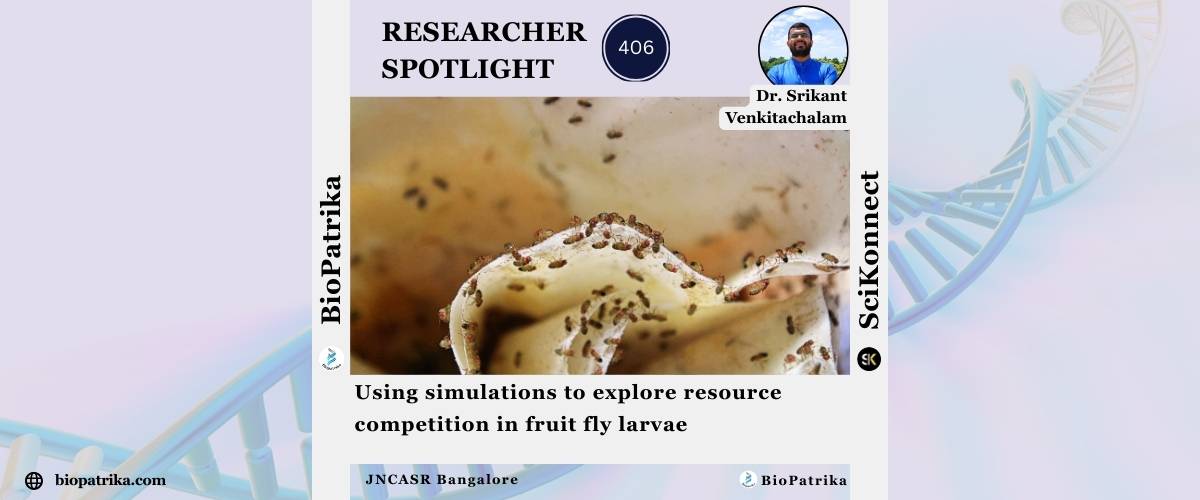
How Simulations Reveal Resource Competition in Drosophila Larvae
Research Summary: We explored the process of competition in fruit fly larvae using individual-based simulations and compared the results with real experimental data, then used the simulation results to design future experiments.
Researcher Spotlight
Dr. Srikant Venkitachalam worked on the featured study as part of his Ph.D., supervised by Prof. Amitabh Joshi, at the Evolutionary and Organismal Biology Unit at J.N.C.A.S.R., Bengaluru. He is currently a postdoctoral scholar at the Department of Biological Sciences at the University of Missouri.
Twitter https://x.com/Srikant_Venkit
Lab: Prof. Amitabh Joshi, Jawaharlal Nehru Centre for Advanced Scientific Research, Bangalore
Lab social media: https://sites.google.com/view/ebl-jncasr/home?authuser=0
What was the core problem you aimed to solve with this research?
Matching the pattern of results obtained in our simulations with results of recent experiments on larval crowding in fruit flies of the genus Drosophila formed the core problem of our study. We first developed a model which used many known larval behaviours and properties to generate the simulations. These properties constituted larval feeding rate, metabolic waste tolerance, minimum critical mass, to name a few. However, this basic model framework was unable to capture patterns seen in experimental results.
How did you go about solving this problem?
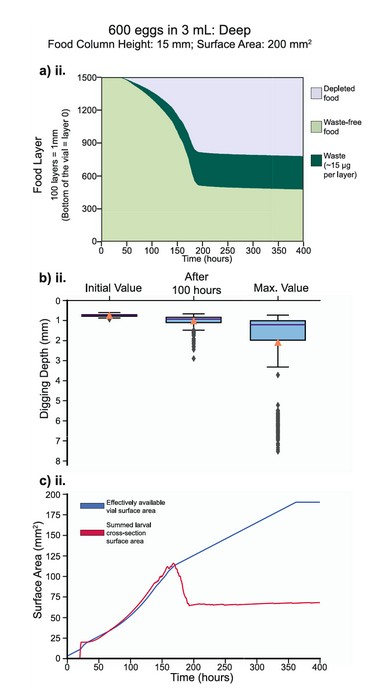
We developed an expanded simulation framework which implemented novel behaviours in Drosophila larvae during crowded conditions, and introduced spatial factors in addition to simple food-quantity-based competition dynamics. Examples were variation in larval digging depth, which determined how deep larvae could dig for fresh food; and spatial crowding parameters, which introduced limitations to accessing food due to lack of space in crowded cultures. We also drew from recent experiments by Dr. Manaswini Sarangi in her PhD work at the Evolutionary Biology Laboratory at JNCASR (Sarangi 2018, PhD thesis), which showed that larval feeding rate was not necessarily a “hard wired” trait as previously thought, but could be plastically increased during crowded conditions. Using those results, we simulated spatial-crowding-based plastic increase in larval feeding rate. We also modelled waste permeation through the food medium based on other results by Dr. Sarangi (Sarangi 2018, PhD thesis). Together, these expansions to the simulation framework were able to successfully match several current experimental data. We concluded our study by ideating several future experiments.
How would you explain your research outcomes (Key findings) to the non-scientific community?
Our study aims to explore the process of competition in fruit fly larvae using computer simulations. These simulations generated virtual ‘larvae’ endowed with several properties and behaviours previously described by researchers over the last 50 years. After generating the virtual larvae, they were made to ‘compete’ for limited ‘food’ resources in ‘crowded’ cultures in simulated experiments designed to match recent real-world experiments. We had a two stage process in creating our simulation framework. 1. We used older experimental data to determine larval properties in a ‘basic’ model, and simulating crowded conditions with these virtual larvae to compare results with recent experiments. 2. As the basic model was unable to match several experimental patterns observed in the real world, we then expanded the basic model with properties and behaviours of larvae that were recently discovered and not properly understood, as well as novel behaviours that are likely to exist. With this expanded framework, our simulations were able to capture several real world experimental patterns. We further used our simulation results to make predictions regarding novel larval behaviours and future experimental designs.
This study is perhaps the first major advance in understanding larval crowding in fruit flies since Larry Mueller’s (1988 Am. Nat.) Drosophila model. — Prof. Amitabh Joshi
What are the potential implications of your findings for the field and society?
Our study aims to create a very specific theoretical model which explores a well known laboratory ecological system. The simulations allow us to make very detailed explorations tailored to our study system and make specific, testable predictions for future experiments. Such kind of theoretical work is necessary to take the fields of competition ecology and density-dependent selection forward, as demonstrated by an earlier theoretical study on larval crowding and population dynamics of fruit flies (Mueller 1988, Am. Nat.).
What was the exciting moment during your research?
The most exciting moment was finding emergent properties from the simulations and their congruence (or lack thereof) with experimental data, which led us to appreciate the great complexity in modelling something as seemingly ‘simple’ as fly larvae competing for food in a controlled environment.
Figure Caption: The expanded framework of our simulation study showing the novel properties and behaviours introduced into a simulated crowded culture. A) permeation of metabolic waste into the food of a crowded culture. As the food depletes over time (light green), the larvae excrete metabolic waste which permeates into the food (dark green). B) digging depth variation in larvae in a crowded culture. The variation in digging increases as more competitive larvae are able to dig more over time. C) Spatial crowding dynamics – as larvae eat through the food, more surface area of food is available for them to feed (blue line over time). However, in a crowded culture, the volume occupied by the larvae may exceed the available space for feeding (red line over time), leading to limitations in food access.
Paper reference: Venkitachalam, Srikant, and Amitabh Joshi. 2026. An Individual-Based Simulation Framework Exploring the Ecology and Mechanistic Underpinnings of Larval Crowding in Laboratory Populations of Drosophila.” Journal of Theoretical Biology 622: 112378. https://doi.org/10.1016/j.jtbi.2026.112378.
Explore more
🎤 Career – Real career stories and job profiles of life science professionals. Discover current opportunities for students and researchers.
💼 Jobs – The latest job openings and internship alerts across academia and industry.
🛠️ Services – Regulatory support, patent filing assistance, and career consulting services.