
Discovery of CagA: How Helicobacter pylori Protein Drives Gastric Cancer
In the early 1980s, the discovery of Helicobacter pylori transformed our understanding of stomach diseases. Scientists had long believed that ulcers were caused mainly by stress or lifestyle, but this spiral-shaped bacterium proved otherwise. Yet one puzzling question remained: if millions of people carried H. pylori, why did only some develop severe disease, including ulcers and even cancer? The answer, it turns out, lay hidden within the bacteria itself—and its discovery would change microbiology forever.
The journey toward this breakthrough began in the late 1980s, when researchers noticed that not all H. pylori strains behaved the same way. Some appeared more harmful than others. Two research teams—one in the United States and another in Italy—set out independently to investigate these differences. Their work followed an insightful principle suggested by a senior scientist: “let the patients do the work.” By studying how patients’ immune systems reacted to different bacterial strains, researchers began identifying specific proteins linked to disease severity.
One key clue emerged when scientists detected a large protein—around 120–130 kilodaltons in size—that triggered strong immune responses in patients with ulcers. At the same time, molecular biologists were cloning bacterial genes to identify the source of these proteins. Through careful experimentation, both teams eventually pinpointed the same gene, which they jointly named cagA (cytotoxin-associated gene A). This marked a turning point: they had discovered a bacterial factor directly associated with disease severity.
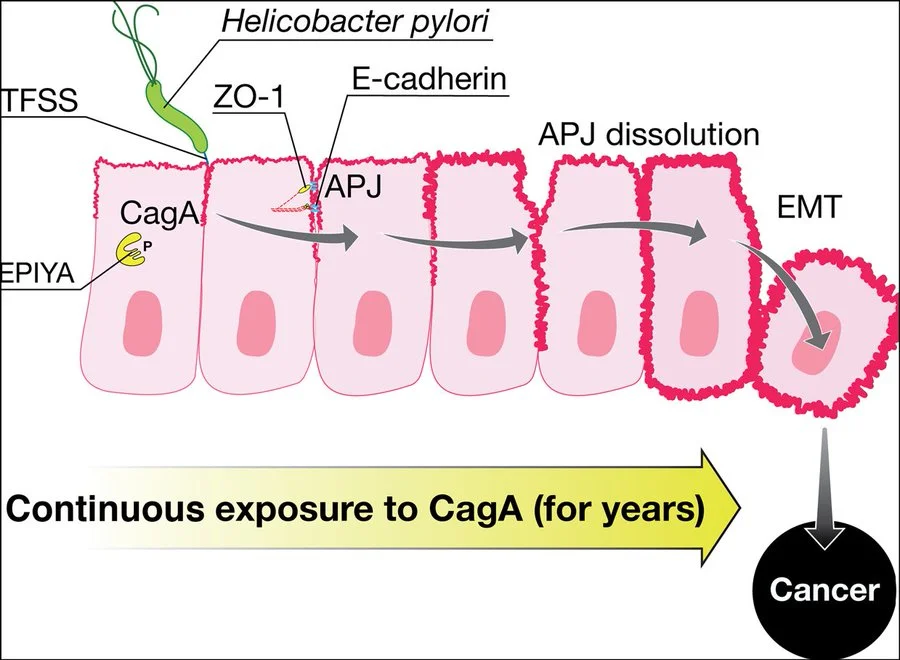
What made this finding extraordinary was what came next. Researchers found that the CagA protein was not just a marker of harmful bacteria—it actively interfered with human cells. Using a specialized molecular “injection system,” the bacterium delivers CagA directly into stomach lining cells. Once inside, the protein disrupts normal cellular functions, alters cell structure, and interferes with key signaling pathways. Over time, these changes can push cells toward uncontrolled growth—a hallmark of cancer.
Further studies revealed that CagA can hijack important cellular regulators, including those involved in maintaining tissue structure and controlling cell division. It can weaken the body’s natural tumor-suppressing mechanisms, such as the p53 pathway, and trigger processes resembling epithelial-to-mesenchymal transition—a critical step in cancer development and metastasis. This made CagA the first known bacterial protein directly linked to tumor formation, fundamentally changing how scientists think about infections and cancer.
Interestingly, the story also revealed unexpected complexity. While CagA-positive strains increase the risk of stomach cancer and ulcers, they appear to offer some protection against other conditions, such as certain esophageal diseases and even asthma. This dual role highlights the intricate relationship between humans and their microbial companions—where a single organism can be both harmful and beneficial, depending on context.
Over the decades, the discovery of CagA has opened an entire field of research. Scientists have explored vaccines, drug targets, and detailed molecular mechanisms of how bacteria interact with human cells. Thousands of studies have since built on this foundation, deepening our understanding of how infections can drive chronic disease and cancer.
At its heart, the discovery of CagA is not just a story about a protein—it is a story about scientific curiosity, collaboration, and persistence. Two teams, working independently across continents, followed different paths that ultimately converged on the same answer. Their work revealed that cancer is not always a purely genetic or lifestyle disease; sometimes, it begins with an infection.
Today, as researchers continue to unravel the complex links between microbes and human health, the legacy of CagA stands as a reminder: even the smallest organisms can have the biggest impact on our lives.
Source: https://journals.asm.org/doi/10.1128/mbio.03641-24
Explore more
🎤 Career – Real career stories and job profiles of life science professionals. Discover current opportunities for students and researchers.
💼 Jobs – The latest job openings and internship alerts across academia and industry.
🛠️ Services – Regulatory support, patent filing assistance, and career consulting services.