

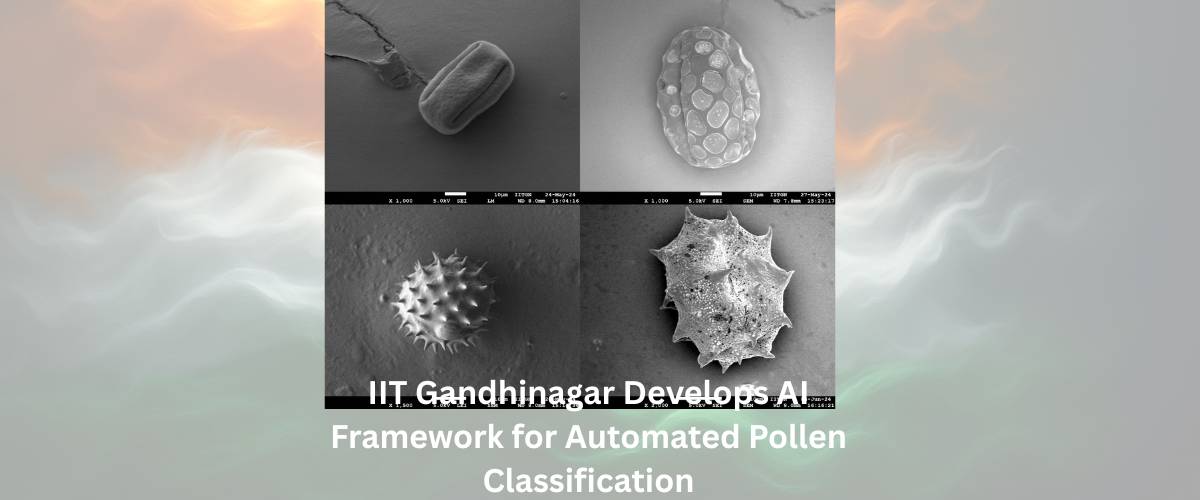
IIT Gandhinagar Researchers Develop an AI-based Framework for Automated Classification of Pollen Grain Images, with Applications in Agriculture, Medicine, and Biodiversity Monitoring
- Researchers presented a scalable, automated framework for pollen identification using scanning electron microscopy images and machine learning.
- The team developed MPalyn (Medicinal Pollen and Palynology SEM Database), an open-access web-based application that organises pollen images and associated data.
- The computer vision framework provides a reproducible, adaptable solution for pollen analysis, improving speed and accuracy while minimising reliance on manual annotation.
Gandhinagar | February 12, 2026: Researchers from the Indian Institute of Technology Gandhinagar (IITGN) presented an approach that combines scanning electron microscopy (SEM) with a computer vision model and a web-based application to automatically classify pollen grains based on their shape, size, and microscopic surface features. Using a representative dataset of SEM images from 28 diverse medicinal plant species, the team demonstrated an efficient analysis of pollen with broad applications in fields such as agriculture, allergen source identification, historical climate change, and archaeology. Their findings were recently published in Botany Letters.
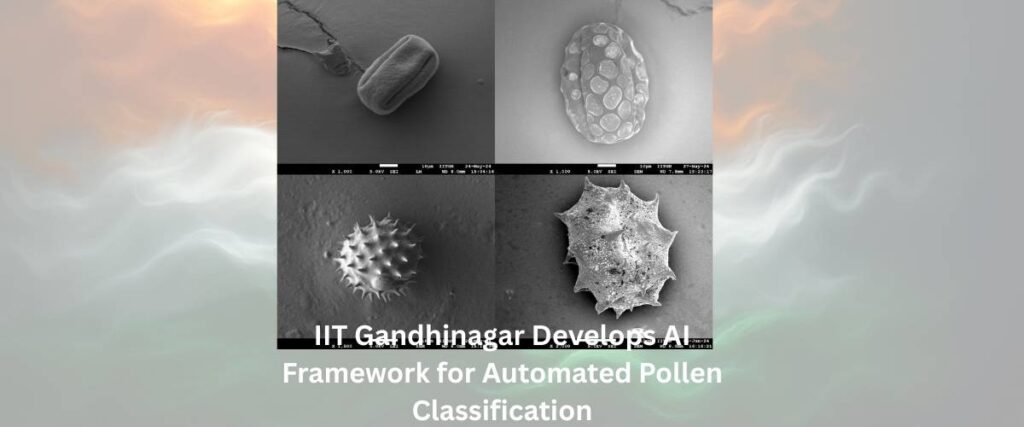
Invisible to the naked eye, pollen grains facilitate plant reproduction. Their shape, size, and surface features (morphology) can aid in identifying and classifying different species, serving as critical biological markers. These morphological features can be effectively captured using SEM, which uses a focused electron beam to visualise microscopic surface structures in detail. “Although robust imaging techniques are available, standardised workflows and large-scale datasets to facilitate automated pollen analysis are still lacking, especially within underrepresented plants,” explained Jaidev Sanjay Khalane, a final-year undergraduate from IITGN and the first author of the study. Mr Khalane completed this study as part of the Summer Research Internship Program (SRIP) with Dr Subramanian Sankaranarayanan, Assistant Professor in the Department of Biological Sciences and Engineering and the Principal Investigator at the Plant Molecular & Developmental Cell Biology (PMDCB) Laboratory.
“The team began by collecting 28 distinct flowering plant species with known medicinal properties from the IITGN campus in Gujarat, India. Pollen analysis using SEM at the Institute’s Central Instrumentation Facility revealed distinct and unique features in pollen shape and surface, ranging from spheroid to irregular and smooth to spiny,” said Dr Sankaranarayanan. This was followed by the development of MPalyn (Medicinal Pollen and Palynology SEM) Database. The web-based, open-access application MPalyn includes species details and corresponding high-resolution SEM images for structured exploration.
While its current dataset includes medicinal plants with 269 images for segmentation and 5842 images for classification, the framework can also be adapted for future extensions. As the next step, the team implemented YOLOv11n (You Only Look Once), a computer vision model to extract high-resolution pollen grain images with minimal background noise from SEM images. Computer vision is a class of artificial intelligence that trains computers to “see” and make sense of that visual information, such as recognising patterns. “This method can be used in large-scale studies and reduces dependency on the time-consuming and difficult-to-scale manual segmentation,” added Dr Nilesh Gawande, former postdoctoral fellow at the PMDCB lab and Assistant Professor at Woxsen University, Hyderabad.
The researchers also tested multiple classification models on manually segmented pollen images. They found that the Vision Transformer (ViT) model achieved the highest classification accuracy. It effectively learned and discriminated minute differences in pollen structures. According to Dr Shanmuganathan Raman, “Overall, the study involves an interdisciplinary methodology by integrating microscopy and computer vision models to accurately and speedily automate pollen analysis, with broad applications in domains ranging from plant taxonomy and biodiversity monitoring to agriculture, pollen allergies, and paleoecology.” Dr Raman is a Professor at the Department of Computer Science & Engineering (CSE) and Electrical Engineering. He is also the Head of the CSE department and the Principal Investigator at the Computer Vision, Imaging, and Graphics (CVIG) Lab.
The researchers noted that improving models and algorithms can help decrease the chances of error in classifying pollen that are morphologically similar or belong to closely related species. The team acknowledged the Department of Biotechnology for the Ramalingaswami re-entry fellowship grant and a start-up grant from IITGN to Dr Subramanian Sankaranarayanan.
Explore more
🎤 Career – Real career stories and job profiles of life science professionals. Discover current opportunities for students and researchers.
💼 Jobs – The latest job openings and internship alerts across academia and industry.
🛠️ Services – Regulatory support, patent filing assistance, and career consulting services.



[…] Biopatrika […]