
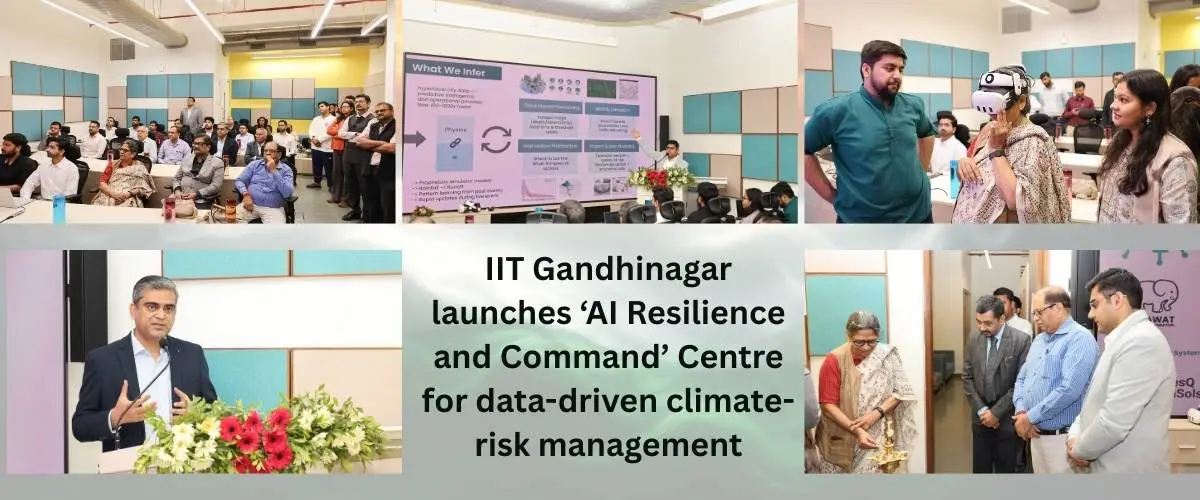
The Centre will utilize physics-consistent modelling and Artificial Intelligence to support real-time flood assessment, scenario analysis and decision support for urban systems
Gandhinagar | February 2026: As Indian cities grapple with increasingly frequent floods, climate extremes, and mounting infrastructure stress, the Indian Institute of Technology Gandhinagar (IITGN) has taken a decisive step towards strengthening urban resilience with the launch of its AI Resilience and Command (ARC) Centre on February 05, 2026.
Located at the IIT Gandhinagar Research Park, the ARC Centre marks a shift from reactive disaster response to anticipatory, data-driven climate-risk management. Designed to connect the dots from “Rain to Resilience,” the Centre integrates flood forecasting, mobility impacts, and operational decision support into a single physics-guided artificial intelligence framework, enabling cities to prepare, respond, and recover more effectively from extreme events.
By combining scientific rigour with real-time intelligence, the ARC Centre aims to support safer urban systems, protect livelihoods, and enable sustainable growth, aligning closely with India’s long-term vision of Viksit Bharat 2047.
By enabling real-time intelligence, faster simulations, and actionable decision support, the ARC Centre is expected to significantly enhance how cities anticipate and manage climate risks. The Centre’s integrated approach will help urban authorities reduce response time during extreme events, minimise disruption to mobility and infrastructure, and make more informed planning decisions. Over time, this is expected to translate into safer cities, reduced economic losses, better protection of vulnerable communities, and improved quality of life for urban residents.
Speaking at the launch, Prof Amit Prashant, Dean, External Relations, underscored the broader impact of the initiative. “The project has strong potential to serve cities as well as the communities living in them. It received global appreciation following its successful implementation last year, reflecting its relevance and impact. With continued guidance and collaboration, the focus now is on strengthening the initiative further and making it even more effective.”
During the event, the research team demonstrated how the ARC Centre combines physics-consistent modelling and artificial intelligence to deliver real-time flood assessment, scenario analysis, and decision support for complex urban systems. The demonstrations were supported by teams from the AI Centre of Excellence (AICoE) – Sustainable Cities project and AIResQ ClimSols Pvt. Ltd.
At the core of the Centre are advanced decision-support tools developed by AIResQ ClimSols Pvt. Ltd., an IIT Gandhinagar–incubated deep-tech company. These tools enable faster simulations, real-time flood prediction, and dynamic ‘what-if’ scenario exploration, while maintaining a strong scientific foundation essential for public decision-making.
Discussions at the launch repeatedly returned to the central role of water in shaping urban resilience. Prof. Udit Bhatia, Principal Investigator, Urban flooding module of the AI Centre of Excellence (AICoE) – Sustainable Cities project, IIT Gandhinagar, highlighted that while cities across the world face diverse challenges, water cuts across multiple Sustainable Development Goals. “If we truly want to make a difference at scale, we must start with water. While ensuring clean and equitable access is critical, cities are equally vulnerable to floods caused by excess water in very short durations, which can bring infrastructure and urban life to a standstill.”
Emphasising the broader implications of artificial intelligence, he noted, “While the global AI revolution driven by generative AI has made remarkable advances, its true value will be realised only when it delivers measurable improvements in quality of life. In cities, this means addressing real and interconnected challenges such as urban flooding, mobility disruption, and infrastructure resilience rather than deploying isolated technologies.”
Pointing to the gap between technological capability and on-ground adoption, Prof. Bhatia added, “We are sitting at the cusp of powerful technologies, yet the question is why these tools are not embedded into city planning, transportation systems, roads, and infrastructure projects.” He explained that the ARC Centre focuses on translating risk into actionable insights, enabling authorities to prioritise resources and respond effectively to urban hazards.
Bringing an administrative perspective to the conversation, Dr Vivek Kapadia, former Secretary to the Government of Gujarat and Professor of Practice, stressed the importance of structured and evidence-based decision-making. “We need to move towards data-backed and structurally sound decision-making instead of relying on ad hoc approaches. With the use of advanced computational tools and automation, processes that earlier took months can now be completed much faster.”
Highlighting the need for responsible deployment of technology, he added, “This is not just an ambition; it is a collective dream—to build systems that are robust, inclusive, and capable of supporting better governance and development.”
Developed through sustained translational research at the Machine Intelligence and Resilience (MIR) Lab and supported institutionally by the AI Centre of Excellence – Sustainable Cities, implemented by the Airawat Research Foundation, the ARC Centre views cities as interconnected systems where climate, infrastructure, mobility, and communities interact.
The inaugural ceremony was attended by several senior government officials who also participated in the lamp lighting ceremony and shared their reflections on urban resilience and governance. The distinguished guests included Dr. Sangeeta Singh, Vigilance Commissioner of Gujarat; Shri P. C. Vyas, Secretary, Water Resources Department, Government of Gujarat; Shri P. R. Patelia, Secretary, Roads and Buildings Department; and Shri M. D. Patel, Special Secretary, Water Resources Department. Their presence underscored the importance of collaborative engagement between academia, government, and technology providers in addressing complex urban and climate challenges.
The launch brought together policymakers, practitioners, and academia. Mr Amar Nath, CEO, Airawat Foundation, attended the inaugural ceremony along with faculty members, researchers, students, and senior government officials, who reflected on the urban challenges they face and the potential of the ARC Centre’s tools to strengthen city resilience.
Highlighting the role of technology in addressing urban challenges, Amar Nath said, “India’s cities are facing complex challenges related to water, air quality, infrastructure, and space management. We strongly believe that artificial intelligence can play a transformative role in developing practical, ground-level solutions for sustainable cities.” He added that the Foundation works closely with researchers, industry partners, and global institutions to ensure that innovation translates into measurable on-ground impact.
By bringing research, industry, and governance together in a shared space, the ARC Centre is envisioned as a next-generation hub for urban resilience, real-time flood intelligence, and decision support, strengthening climate preparedness and long-term resilience planning for cities across India.
Explore more
🎤 Career – Real career stories and job profiles of life science professionals. Discover current opportunities for students and researchers.
💼 Jobs – The latest job openings and internship alerts across academia and industry.
🛠️ Services – Regulatory support, patent filing assistance, and career consulting services.