
Early detection, one click at a time: How Mukhia Plus is changing oral health
Tobacco-associated oral cancer is a serious public health problem in India. In spite of the healthcare burden, rates of screening for oral cancer in the country are dismally low. This is in part owing to the lack of accessible, affordable and robust screening tools, and in particular the lack of those tools that can be integrated into wellness and healthcare programs at various levels. Edgescan AI’s Mukhia Plus is an AI oral cancer screening app that is filling this gap.
In this conversation, we speak with Dr. Prachee Hendre, a periodontist and tobacco-cessation counselor with Edgescan AI, on the app-based screening tool, its development and validation, and most recent deployment across sites in the country.
Question 1: Tell us about Mukhia Plus and the gap in the healthcare management of tobacco users that it is aiming to fill.
Mukhia Plus is an AI based oral cancer screening tool which uses a smart phone camera to aid in the early detection of suspicious oral cancers & potentially malignant disorders of the oral cavity.
Built using state-of-the-art network architectures optimized for medical image analysis, the non-invasive tool enables localization and categorization of oral lesions using standard smartphone photographs. Post image acquisition, the Mukhia Plus algorithm functions through a trained model that analyzes each image and generates clinically-relevant findings.
Tobacco use is a major preventable public health challenge in India, with over 260 million users, significantly contributing to the country’s oral cancer burden. Oral cancers are often preceded by clinically detectable potentially malignant disorders; therefore, early and systematic screening is critical to improving survival and reducing mortality. However, large-scale screening is frequently limited by variability in expertise and access to specialists. Edgescan AI’s Mukhia Plus bridges this gap between undetected oral lesions and accessible mass screening.
Question 2: Beyond being a cool piece of technology, a medical app has to undergo testing, validation, and on site deployment to fully prove its capability. Could you take us through that journey with Mukhia Plus?
The journey of Mukhia Plus from technology to application has been an interesting one.
The machine learning model incorporated in Mukhia Plus was built and trained iteratively using tens of thousands of clinical and image data points. The technology to securely access the model, query it with images taken at the point of care, and present results to the user, was then incorporated into a newly-developed app. This app went through a rigorous process of acquiring regulatory approvals to become a Class B licensed ‘Software as a Medical Device.
A few key features of the developmental journey of the Mukhia Plus model include training on a dataset of more than 50,000 clinical images specifically acquired from 18 different screening sites across India. The image dataset was sourced from a wide geographical distribution, from the North-East regions to Mumbai, and from Srinagar to Kanyakumari representing diverse ethnicities, demographics, and cultural variations related to tobacco use. The images were annotated by an expert panel including oncosurgeons and oral pathologists, correlating with clinical history and biopsy findings where relevant.
Taken together, the model that is now incorporated in Mukhia Plus is validated by a double blinded, randomised clinical trial registered with Clinical Trials Registry of India and is an ISO certified product that is licensed for screening in India.
Question 3: Where do you see the future deployment and use-case scenario for Mukhia Plus – corporate hospitals, rural healthcare, insurance companies – what are the possibilities?
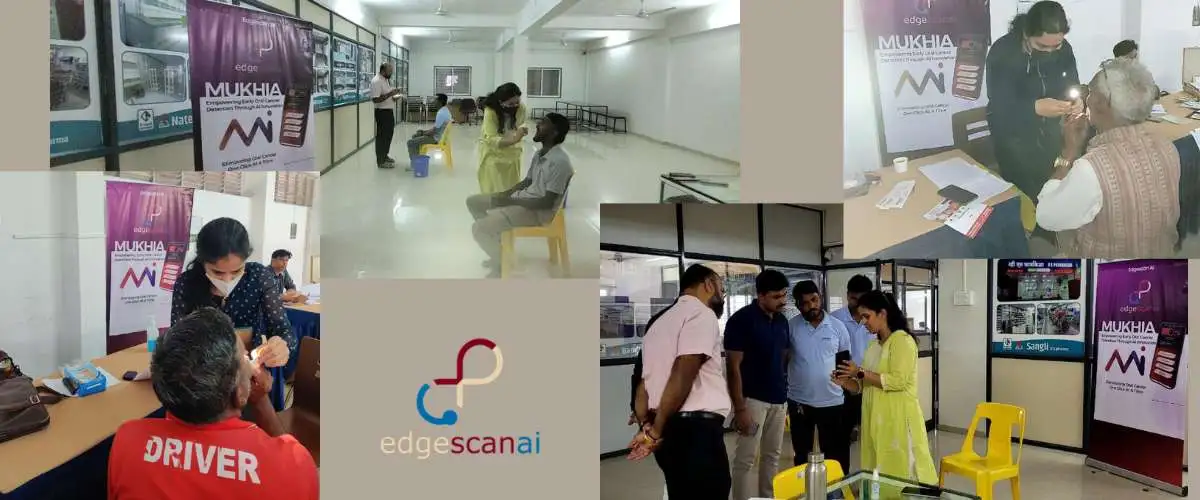
In 2025, the model incorporated in Mukhia Plus was used as a screening tool for employees in an automobile industry unit in Pune. The model showed accuracy levels up to 89%, sensitivity as high as 96%, and a precision rate of 92%, which is among the best for screening tools. Post screening, employees identified with potentially malignant disorders and suspicious cancers were referred to oncology and dental departments of the allied hospital on an urgent basis, and, in addition, all identified tobacco users were also referred to a long-term tobacco cessation program. The important part of this program was that the specific industry site had lost two employees to oral cancer in previous years, and hence this screening initiative was significant.
In line with this case study, Mukhia Plus is well-suited for the use as a mass screening tool for detection of oral cancer lesions, including potentially malignant changes across the population. Wherever a smart phone can reach, Mukhia Plus will help.
So, the opportunities for use are diverse. Corporate hospitals can incorporate Mukhia Plus into their wellness and health check packages. Rural healthcare workers can use Mukhia Plus in inaccessible areas and for vulnerable populations. Mukhia Plus can be a good part of pre-employment check ups for healthcare claims and insurance services. Pathology labs can incorporate Mukhia Plus in their test packages. Beyond healthcare setups, Mukhia Plus can also be a part of health programs for groups with high prevalence of tobacco use such as third shift workers, drivers, construction site workers and security workers.
Question 4: The medical community has widely relied on ‘examination by a clinician’ to be the gold-standard screening approach for several conditions, especially those that are easily accessible to visual examination. How is Mukhia Plus better than clinical screening and what specific advantages would the app offer?
While clinical examination by a trained clinician remains the gold standard, tools like Mukhia Plus are designed to augment—not replace—clinical expertise, particularly in settings where access to specialists is limited.
The app offers several practical advantages that can strengthen and expand current screening approaches. Mukhia Plus avoids ‘clinician-fatigue’ that is often seen in mass screening programs. Also, all individuals cannot be seen by a specialist, so Mukhia Plus creates a pathway for necessary and urgent referrals for individuals who are in need of it. The repeatable results of the tool makes it a handy equipment for busy clinicians and their teams so as to not miss a finding due to lack of time or fatigue or accessibility.
Question 5: As a trained dental surgeon, periodontist, and tobacco-cessation counselor, how do you see Mukhia Plus facilitating the healthcare of tobacco users beyond what is currently on offer, and what other arms of the healthcare approach – counseling, replacement and cessation would it facilitate, if so?
As a trained dentist and periodontist, I have always believed in the power of prevention, and Mukhia Plus – as an accessible, affordable and robust screening tool – is exactly that. Currently, the overwhelming majority of tobacco users seek cessation support and medical intervention only when lesions appear – a stage when it is often too late or complicated for meaningful intervention. An AI-assisted screening tool changes this approach from ‘reactive-corrective’ treatment to ‘proactive’ early detection and prevention.
As a trained and certified tobacco cessation counsellor, I see the tool strengthening tobacco-cessation efforts and programs by linking early detection, behavioral counseling, and cessation support into one workflow. Mukhia Plus does this by augmenting the identification and recognition of tobacco-related harm among users. The app supports the documentation of clinical findings for long term followup of the patient. Most importantly, it drives home the need and urgency of cessation support with nicotine replacement, lifestyle changes, and behavioural modifications.
Question 6: In your experience with deployment across different sites, what do you expect to be the most likely roadblock or hesitancy in the uptake of this app-based technology by healthcare workers for tobacco-derived oral precancerous and cancer screening?
The only roadblock is the willingness of tobacco users to get screened and the association with the fear of identifying a serious lesion. To overcome this hesitancy, it is important to convey to individuals undergoing screening that screening can lead to early detection of potential cancerous lesions and cancer, enable better treatment and management, as well as limit financial and social consequences for themselves and their families.
To know more about how you can engage with Mukhia+, write to ask@edgescan.ai.
Interview led by Karishma S Kaushik, MBBS, MD, PhD
Explore more
🎤 Career – Real career stories and job profiles of life science professionals. Discover current opportunities for students and researchers.
💼 Jobs – The latest job openings and internship alerts across academia and industry.
🛠️ Services – Regulatory support, patent filing assistance, and career consulting services.