


Reign of Boronopeptides: Pioneering module for precision bacterial imaging
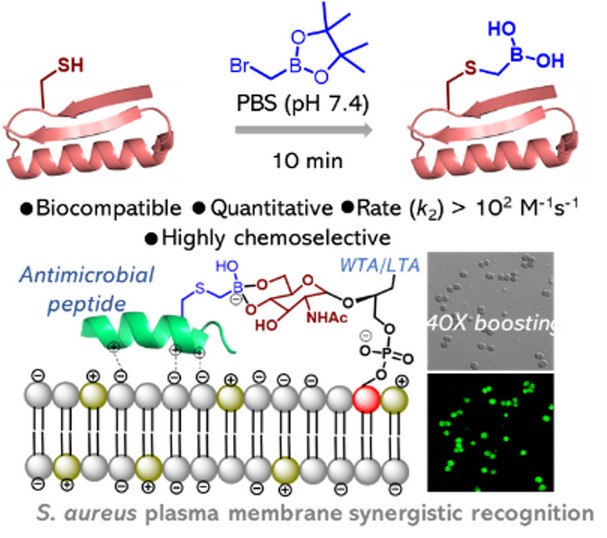
Research Summary: A straightforward chemical reaction in water has been developed for the installation of boronic acid into various proteins and peptides. An antimicrobial peptide incorporating boronic acids demonstrated selective detection of Gram-positive bacteria with high efficacy and improved serum stability.
Researcher Spotlight

An alumnus of St. Xavier’s (Kolkata) and University of Calcutta, Saurav Chatterjee joined IIT Ropar with Dr. Anupam Bandyopadhyay to delve deep into chemical biology. Focusing on developing reaction methodologies and applications for boronopeptides, he also worked in tandem with companies to identify and synthesize impurities in peptide API. Currently, Saurav is a postdoctoral fellow in the lab of Prof. Fernando Albericio.
LinkedIn | Twitter | Instagram
Lab: Dr. Anupam Bandyopadhyay, Indian Institute of Technology Ropar, Punjab 140001
Lab social media: GSite, Twitter (@AB_IITRPR)
What was the core problem you aimed to solve with this research?
The problem we attempted to address was twofold: first, to develop a readily operable reaction methodology for the installation of alkyl boronic acids onto peptides, and second, to enhance the imaging characteristics of peptides for staining bacteria. Given the looming issue of antimicrobial resistance, peptides serve as invaluable weapons to help us fight this war.
How did you go about solving this problem?
Given the properties of boronic acid, we hypothesized that its orbital interaction with an adjacent electrophilic carbon center can increase the electrophilicity. Thus, the boronic acid moiety can be easily installed via a simple substitution reaction on peptides and proteins with a nucleophilic cysteine residue. With a positive result from computational calculations, we proceeded to experimentally verify our findings. After solidifying our understanding of peptide and protein modification, we selected a clinically used antimicrobial peptide, UBI, which is known to target bacterial membranes. A bis-boronic acid modification to the peptide increased its imaging efficacy by 40-fold.
How would you explain your research outcomes (Key findings) to the non-scientific community?
Peptides are the new craze over small molecules for medicinal applications. Often, modifications to the peptide chain are essential to improve the druggable properties of peptides. Developing green, reproducible, and near quantitative methodologies for such modifications, for example, with boronic acids, is imminent. Our findings demonstrate a clean, fast, and nearly quantitative pathway to synthesize boronopeptides without the use of any additives. Such boronopeptides were intuitively deployed to detect a specific class of disease-causing bacteria with a high affinity. This finding will be further explored in animal models, with numerous potential applications in the future.
‘Chemical Biology should be exploited utilizing simple chemical tools that can be accessed by human beings from every corner of the world. This work is exemplary.’ — Dr. Anupam Bandyopadhyay
What are the potential implications of your findings for the field and society?
The synthetic strategy for installing boronic acid on peptides and proteins is a paradigm shift from the current methods. It will provide easy access to boronopeptides, with a nudge to fellow scientists to develop novel yet simple modification strategies. On the other hand, given the superior imaging prowess of mono and bivalently bonded boronopeptide, it is sure to have much wider implications in healthcare.
What was the exciting moment during your research?
We, scientists, are most delighted when our hypothesis is proved correct. Carrying out reactions in water with high efficiency is a challenge; however, we successfully overcame it with good results. A clean quantitative conversion in 10 minutes with no accompanying by-products was the pinnacle of our happiness. For the biological application of the synthesized boronopeptides, we expected it to bind with high affinity; however, the selectivity of binding among different strains of bacteria was the cherry on top.
Paper reference: S. Chatterjee, A. Chowdhury, N. Verma, S. Basa, N. M. Tripathi, V. Gour, V. Rai, A. Bandyopadhyay, ‘An efficient method for site-selective boronation of peptides and proteins applied in magnified bacterial imaging’ Nat Commun 2025, DOI 10.1038/s41467-025-67141-5.
Explore more
🎤 Career – Real career stories and job profiles of life science professionals. Discover current opportunities for students and researchers.
💼 Jobs – The latest job openings and internship alerts across academia and industry.
🛠️ Services – Regulatory support, patent filing assistance, and career consulting services.