
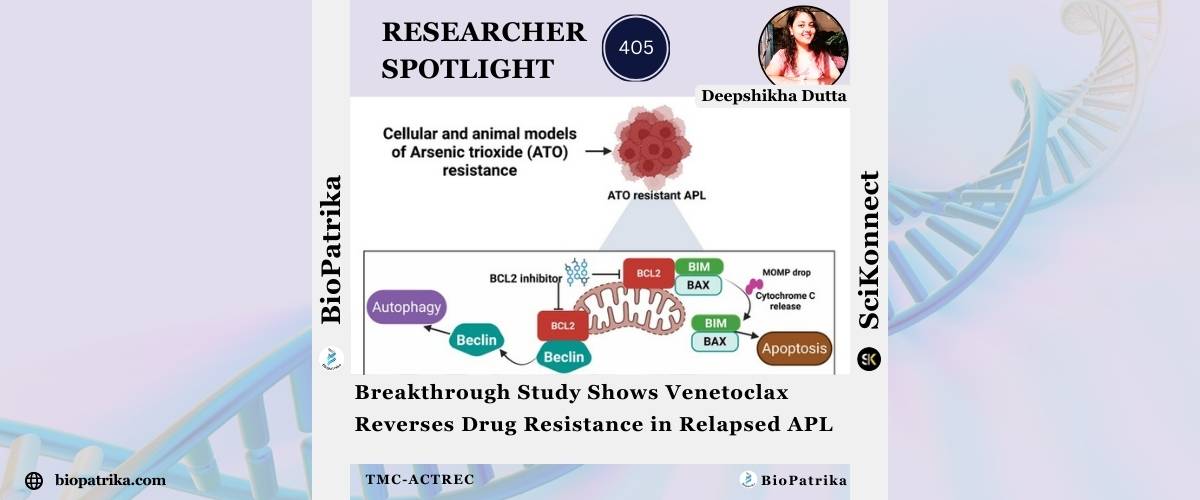
Venetoclax Overcomes ATO-Resistance by Inducing Apoptosis and Autophagy in APL
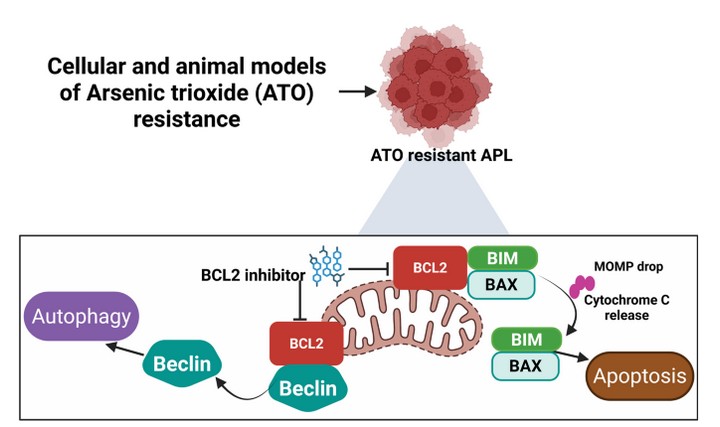
Research Summary: Venetoclax induces mitochondrial apoptosis and autophagy in arsenic trioxide-resistant acute promyelocytic leukemia cells by targeting mitochondrial metabolic reprogramming and disrupting BCL2/Beclin-1 interaction. This study evaluated the pre-clinical efficacy of venetoclax in APL.
Researcher Spotlight

Deepshikha Dutta is a Ph.D scholar at TMC-ACTREC. Her research aims to gain a deeper understanding of ATO-resistance APL using different APL models of xenografts with novel therapeutic combinations to overcome ATO resistance.
Linkedin: https://www.linkedin.com/in/deepshikha-dutta-00a1b024a/
Twitter: https://x.com/Deepshikha_Dia
Lab: Dr. Syed K. Hasan, Tata Memorial Centre-Advanced Centre for Treatment, Research and Education in Cancer (TMC-ACTREC)
Lab website: https://actrechasanlab.wixsite.com/home
What was the core problem you aimed to solve with this research?
The core problem was ATO resistance in 8-10% of APL patients, driven by mitochondrial dysregulation, elevated BCL2 anti-apoptotic protein, and oxidative phosphorylation (OXPHOS) reliance with limiting treatment options. No prior systematic study had investigated venetoclax’s mechanistic basis in ATO-resistant APL. The research aimed to elucidate venetoclax (alone or with ATO) effects on mitochondrial stress, apoptosis, autophagy, and BCL2-Beclin-1 disruption to overcome ATO resistance.
How did you go about solving this problem?
We solved ATO resistance in APL by systematically testing venetoclax’s effects across in vitro, ex vivo, and in vivo models. For the in Vitro approach, we used ATO-resistant cell lines (NB4-EVAsR1 and UF1), and for ex vivo, we used primary blasts from 25 APL patients; assessed cytotoxicity via CTG assays. We measured mitochondrial function by Seahorse XF for basal oxygen consumption rate (OCR), checked mitochondrial reactive oxygen species (ROS) by MitoSOX and mitochondrial membrane potential (MMP) by JC-1, and apoptosis by Annexin V/PI using flow cytometry, checked apoptosis and autophagy protein markers by immunoblots, LC3-LAMP1 colocalization by confocal, and structures by transmission electron microscopy (TEM), proteomics approach by LC-MS/MS with Reactome for analysis, and understanding mechanisms by co-IP for BCL2/Beclin-1, shRNA knockdowns, and cycloheximide (CHX) chase assay.
For in vivo validation, we had both subcutaneous and orthotopic NOD/SCID xenografts, and also we also developed an in vivo ATO-resistance xenograft by using a syngeneic FVB/N-hPML-RARA+ model. We evaluated tumor burden (hCD45+ and CD117/GR1+), apoptosis, and mitochondrial ROS, survival (Kaplan-Meier), protein markers of apoptosis and autophagy while histology (H&E) staining on vital organs and serum/hematology markers were examined to assess the safety profile.
How would you explain your research outcomes (Key findings) to the non-scientific community?
Acute promyelocytic leukemia (APL) is curable with arsenic trioxide (ATO), but 8-10% of patients relapse and become resistant. Our study shows venetoclax, that blocks a survival protein called BCL2. Venetoclax also targets these resistant cells’ overactive energy factories, that is mitochondria, thus reviving treatment for APL patients who relapse and resist standard ATO therapy. It triggers cell suicide (apoptosis), and activates self-digestion (autophagy), even breaking the leukemia-causing PML-RARA onco-protein. In lab tests and patient samples, it kills resistant APL cells at very low doses (nanomolars). In mice models with human APL tumors, it shrinks leukemic burden, boosts survival; and combining with ATO works even better, maintaining the safety profile with no toxicity. This therapeutic strategy offers a potential hope for relapsed and resistant patients over conventional therapy.
What are the potential implications of your findings for the field and society?
These findings offer venetoclax as a promising therapy for the 8-10% of APL patients with ATO resistance, potentially improving survival in relapsed cases. Preclinical evidence supports venetoclax alone or in combination with ATO for ATO-resistant APL, targeting mitochondrial OXPHOS, promoting BCL2/Beclin-1 disruption, and triggering apoptosis and autophagy. This study also gives an insight into venetoclax use since it highlights BCL2 inhibition’s dual pro-apoptotic and pro-autophagic role in ATO-resistant APL by exploiting metabolic vulnerabilities.
Societal Impact
This study provides evidence that venetoclax can save lives. Oral venetoclax administration offers accessible therapy, reducing chemotherapy reliance and toxicity for relapsed patients, providing a better remission rate.
What was the exciting moment during your research?
Venetoclax not only killed resistant APL cells, it disrupted their mitochondria, collapsed their energy production (OCR), and triggered a surge in mitochondrial ROS and apoptosis. We also found it activates a pro-death form of autophagy by breaking the BCL2–Beclin-1 complex, something not previously shown in ATO-resistant APL. Seeing consistent reduction of leukemic burden and improved survival in the mouse ATO-resistant models with venetoclax or Ven-ATO was a powerful proof that this strategy could genuinely help patients who currently have very limited options.
Paper reference: Dutta D, Maity A, Gupta SK, Gera P, Jain H, Bagal B, Chatterjee G, Rajpal S, Nayak L, Punatar S, Bandyopadhyay S, Chakraborty A, Chendamarai E, Balasundaram N, Gota V, Khattry N, Sengar M, Mathews V, Hasan SK. Venetoclax induces mitochondrial apoptosis and autophagy to overcome arsenic trioxide resistance in acute promyelocytic leukemia. J Transl Med. 2026 Jan 12;24(1):56. doi: 10.1186/s12967-025-07623-8. PMID: 41527127; PMCID: PMC12797632.
https://link.springer.com/article/10.1186/s12967-025-07623-8
Explore more
🎤 Career – Real career stories and job profiles of life science professionals. Discover current opportunities for students and researchers.
💼 Jobs – The latest job openings and internship alerts across academia and industry.
🛠️ Services – Regulatory support, patent filing assistance, and career consulting services.