


Conserved MIR169:NF-YA:ARGOS module regulates plant growth and yield
Research Summary: Our study shows that reduced NF-YA target levels and enhanced auxin levels in microRNA169 (MIR169) overexpression lines regulate ARGOS to augment vegetative growth as well as yield in Arabidopsis and a crop plant, tomato.
Author interview

Dr. Apoorva Gupta has recently completed her PhD from BRIC-NIPGR, New Delhi. Her PhD work focuses on understanding the molecular mechanism of microRNA mediated regulation in various developmental and abiotic stress responsive pathways in Arabidopsis as well as an important crop plant, tomato.
Linkedin: https://www.linkedin.com/in/apoorva-gupta-82b423157/
Twitter: https://x.com/apoorva_gupta28
Instagram: https://www.instagram.com/apoorva.gupta2/
Lab: Dr. Saloni Mathur, National Institute of Plant Genome Research (NIPGR)
Lab social media: https://x.com/SMLAB108
What was the core problem you aimed to solve with this research?
Global climate change and population explosion in conjunction with reducing arable land has raised several concerns for feeding the future generations. There is an urgent need to develop crops that are higher yielding, can mitigate harsh climate and those which can complete their life cycle early to counter shorter growing seasons.
How did you go about solving this problem?
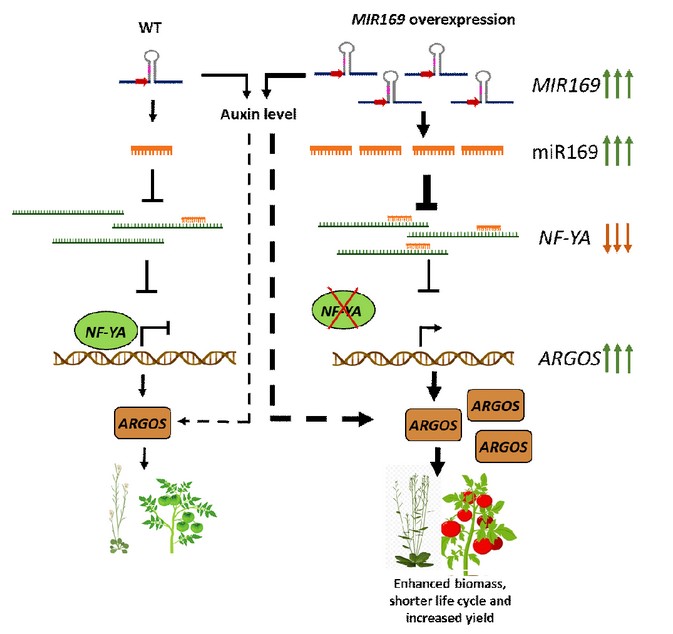
Here, we report that elevated miR169d expression and concomitant reduced NF-YA2 (Nuclear Factor-Y subunit-A) target levels, positively regulate vegetative-growth and yield in Arabidopsis along with a shorter life-cycle. We show that NF-YA2 directly binds to the promoter of ARGOS (Auxin-Regulated Gene involved in Organ-Size), this gene is upregulated in MIR169d-OE due to reduced NF-YA2 repressor levels.
To assess the translational potential of this module in a crop, we show that Sly-MIR169-OE lines in tomato, having reduced target Sly-NF-YA10 levels also regulate Sly-ARGOS resulting in early flowering, larger-sized fruits, more fruit fresh-weight, higher fruit-set, early fruiting and better shelf-life than wild-type plants.
By turning up a conserved natural genetic switch (MIR169), plants can grow larger and produce more fruits in less time– a promising step towards feeding a growing population with decreasing arable land. — Dr. Saloni Mathur
How would you explain your research outcomes (Key findings) to the non-scientific community?
The world population is continuously increasing and the agricultural land is rapidly decreasing due to urbanization. In this scenario, it becomes essential to develop crop varieties that can produce more food and can grow quickly.
In this research, we found that a tiny molecule called microRNA (a type of genetic material that doesn’t make proteins but controls the function of certain other genes) can help plants grow bigger and faster. By increasing the levels of one particular microRNA, called MIR169, plants produced more leaves and fruits and completed their life cycle sooner. Normally, a protein called NF-YA slows down growth by blocking another gene called ARGOS. ARGOS is important because it makes leaves and fruits larger because of increased cell number. Therefore, when MIR169 levels go up, NF-YA levels go down. This removes the block by NF-YA, allowing ARGOS to be more active and boosting plant growth.
Increasing MIR169 has an extra benefit too, it also raises the levels of a plant hormone called auxin, which further activates ARGOS. Together, these changes make plants grow faster, bigger, and yield more food. We tested this in both a common research plant (Arabidopsis) and an economically important food crop (tomato).
What are the potential implications of your findings for the field and society?
In this study we have shown that the MIR169 overexpression lines in Arabidopsis as well as tomato have increased vegetative biomass, enhanced yield (increased silique/fruit size as well as more number of fruits per plant) and a shorter life cycle as compared to the wild type plants. We show that a conserved MIR169:NF-YA:ARGOS module is responsible for regulating these phenotypes.
As we show that overexpressing MIR169 or downregulating its target NF-YA results in early maturing and higher yielding varieties, in order to release this variety for field trials and consumption, a CRISPR/Cas9 knockout line of NF-YA can be generated. These NF-YA gene-edited lines are expected to be early maturing and higher yielding. Early maturing varieties would increase scope for multiple cropping in a year, more time for field preparation and flexibility in sowing time. Higher yielding varieties would meet increasing demands to produce more in limited arable land. Since miRNAs are conserved across plants, the miR169:NF-YA pair is also expected to regulate biomass, yield and life-cycle in other crop species.
What was the exciting moment during your research?
One of the most exciting aspects during our research was when we discovered that the overexpression of MIR169 leads to an increase in ARGOS levels by two parallel pathways: overexpression of MIR169 increases the auxin levels, leading to increased ARGOS levels; and downregulation of the target NF-YA leads to the de-repression of ARGOS, again leading to increased ARGOS levels.
It was also really exciting to observe that the MIR169 overexpressing tomato plants not only had increased yield and a shorter life cycle (early flowering and reduced fruit maturation time), but the fruits also had an increased shelf life.
Paper reference: Gupta, A., Rao, S., Jha, S., Ghosh, D., Virmani, R., Shrivastava, M., Kumar, A., Sahoo, L., Das, J.R., Crespi, M. & Mathur, S. (2025). The MIR169: NF‐YA module enhances biomass and yield via ARGOS in Arabidopsis and tomato. The Plant Journal, 124(2), e70538. https://onlinelibrary.wiley.com/doi/full/10.1111/tpj.70538
Explore more
🎤 Career – Real career stories and job profiles of life science professionals. Discover current opportunities for students and researchers.
💼 Jobs – The latest job openings and internship alerts across academia and industry.
🛠️ Services – Regulatory support, patent filing assistance, and career consulting services.