


How Pseudomonas aeruginosa Builds Its Polar Flagellum
Research Summary: This study provides insights into the molecular mechanisms underlying the polar assembly of flagella, mediated by an SRP GTPase FlhF, offering a targeted approach for controlling infection by this pathogen.
Researcher Spotlight

Shikha Raghav is a PhD Scholar at the Regional Centre for Biotechnology. She uses biophysical, biochemical and in vivo approaches to understand the factors involved in maintaining the flagellation pattern in P. aeruginosa.
Linkedin linkedin.com/in/shikha-raghav-a2085822a
Instagram https://www.instagram.com/shikha.raghv/
Lab: Prof. Deepti Jain, Regional Centre for Biotechnology
Lab social media: https://x.com/deepjxtal
What was the core problem you aimed to solve with this research?
Pseudomonas aeruginosa utilizes a single polar flagellum for motility, virulence, pathogenesis, and the formation of biofilms. We aimed to understand why the flagellum in this bacterium was exclusively assembled at the bacterial cell pole.
How did you go about solving this problem?
We utilized biochemical, biophysical and imaging techniques to address the problem. We designed a series of constructs of the protein, which were complemented in the knockout strain of the bacteria, and motility, cellular localization, and flagellar phenotypes were evaluated.
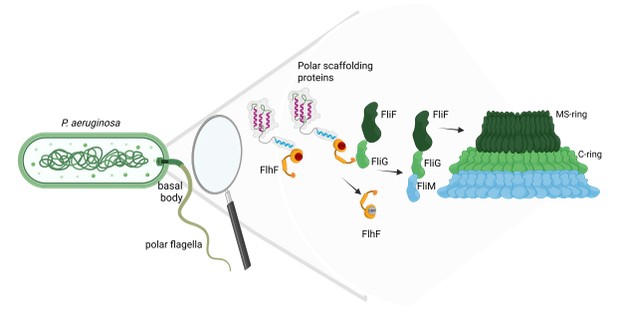
We also established the interaction between the FlhF and the components of the flagellar basal body, using both in vivo and in vitro experiments.
How would you explain your research outcomes (Key findings) to the non-scientific community?
FlhF is a protein with three domains. We have shown that one of the domains of FlhF directs the protein to the bacterial cell poles. The other domain acts like a scaffold for the assembly of the flagellar components.
This study is relevant because flagella are the motility organs of bacteria, which help them move and thus facilitate infection.
FlhF, an SRP-GTPase, is a molecular GPS that targets flagella to the poles. — Prof. Deepti Jain
What are the potential implications of your findings for the field and society?
Pseudomonas aeruginosa is the leading cause for hospital-acquired infections. It possesses a tail-like structure called flagella, which not only aids in movement but is also important for causing infections, thus acting as a virulence factor. The findings from the study have implications in targeting the interaction between FlhF and basal body proteins to hinder the motility and eventually the infectivity of P. aeruginosa.
What was the exciting moment during your research?
The most exciting part of the study was when the deletion of domains in FlhF led to distinct changes in flagellar phenotypes, as captured through transmission electron microscopy.
Paper reference: Raghav S, Prajapati R, Jain D. Role of FlhF and its domains in the assembly of a polar flagellum in P. aeruginosa. J Bacteriol 0:e00332-25. https://doi.org/10.1128/jb.00332-25
Explore more
🎤 Career – Real career stories and job profiles of life science professionals. Discover current opportunities for students and researchers.
💼 Jobs – The latest job openings and internship alerts across academia and industry.
🛠️ Services – Regulatory support, patent filing assistance, and career consulting services.