

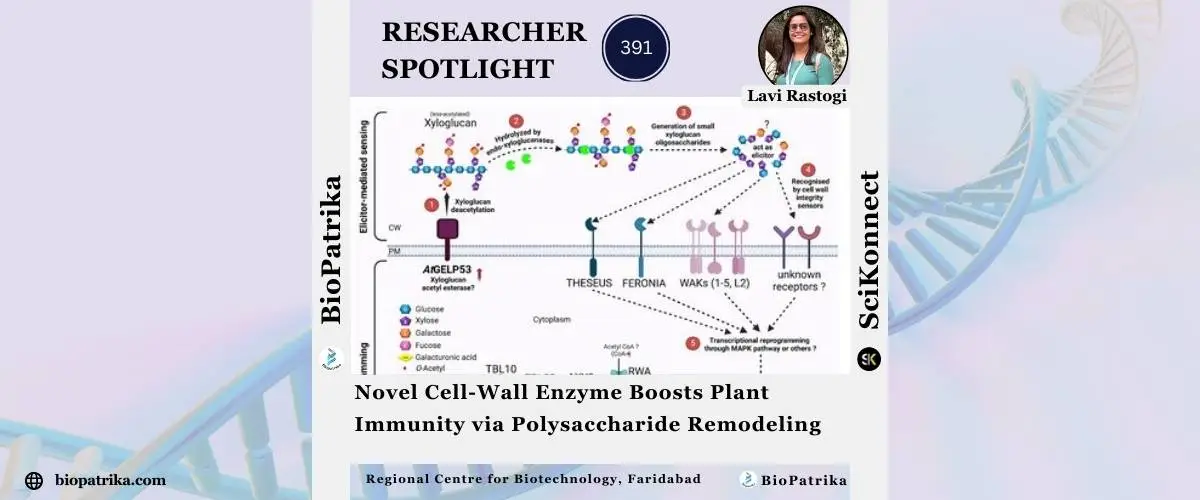
Unlocking the polysaccharide potential: A Novel Enzyme That Remodels Cell Walls To Boost Immunity
Research Summary: This study identifies a novel acetylesterase enzyme that, upon overexpression, remodels the cell wall through xyloglucan oligosaccharide-mediated signaling that helps enhance plant immunity against bacterial pathogens.
Researcher Spotlight

Dr. Lavi Rastogi has recently completed her PhD from Regional Centre for Biotechnology, Faridabad. She has demonstrated exemplary dedication and perseverance, guiding this work with remarkable focus, persistence, and a strong work ethic.
Linkedin- https://www.linkedin.com/in/lavi-rastogi-860788244
Twitter- https://x.com/lavirastogi9
Instagram- https://www.instagram.com/lavi_rastogi_/
Lab: Dr Prashant Pawar, Regional Centre for Biotechnology, Faridabad
Lab website: https://rcb.res.in/faculty/dr-prashant-mohan-pawar
What was the core problem you aimed to solve with this research?
Polysaccharide acetylation plays a crucial role in plant development and is regulated by acetyltransferases and esterases located in the Golgi, plasma membrane, or cell wall. The role of acetylesterases in plant cell walls remains poorly understood. Therefore, we aimed to investigate the Arabidopsis GDSL Esterase/Lipase Protein (GELP) family to identify some novel acetylesterase enzymes and functionally characterize them to understand their role in cell wall remodeling and in plant immunity.
How did you go about solving this problem?
To characterize GELP53, we employed an integrated approach combining several advanced methodologies, including biochemical assays, molecular docking simulations, imaging techniques, transcriptomic and proteomic analyses, elicitor-based assays, and cell wall composition analysis that identified this protein as a plasma membrane-localized xyloglucan acetyl esterase, marking the first report of this enzyme in plants. This study revealed that GELP53 is involved in oligosaccharide-mediated plant cell wall integrity maintenance, leading to remodeling and improved defense against bacterial pathogens. Thus, we identified GELP53’s novel function in cell wall remodeling and plant immunity.
How would you explain your research outcomes (Key findings) to the non-scientific community?
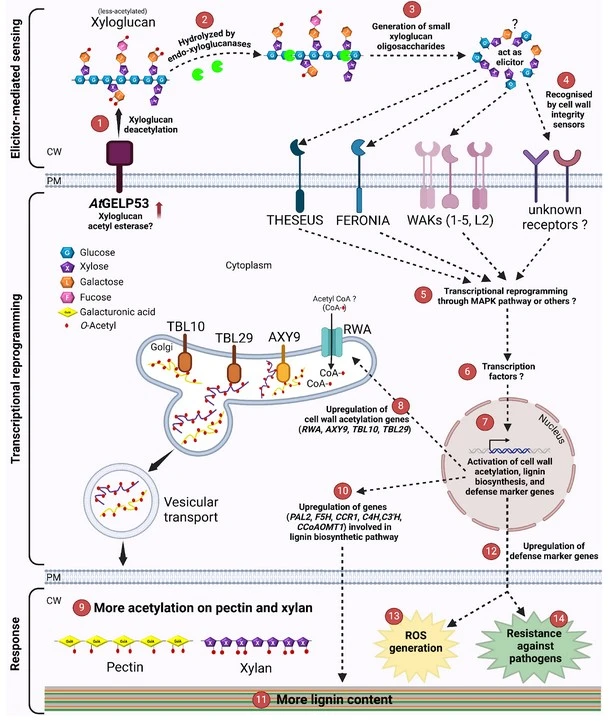
This study characterizes AtGELP53, a member of the GDSL Esterase/Lipase Protein (GELP) family. Our findings demonstrate that GELP53 can function as a xyloglucan acetyl esterase, specifically removing acetyl modifications from xyloglucan polysaccharides in plant cell walls. The deacetylated xyloglucan is subsequently cleaved by endoxyloglucanases, producing xyloglucan oligomers. These oligomers may bind to specialized cell wall receptors, triggering signaling pathways that enhance the plant’s defense response against pathogen attack.
“Novel polysaccharide acetyl esterase (GELP53) that boosts plant immunity by restructuring the cell wall.” – Dr Prashant Pawar
What are the potential implications of your findings for the field and society?
Understanding how GELP53 modulates cell wall acetylation could advance knowledge of plant cell wall remodeling mechanisms and their role in both development and stress responses. This contributes to the broader understanding of how post-synthesis modifications of cell wall polysaccharides regulate plant physiology. The discovery of novel acetylesterases also expands our toolkit for studying and manipulating cell wall composition, which has been a longstanding challenge in plant biology.
What was the exciting moment during your research?
During this study, the most exciting moment emerged when we identified xyloglucan as GELP53’s specific substrate, marking the first such characterization in plant systems. Subsequently, we demonstrated how in planta GELP53 overexpression activates oligosaccharide-mediated signaling cascade. This enabled us to establish the link between GELP53’s role in activating plant immunity pathways.
Paper reference: Rastogi et al., Arabidopsis GELP53 overexpression modulates polysaccharide acetylation and defense through oligosaccharide-mediated signaling, The Plant Cell, Volume 37, Issue 11, November 2025, koaf184, https://doi.org/10.1093/plcell/koaf184
Explore more
🎤 Career – Real career stories and job profiles of life science professionals. Discover current opportunities for students and researchers.
💼 Jobs – The latest job openings and internship alerts across academia and industry.
🛠️ Services – Regulatory support, patent filing assistance, and career consulting services.