

New Study Decodes How Osteoclasts Regulate Bone Resorption Through Lysosome Dynamics
Research Summary: Arl8b, a lysosomal GTPase, interacts with its effector RUFY4 to regulate lysosome maturation, positioning, and cathepsin K processing in osteoclasts, thereby enabling efficient bone resorption and maintaining bone homeostasis.
Researcher Spotlight
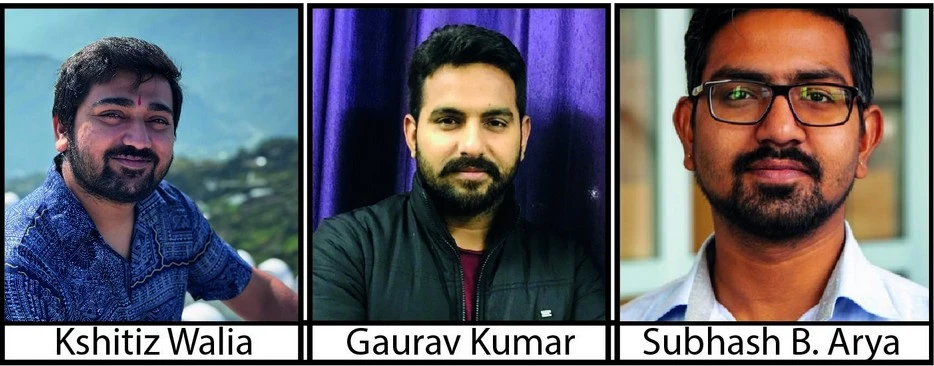
Co-first authors: Kshitiz Walia, Gaurav Kumar, Subhash B. Arya
Kshitiz Walia recently completed his Ph.D. under the supervision of Dr. Amit Tuli, Senior Principal Scientist at CSIR-Institute of Microbial Technology (Chandigarh). Dr. Gaurav and Dr. Subhash, both alumni of Dr. Tuli’s laboratory, and are currently working as an HHMI Postdoctoral Associate at Weill Cornell Medicine and as a Research Investigator at University of Michigan, respectively.
LinkedIn: Kshitiz Walia
Twitter: @Kshitizwalia
Instagram: kshitiz_walia
Gaurav: @gk_khunger
Subhash: @arya_subhash
Lab: Dr. Amit Tuli, CSIR-Institute of Microbial Technology
Lab link: https://www.imtech.res.in/contact/staff/dr-amit-tuli/121
Twitter: @amit_tuli
What was the core problem you aimed to solve with this research?
Here, we sought to address an important question in the field of bone biology pertaining to how secretory lysosomes are matured, trafficked, and positioned in osteoclasts to enable efficient bone resorption. Although the secretion of lysosomal hydrolases, such as cathepsin K, is essential for bone remodeling, the molecular machinery regulating lysosome fusion, positioning, and cathepsin K processing in osteoclasts remained poorly understood. In this study, we identified the key molecular regulators and interaction networks controlling these processes.
How did you go about solving this problem?
In this study, we used a combination of cell biology, molecular, and microscopy-based approaches. We selectively depleted proteins in osteoclasts using small-interfering RNA and combined this with confocal microscopy, trafficking assays, and bone resorption assays to directly link molecular interactions with functional outcomes. These strategies allowed us to decipher the role of the lysosomal GTPase Arl8b and its interaction partners, RUFY4 and the HOPS complex, in regulating lysosome secretion, and ultimately osteoclast-mediated bone resorption.
“Our study identifies the Arl8b-RUFY4-HOPS pathway as a critical regulator of lysosome dynamics and osteoclast-mediated bone resorption.” – Dr. Amit Tuli
How would you explain your research outcomes (Key findings) to the non-scientific community?
Bones are constantly renewed through a balance between bone formation and bone breakdown. Specialized cells called osteoclasts help break down old bone by releasing enzymes stored inside compartments known as secretory lysosomes. For healthy bones, these lysosomes must move to the correct location within the cell and release their contents in a controlled manner. However, how this process is regulated was not well understood.
In this study, we found that a protein called Arl8b acts like a traffic controller inside osteoclasts, guiding lysosomes to the site where bone breakdown occurs. Arl8b works together with other proteins, including RUFY4 and the HOPS complex, to help lysosomes mature, move to the correct position, and release an enzyme called cathepsin K that is essential for dissolving bone. When these proteins were disrupted, osteoclasts could no longer break down bone efficiently.
Our findings reveal an important cellular pathway that helps maintain healthy bone remodeling and may provide new clues for understanding and treating bone diseases such as osteoporosis.
What are the potential implications of your findings for the field and society?
Findings from our research work provide important mechanistic insights into how osteoclasts regulate bone resorption through the coordinated maturation, trafficking, and positioning of secretory lysosomes. By identifying the Arl8b-RUFY4-HOPS pathway as a key regulator of lysosome dynamics and cathepsin K processing, this work advances the understanding of the fundamental cellular mechanisms governing bone remodeling and skeletal homeostasis.
These findings have broader implications for the field of bone biology because defects in osteoclast function contribute to several skeletal disorders, including osteoporosis, osteopetrosis, rheumatoid arthritis, and cancer-associated bone loss. Understanding the molecular pathways that control osteoclast-mediated bone resorption may help identify new therapeutic targets for the treatment of these diseases.
Beyond bone biology, this study also expands knowledge of lysosome trafficking and membrane fusion mechanisms, processes that are important in immunity, neurodegeneration, and lysosome-related disorders. Thus, this study not only contributes to fundamental cell biology but may also support the future development of targeted strategies to treat bone and lysosome-associated diseases.
What was the exciting moment during your research?
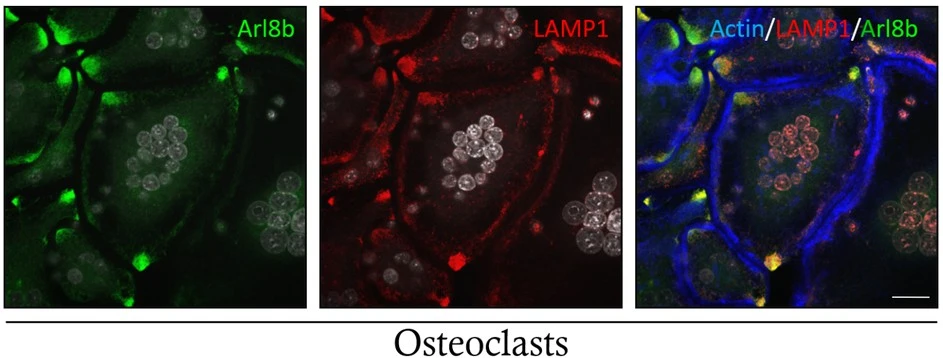
One of the most exciting moments during this research was generating giant multinucleated osteoclasts in culture and observing them under the microscope. Watching these large, highly specialized bone-resorbing cells form intricate actin rings and organize their lysosomes toward the resorbing surface was both visually striking and scientifically rewarding.
Another particularly memorable achievement was that the significance and visual impact of our findings were recognized by the journal (Molecular Biology of the Cell), which featured our study as a cover image. Seeing our work highlighted on the journal cover was both exciting and gratifying, and it reflected the broader importance of the study to the field of bone and lysosome biology.
Figure Caption: Representative confocal micrograph demonstrating Arl8b localization to LAMP1-positive lysosomal compartments adjacent to the actin ring in bone-resorbing osteoclasts.
Paper reference: Kshitiz Walia#, Gaurav Kumar#, Subhash B. Arya#, Priya Chouhan, Arshdeep Kaur, Medha Gupta and Amit Tuli. “RANKL-inducible Arl8b effector RUFY4 drives HOPS-mediated lysosomal maturation and trafficking in osteoclasts.” Molecular Biology of the Cell 2026. https://www.molbiolcell.org/doi/abs/10.1091/mbc.E25-08-0412?journalCode=mboc
New Book Launched – Molecules, Mentors & Mindsets: Building Indian Biopharma
Buy your copy today: https://biopatrika.com/science-society/book-molecules-mentors-mindsets-building-indian-biopharma-biocon/
Book Launch: Molecules, Mentors & Mindsets: Building Indian Biopharma | Biocon Focus