
IIT Gandhinagar’s Curiosity Conference 2026 explores how curiosity can inform novel educational and public-facing approaches
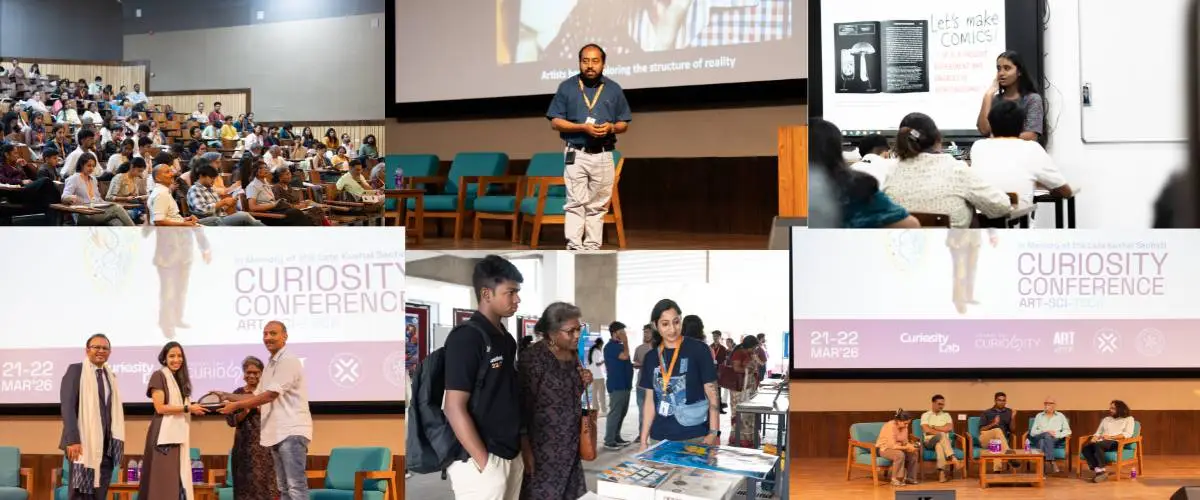
- Held on 21–22 March 2026, the third edition of the Curiosity Conference brought together scholars, scientists, artists, engineers, and school students to foster interdisciplinary dialogue.
- The event focused on curiosity as the foundation of innovation and the driver of human civilisation and knowledge systems.
- The speakers discussed how art, science, and technology should function as interconnected modes of thinking, and education should focus on exploration-driven learning.
Gandhinagar | March 23, 2026, : The Indian Institute of Technology Gandhinagar hosted the Curiosity Conference 2026 on March 21–22, which brought together art, science, and technology to reimagine learning through curiosity. This year’s theme, the intersection of art–sci–tech, invited reflections on how curiosity shapes flexible thinking, creativity, and problem-solving.
According to conference coordinators Dr Jaison Manjaly and Argha Manna, “Any knowledge system in the world would not have been possible without curiosity.” Dr Jaison is a Jasubhai Memorial Chair Professor, and Mr Manna is an artist-in-residence at the Department of Humanities and Social Science, IITGN. They believe that there is a need to move beyond rigid systems and cultivate curiosity and meaningful exploration across fields in education, something that is consistently emphasised by IITGN.
This conference honoured the contributions of late Kushal Sacheti, an alumnus of IIT Kanpur and the Founder and CEO of Galaxy USA Inc. and the Centre for Curiosity, New York, USA. A visionary entrepreneur, philanthropist, and advisor, he supported the Curiosity Lab at IITGN in many ways. His family, Poonam Sacheti and Astav Sacheti, shared how curiosity manifests in everyday tasks, ranging from why chapatis puff up to why metal cannot be placed in a microwave! These seemingly simple inquiries reflect the essence of scientific thinking.
Speakers underlined that curiosity is deeply personal yet universally essential. The keynote session by Sukant Saran explored how science and art are representations of reality that expand our consciousness and vision. Mr Saran is a physicist-turned-artist at the Tata Institute of Fundamental Research, Mumbai. He illustrated how scientific concepts, ranging from the intricacies of atoms to space-time theories, can be expressed artistically, inspiring curiosity.
Artist-in-residence at the Hampi Art Lab, Arvind Sundar’s keynote discussed mathematics, geometry, and infinity through artistic practice. From the golden ratio and never-ending patterns called fractals to impossible structures and origami, the work demonstrated how math can inspire visual forms. Contemporary artist Shailesh BR showed his works that translate complex theories into mechanised installations, exhibited globally at venues like the Daejeon Museum of Art. His talk underscored the power and potential of curiosity.
Interdisciplinary researcher Pratyasha Nath, with Associate Professor Jenia Mukherjee from IIT Kharagpur, highlighted the wonders of visual arts to “see the unseen” in science. Through their comics, ‘Fables of the Anthropocene,’ they showed how research can be translated into compelling, relatable, and curiosity-inducing narratives. Indian Medical Artist and Imaging Scientist Kaushik Ghosh underscored the importance of “jal, jungle, jameen” (water, forest, land) and their relationships with people as a relational way of “seeing” health. Dr Ghosh is associated with the Post Graduate Institute of Medical Education & Research, Chandigarh.
On the second day of the conference, founder and executive director of the ArtSparks Foundation, Nisha Nair, shared her journey of establishing creative learning labs in under-resourced government schools, marking the beginning of a new approach to education! She discussed initiatives like ‘Project Empower’ as valuable opportunities for girl students, where art takes the learning outside the confinements of classrooms. Dr Andrea Kantrowitz, Associate Professor, State University of New York, presented drawing as a fundamental cognitive tool that enables observation and discovery. Through an interactive exercise, the conference participants experienced how simple scribbles can lead to rich interpretations.
The virtual session by Dr Aditya Singh, postdoctoral researcher, University of Giessen, mentioned how effective learning depends on asking the right questions at the right time that can sustain curiosity. The session by physicist-turned-journalist Pallab Roygupta, a core member of IIT Madras’s ‘Shaastra’ magazine, showed profound connections between art and science. His examples included van Gogh’s ‘The Starry Night,’ reflecting concepts from fluid dynamics, and Jackson Pollock’s artwork, revealing interesting mathematical patterns.
The conference also included three panel discussions, which involved the keynote speakers and Dr Manjaly, along with Dr Neeldhara Misra, Dr Madhu Vadali, and Dr Ambika Aiyadurai, Associate Professors at the Departments of Computer Science and Engineering, Mechanical Engineering, and Humanities and Social Sciences, IITGN. Critical discussions included bringing science and engineering into artistic practices, crafting stories, and examining art as an essential component of curiosity and education. Workshops and a poster session, including hands-on activities and discussions, enabled participants to engage with interdisciplinary ideas and understand that curiosity is a necessity that equips us to navigate an ever-evolving world.
Explore more
🎤 Career – Real career stories and job profiles of life science professionals. Discover current opportunities for students and researchers.
💼 Jobs – The latest job openings and internship alerts across academia and industry.
🛠️ Services – Regulatory support, patent filing assistance, and career consulting services.