


Collagen PTM Heterogeneity in Human Adrenal Gland Revealed by Proteomics
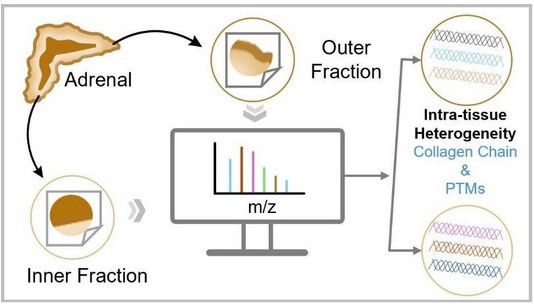
Research Summary: Here, we have examined site-specific post-translational modifications (PTMs) of collagen within the ECM of the human adrenal gland and uncovered notable intratissue heterogeneity, suggesting that small molecular changes can influence tissue structure and function.
Researcher Spotlight

Ashutosh Joshi and Ayush Nigam are co-first authors who performed this work at IIT Mandi. Ashutosh Joshi, PhD scholar, investigates the stereo-electronic effects of PTMs on collagen, while Ayush Nigam investigated the mass-spec based approach to delineate collagen PTM as an M. Tech Bioengineering scholar at IIT-Mandi. He will be joining University of Tübingen as an International Max Planck Research School (IMPRS) “From Molecules to Organisms” PhD scholar from summer 2026.
Linkedin: https://www.linkedin.com/in/ashutosh-joshi-921b74137/
Twitter: @j__ashutosh
Linkedin : https://www.linkedin.com/in/ayush-nigam-a5276018b/
Twitter : https://x.com/Ashnig09
Instagram : https://www.instagram.com/ayushh_nigam
Lab: Dr. Trayambak Basak, School of Biosciences and Bioengineering, Indian Institute of Technology Mandi
Lab social media: X- @trayambakbasak , Linkedin- Trayambak Basak
Co-Corresponding author: Dr. Bhaskar Mondal, School of Chemical Sciences, Indian Institute of Technology Mandi
Twitter/X- @CompCatLab
What was the core problem you aimed to solve with this research?
There is an abundance of the collagen family of proteins present in the extracellular matrix (ECM) of the adrenal gland, and they undergo a plethora of post-translational modifications (PTMs) during the biosynthesis. Prior studies showed differences in overall ECM protein levels between the adrenal Outer Fraction (OF: capsule + zona glomerulosa) and Inner Fraction (IF: zona fasciculata + zona reticularis). However, the variation in the collagen chains and site-specific PTMs has not been identified in both fractions. Our work addresses this gap by systematically identifying and quantifying collagen PTMs in zona glomerulosa compared to zone fasciculata and zona reticularis in Human Adrenal glands, highlighting the intra-tissue heterogeneity.
How did you go about solving this problem?
In the current work, we have reanalyzed the existing proteomic dataset obtained for human adrenal ECM with a collagen-focused workflow. We started with a two-step database search (MyriMatch) with a special focus on collagen PTMs known to occur in collagen molecules. As a result, we could identify numerous modified collagen peptides. In total, we found 963 4-hydroxyproline (4-HyP) sites, 201 3-hydroxyproline (3-HyP) sites, 105 hydroxylysine (HyK) sites, 17 galactosyl-HyK sites, and 35 glycosylated-galactosyl-HyK sites across 25 collagen chains. Subsequently, we mapped the identified sites to the respective collagen PTM maps. Post-identification, we calculated the occupancy values using MS1 intensities for site-specific quantification for several modifications of different collagen chains in the OF and IF. The rigorous quantification presented us the overall stable collagenome with notable intra-tissue specific heterogeneity across the fractions. Altogether, this allowed us to obtain detailed sequence maps of PTMs across all collagens, which we have presented in our ColPTMScape database ( https://colptmscape.iitmandi.ac.in/ ).
How would you explain your research outcomes (Key findings) to the non-scientific community?
We observed that collagen proteins in the adrenal gland carry distinct PTMs depending on their location. To put into ink of collagen as the scaffold of a building, which is further modified by attaching sticky labels (such as hydroxylation or sugar labels). While the adrenal gland appears homogeneous, we showed that these molecular tags vary between the OF and inner IF. For example, in one of the most abundant collagen chains (COL1A1), it was found to be labeled with more hydroxyl groups at specific lysine residues in the OF than in the IF, and in (COL4A2), more sugar tags were observed in the IF. This indicates that minor differences could affect the structural integrity of a tissue through collagen cross-links and physiological functions of each fraction.
In other words, we can say that collagen in one part of the adrenal gland is chemically “dressed” a bit differently than collagen in another part. This uneven “dressing” could possibly influence the hormone production and secretion in the adrenal gland.
“Here, we deciphered the “intra-tissue specific Collagen PTM heterogeneity” facilitating our goal to understand the structural & functional role of these PTMs.” – Dr. Trayambak Basak
What are the potential implications of your findings for the field and society?
This study provides the first comprehensive atlas of collagen PTMs in the human adrenal and demonstrates that the chemical composition of ECM is heterogeneous across regions within a tissue.
The manifold implications of the findings are:
- First, it indicates that remodeling and crosslinking processes differ between regions of the gland; distinct PTM patterns (for example, K862 site at COL1A1 chain) may influence the strength of collagen fibers and the cell-ECM and protein-protein (matrix) interactions.
- Second, we have observed especially high glycosylations in basement membrane collagens such as COL4A2, which might be associated with steroid hormone release regulation.
- By establishing this pipeline and dataset, future studies can explore disease-related changes, for example, whether adrenal tumors or fibrosis alter specific collagen PTMs.
- Finally, this work contributes to development of proteomic studies of highly modified proteins and open avenues to investigate the available heterogeneity in the collagenome of a tissue.
This study shows the intra-tissue specific variations, that even within a tissue there can be variations on collagen chain and site-specific collagen PTMs level. Overall, the findings set the stage for future researchers, for understanding how collagen biochemistry regulate ECM remodeling in adrenal function.
What was the exciting moment during your research?
One of the most thrilling aspects of this study is when we realized that a project which started out as a learning experience in Ayush’s proteomics journey evolved into a hypothesis-driven and a clear scientific question. Initially, the dataset served to get us more familiar with collagen proteomics and its challenges in terms of analyzing the data. However, when we started exploring the data in a systematic way, we found some interesting patterns in collagen PTMs.
The moment we went from mere exploration to formulating a specific scientific hypothesis was very important for the study’s success. This is when we proposed a novel hypothesis about intra-tissue specific differences in collagen PTMs. After that, the project took a decisive direction, where we refined our pipeline, validated results and structured the study into a coherent narrative. During this journey, a key “Aha!” experience came when we found that there was one particular site (COL1A1 K862) where hydroxylation was more abundant in the OF and the glycosylation was more abundant in the IF.
Paper reference: Ashutosh Joshi⊥, Ayush Nigam⊥, Jean Lucas Kremer, Claudimara Ferini Pacicco Lotfi, Bhaskar Mondal*, and Trayambak Basak*. Biochemistry. DOI: 10.1021/acs.biochem.6c00162 (⊥ : Equal contribution). Link: https://doi.org/10.1021/acs.biochem.6c00162
Explore more
🎤 Career – Real career stories and job profiles of life science professionals. Discover current opportunities for students and researchers.
💼 Jobs – The latest job openings and internship alerts across academia and industry.
🛠️ Services – Regulatory support, patent filing assistance, and career consulting services.