
IIT Gandhinagar Students Propose Peer-Led Preventive Healthcare Model
- IITGN students propose a peer-powered preventive healthcare network integrating Fit India and ABHA to close India’s 9-year Healthy Life Expectancy gap—an idea that resonates with ongoing global conversations around health, including World Health Day.
- With $38 billion lost annually to premature morbidity, the model positions preventive health as critical to national productivity and youth empowerment.
- By activating existing digital health infrastructure and mobilising student ‘Sathis,’ the initiative aims to embed healthy living into everyday community life.
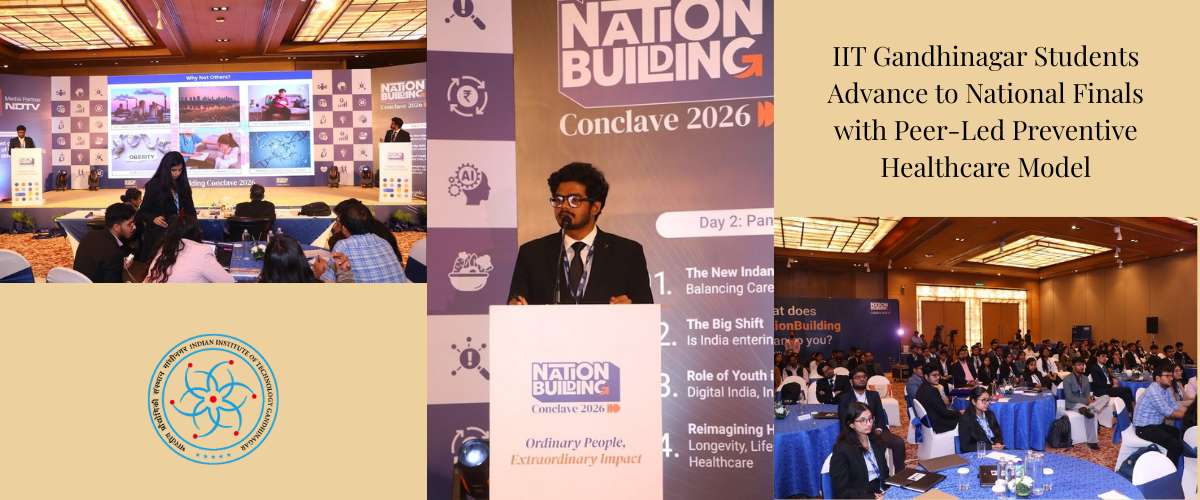
Gandhinagar | April 6, 2026: A student team from the Indian Institute of Technology Gandhinagar (IITGN) has advanced to the National Finals of the 3rd Nation Building Case Study Competition, India’s largest undergraduate challenge focused on reimagining the future of healthcare with 1,35,000+ students from 2500+ colleges across India participating across three editions. The team has presented an ambitious, youth-driven model aimed at transforming preventive healthcare in India. At a time when global conversations around health are taking centre stage with World Health Day, the initiative underscores the urgency of preventive healthcare in India.
Their proposal envisions a scalable digital wellness network designed to reduce India’s nine-year Healthy Life Expectancy gap, address the estimated $38 billion annual economic loss caused by premature morbidity among youth, and shift the country from a reactive ‘sick-care’ system to a culture of preventive health.
Team Halcyora, comprising Rupak Banerjee (Dual Major BTech in Artificial Intelligence and Mechanical Engineering) and Aakash Kushwah (BTech in Civil Engineering), developed what they call a ‘Peer-Powered Wellness Network.’ The idea stems from a critical national health statistic related to Healthy Life Expectancy (HALE), the average number of years a person is expected to live in good health, free from chronic illness or disability. In India, while the overall Life Expectancy stands at 67.3 years, the Healthy Life Expectancy is only 58.1 years. In effect, this gap means that Indians spend nearly nine years managing preventable diseases and long-term health conditions, highlighting the urgent need for a stronger preventive healthcare ecosystem.
“For us, the turning point was realising that our healthcare system is actually a sick-care system,” says Rupak. “We treat diseases after they appear instead of building a culture of total physical, mental, and social well-being.”
For him, this realisation is deeply personal. He recalls losing his grandfather, a smoker who was outwardly the picture of great health, to a sudden heart stroke at just 60. The experience challenged the belief that looking fit always means being healthy. This understanding deepened further when Rupak came across the statistic that nearly 35 per cent of adults in India consume tobacco in some form, leading to around 114 tobacco-related deaths every hour. “That’s when it truly felt urgent,” he says. “We don’t have time for slow policy cycles. We need a people-led movement.”
India’s health burden carries heavy economic consequences. Non-Communicable Diseases account for 61 per cent of total deaths, translating to over 58 lakh deaths annually. Out-of-Pocket Expenditure constitutes 39.4 per cent of total health spending, pushing nearly 7 per cent of Indians into poverty each year. Premature morbidity and mortality among adolescents alone lead to an estimated economic loss of $38.01 billion annually, about 1.3 per cent of India’s GDP. ‘Healthy youth equals a wealthy economy,’ the team explains. “Closing the health gap is not just a medical issue; it is a productivity imperative.”
At the heart of their model is integration within India’s existing digital health infrastructure. The model links the Fit India ecosystem with the 14-digit Ayushman Bharat Health Account (ABHA), a unique digital health ID that allows citizens to store medical records, access healthcare data, and share information with consent across providers. With more than 67 crore ABHA IDs already generated, the infrastructure is in place. The team calls for activating it more meaningfully.
Their framework operates on two interconnected layers. The first is a lifestyle layer where individuals track daily steps, sleep patterns, and tobacco-free milestones while earning gamified ‘Health Credits’ which can be utilised in subsidised public transport, insurance schemes, etc, like other developed countries. The second is a clinical layer that connects these habits to the ABHA system, enabling long-term tracking and consent-based sharing with healthcare providers. Rather than relying solely on medical professionals and further overburdening an already strained system—India’s doctor-to-population ratio stands at approximately 1:834—the model empowers youth volunteers called ‘Sathis’ as community wellness catalysts. These volunteers would help citizens generate ABHA IDs, establish Tobacco-Free Zones, and set up wellness booths on campuses and in neighbourhoods, normalising preventive health practices through peer influence.
To make preventive health visible and actionable, the team recommends introducing ‘HALE Impact Scores,’ simple red or green indicators on processed foods and tobacco products that reflect their long-term impact on healthy life years. They also suggest innovative ‘ABHA Wellness Bonds,’ financial instruments that link returns to measurable improvements in community health indicators, thereby tying public health outcomes to economic incentives.
Judges at the zonal stage appreciated the feasibility of the proposal and its ability to integrate seamlessly with existing frameworks such as Health and Wellness Centres, the Ayushman Bharat Digital Mission, and the National Health Mission. The plan includes a 5,000-node pilot, with an estimated capital expenditure of ₹40–78 crore, primarily allocated for digital integration, kiosks, and volunteer training. Its implementation would involve coordinated efforts between the Ministry of Health and Family Welfare, Fit India, and other allied national missions.
The roadmap for such a large-scale implementation was shaped by the specific collaborative ethos of the team’s home institution. The interdisciplinary culture at IITGN played a crucial role in shaping the idea. By blending perspectives from artificial intelligence, mechanical engineering, and civil engineering, the team approached public health as a socio-technical system rather than merely a medical issue. “IITGN pushes us to solve for India,” they reflect. ‘Solutions must be scalable, frugal, and culturally aligned.’
Team Halcyora remains focused on a singular vision: enabling India’s next generation to gain an extra decade of healthy living through individual-driven action. If implemented nationally, their proposal could mark a significant shift from reactive healthcare to a youth-led preventive movement embedded in daily life, where digital health identities and wellness scores become symbols not of illness, but of pride and proactive well-being.
Explore more
🎤 Career – Real career stories and job profiles of life science professionals. Discover current opportunities for students and researchers.
💼 Jobs – The latest job openings and internship alerts across academia and industry.
🛠️ Services – Regulatory support, patent filing assistance, and career consulting services.