

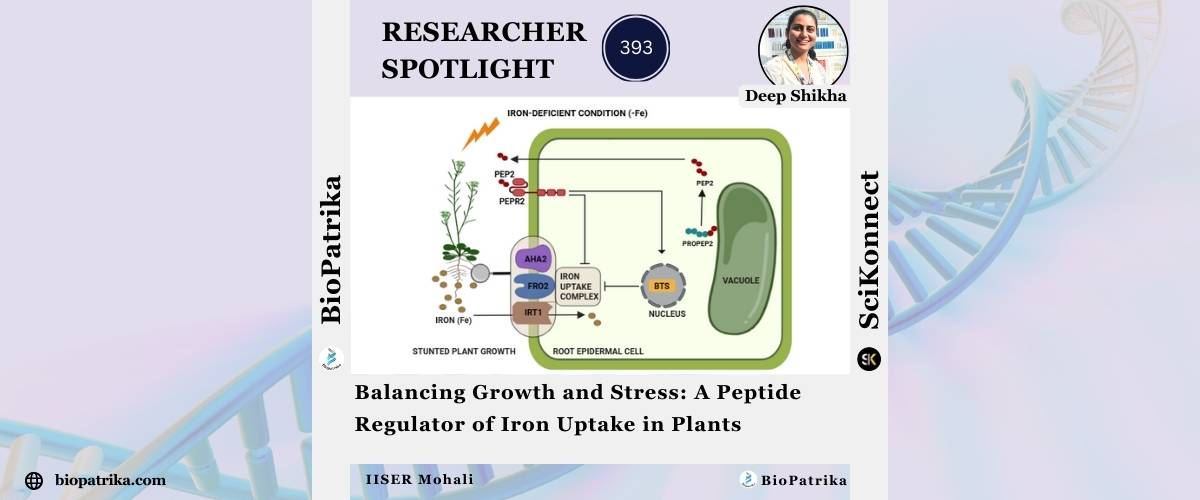
PEP2–PEPR2 Signaling Balances Iron Uptake and Growth in Plants
Research Summary: This study has uncovered a novel molecular module, the PEP2–PEPR2 signalling pathway that plays a key role in regulating plant responses to iron deficiency, integrating growth with iron acquisition. The findings advance our understanding of nutrient homeostasis, enabling strategies to improve crop yield and nutritional quality in iron-poor soils.
Researcher Spotlight
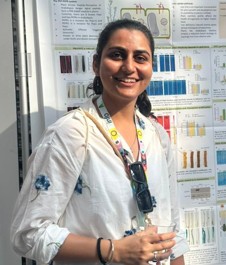
Deep Shikha is currently a PhD scholar in Dr. Santosh B Satbhai’s lab at Indian Institute of Science Education and Research (IISER) Mohali. Her research focuses on understanding the signaling pathways that modulate the root development in response to abiotic stresses.
Twitter: @Deep_Shikha_DS
Lab: Dr. Santosh B Satbhai, Indian Institute of Science Education and Research (IISER) Mohali
Twitter: @sbslab_IISERM
Web page: https://t.co/91xP4u7SCo
What was the core problem you aimed to solve with this research?
Plants form the base of terrestrial ecosystems, acting as primary producers that influence the availability of nutrients for all other organisms. Research over the years has shown that both macro- and micronutrients are essential for regulating plant growth and development. Ensuring an adequate nutrient supply is therefore fundamental for sustaining healthy ecosystems. Today, iron deficiency has emerged as a major agricultural concern. It not only limits plant growth and crop yield but also has serious consequences for human nutrition and health. According to WHO estimates, more than two billion people worldwide suffer from anemia, much of it linked to inadequate dietary iron. To address this hidden hunger, scientists are increasingly focusing on iron biofortification, using agronomic practices and biotechnology-based strategies to enhance iron availability in the edible parts of crops. Since iron fertilizers are costly and environmentally unsustainable, understanding how plants acquire and regulate iron has become a key area of research, one that holds promise for strengthening both agricultural productivity and global nutrition. Our study tackles how a DAMP (Damage Associated Molecular Patterns)-PRR (Pattern Recognition Receptors) module re-channelizes Fe signaling to trigger downstream pathways that determine the nature of plant stress responses. This molecular switch has previously gained attention for its role in plant immunity. This is the first report in which we have uncovered a crosslink between DAMP signaling and iron homeostasis.
How did you go about solving this problem?
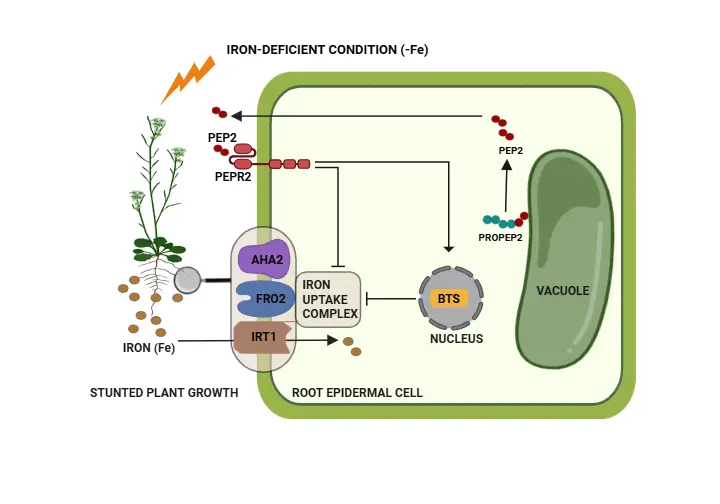
To explore the role of the DAMP-PRR signalling module in maintaining iron homeostasis, we first checked the expression levels of all eight candidate PEPs – a category of DAMP peptide, using Arabidopsis thaliana as model organism. Our RT-qPCR data and western blot results revealed that an endogenous DAMP molecule such as PROPEP2, was significantly induced at both transcriptional and translational levels under Fe deficiency. Furthermore to elucidate the underlying molecular mechanisms through which PEP2 mediate Fe deficiency stress responses, we created loss-of-function mutants and transgenic lines of the PEP2 precursor gene, PROPEP2; and performed phenotypic as well as physiological analysis using WT/Col-0 as control under Fe-deficient and Fe-sufficient conditions. Interestingly, these mutant plants were less sensitive to iron deficiency showing longer roots, stronger rhizosphere acidification, and higher iron accumulation than wild-type plants and overexpression plants of PROPEP2. We found that exogenous application of Pep2 (mature synthetic peptide of PROPEP2) drastically reduced overall plant growth with less chlorophyll content as compared to WT under Fe deficiency. This clearly revealed that both endogenous as well as exogenous PEP2 act as a regulatory switch of iron uptake, preventing excessive activation of iron deficiency responses.
A key breakthrough emerged when we examined the behaviour of genes involved in iron uptake. Analyses at both the transcript and protein levels revealed that plants exposed to synthetic PEP2 showed a marked suppression of IRT1 and FRO2, the core players in the iron-acquisition system. At the same time, PEP2 treatment led to increased expression of BTS, a well-established negative regulator of iron uptake. Together, these results provide strong evidence that PEP2 functions to actively dampen iron-uptake pathways.
We then set out to identify the receptor that recognizes the PEP2 peptide. Our results point to PEPR2 as the primary receptor that senses PEP2 and adjusts root growth under iron-deficient conditions. Working together, the PEP2–PEPR2 signalling pair shapes root architecture, enhances rhizosphere acidification, and fine-tunes iron uptake, ultimately influencing overall iron accumulation in plants. This study uncovers a previously unknown regulatory pathway through which plants balance growth with stress responses, allowing them to control iron uptake and adapt to nutrient-limited environments.
How would you explain your research outcomes (Key findings) to the non-scientific community?
Our research shows that plants have a smart “control switch” that helps them decide when to take up more iron from the soil and when to slow down. Iron is essential for plants, just like it is for humans, but taking up too much or too little can be harmful. We discovered that this switch is controlled by a tiny signalling molecule called PEP2 and its partner PEPR2. Earlier, this molecule was mainly known for helping plants respond to injury or stress, but we now show that it also helps plants manage how much iron they absorb. When the plant senses iron shortage, it normally activates many processes to pull more iron from the soil. But PEP2 acts like a brake system. It prevents the plant from overreacting and taking up excessive iron, helping maintain balance. This mechanism also influences how roots grow and how plants adapt to poor-nutrient soils. In simple terms, our study reveals that plants use this newly-identified PEP2-PEPR2 pathway to carefully balance growth and survival during nutrient stress, ensuring they stay healthy even when iron levels in soil are low.
What are the potential implications of your findings for the field and society?
Iron plays a central role in plant growth and metabolism, yet the mechanisms that control how plants sense, regulate, and adapt to iron deficiency remain only partially understood. Although several components of the iron-uptake machinery are known, the signalling pathways and molecular regulators that fine-tune iron homeostasis under stress conditions are less clear. Our study addresses this gap by uncovering how specific peptide-based signalling modules modulate iron acquisition and coordinate plant growth during iron-limited conditions. Instead of acting through many separate genes, we found a single signalling system, PEP2-PEPR2 that can influence several processes at once, including root growth, soil-level changes around the roots, and the amount of iron plants take up. This makes the system an important “control hub” for managing iron balance. Another interesting outcome of this work is that it links plant immunity with nutrition. Until now, molecules like PEP2 were thought to function mainly in defence against damage or infection. Discovering that they also regulate nutrient uptake reveals that plant signalling systems are far more interconnected than previously believed. Because this mechanism works at the signalling level rather than by permanently changing genes, it could potentially be adjusted or fine-tuned in crops. For example, farmers or breeders may one day be able to help crops absorb iron more efficiently in poor soils, improving yield and nutritional quality without overloading the plant. Although the work was done in Arabidopsis thaliana, a model plant, similar pathways are often shared across major crops such as wheat, maize, and rice. Since iron deficiency affects a large share of farmland worldwide, understanding and utilizing this signalling pathway could support more resilient crops and better nutrition for communities that depend on them.
What was the exciting moment during your research?
We were testing the hypothesis that Pep2 treatment could suppress iron uptake machinery via BTS, a master negative regulator of iron homeostasis. The most exciting moment in our research came when we discovered that, in WT, there was a reduction in FCR activity and expression of FRO2, IRT1 and ILR3 in response to Pep2 treatment under –Fe stress. On the contrary in bts-1 mutant plants, no such reduction in FCR activity as well as transcript levels of key genes was observed upon exogenous Pep2 application under –Fe. This finding supported our hypothesis that BTS is likely to play a crucial role in regulating Pep2-mediated suppression of Fe uptake. However, the mechanism behind this repression needs further investigation.
Paper reference: Danger-associated peptide modulates iron deficiency signaling and root growth in Arabidopsis. Deep Shikha, Ankit Kumar, Pooja Jakhar, Nelson Serre, Varsha Koolath, Swati Bhardwaj, Sanskar Mishra, Yvon Jaillais, Santosh B. Satbhai. https://doi.org/10.1111/nph.70792
Explore more
🎤 Career – Real career stories and job profiles of life science professionals. Discover current opportunities for students and researchers.
💼 Jobs – The latest job openings and internship alerts across academia and industry.
🛠️ Services – Regulatory support, patent filing assistance, and career consulting services.