



New Study Identifies Chromogranin B as a Key Regulator of Insulin Secretion and Brain Cell Communication
Research Summary: We identified Chromogranin B as a key cellular traffic controller that guides Insulin and neuropeptides like NPY and BDNF through cells; its loss may cause severe physiological dysfunction.
Researcher Spotlight
Chandramouli Mukherjee is a Ph.D. scholar in the Dr. Bhavani Shankar Sahu Lab, where his research focuses on understanding how resident proteins regulate cellular secretory pathways and how disruptions in these pathways affect physiology and disease.
Linkedin: https://www.linkedin.com/in/chandramouli-mukherjee-397414180/
Twitter: @MukherjeeCm_02
Instagram: cytomouli
Lab: Dr. Bhavani Shankar Sahu, National Brain Research Centre (NBRC)
Lab social media: https://sites.google.com/view/bsslab/home
What was the core problem you aimed to solve with this research? Cells constantly transport and release important molecules such as insulin, hormones, and brain-survival factors to maintain normal body function. However, how cells precisely organize and direct these molecules remains poorly understood. In our study, we identified a protein named Chromogranin B as a crucial “cellular traffic controller” that guides essential cargoes (like Insulin or Neuropeptides) through the cell’s internal transport system. We found that this protein plays a key role in ensuring that molecules like insulin, NPY, and BDNF are properly packaged and delivered for release so that it is able to perform its normal functions in the body. Without Chromogranin B, this transport system begins to fail. Important cellular cargo becomes trapped, cellular stress increases, and communication between cells becomes severely disrupted. Brain and hormone-secreting cells particularly struggle to function efficiently in its absence. We also discovered that this disruption affects the machinery required for proper signal release from cells. This finding changes the previous understanding of Chromogranin B, showing that it is far more important than previously believed. Rather than acting as a passive component, it functions as a master regulator of cellular communication. Our work provides new insight into how failures in this system could contribute to neurological and metabolic disorders. These discoveries may help future research into diseases linked to defective hormone secretion and neuronal dysfunction.
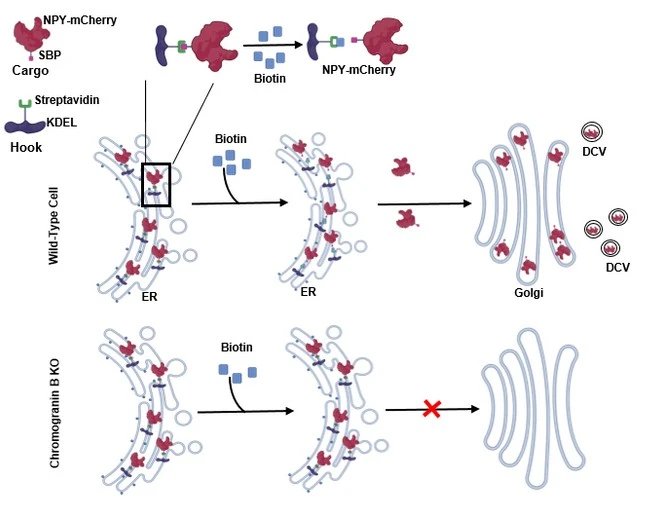
How did you go about solving this problem? To solve this long-standing problem, we used a combination of advanced genetic engineering, live-cell imaging, super-resolution microscopy, electron microscopy, and biochemical approaches. First, we removed the Chromogranin B protein from neuroendocrine cells and mouse models using the CRISPR-Cas9 gene editing system. This allowed us to directly observe what happens inside cells when this protein is missing. We then tracked important cargo molecules such as Neuropeptide Y (an important cargo that regulates functions like appetite and energy balance of the body, cardiovascular functions, regulate mood) in real time using fluorescent live-cell imaging. By visualizing these molecules inside living cells, we discovered that cargo transport became severely disrupted without Chromogranin B.
To further investigate the defect, we used high-resolution electron microscopy to examine the ultrastructure of the packets that contain those cargoes, namely secretory vesicles. This revealed that the vesicles became smaller, poorly organised, and failed to position correctly for release. We also used advanced trafficking assays to follow how cargo moves through different cellular compartments, particularly the endoplasmic reticulum and Golgi apparatus. These experiments showed that cargoes failed to properly enter and move through the cell’s secretory pathway in the absence of Chromogranin B.
Finally, by reintroducing Chromogranin B back into defective cells, we were able to restore many of these functions, confirming that the observed defects were specifically caused by the loss of this protein. Together, these multidisciplinary approaches allowed us to uncover Chromogranin B as a master regulator of cellular cargo trafficking and secretion.
“Our research uncovers a pivotal player in secretory pathways, forging a connection between insulin release and Neurodegeneration: a breakthrough with huge clinical significance.” – Dr. Bhavani Shankar Sahu
How would you explain your research outcomes (Key findings) to the non-scientific community? Our study discovered that cells use a hidden “traffic control system” to deliver important molecules like insulin and brain-survival signals to the right place at the right time. We identified Chromogranin B as a key controller of this system. Without it, the cell’s internal transport network becomes disorganised, important cargo is stuck, and cells fail to release critical signals properly. This breakdown especially affects hormone-secreting and brain cells, which rely heavily on precise communication. We also found that the cell experiences severe stress when this system collapses. In simple terms, Chromogranin B acts like an air traffic controller inside cells, ensuring that vital molecular “packages” safely reach their destination. Our findings reveal an entirely new level of control behind how cells communicate and survive.
What are the potential implications of your findings for the field and society? This study helps us better understand how cells communicate and maintain healthy body functions. Since molecules like insulin and brain-survival signals are essential for controlling blood sugar, memory, mood, and neuronal health, failures in this system could contribute to serious diseases. Our findings may help scientists better understand disorders such as diabetes, neurodegenerative diseases, and certain psychiatric conditions, where cellular communication becomes impaired. By identifying Chromogranin B as a key controller of this process, the study opens new possibilities for developing therapies that restore proper cellular signaling. The work also highlights how even a small disruption inside cells can have widespread effects across the entire body. In the long term, this research could contribute to better treatments for diseases linked to defective hormone release and neuronal dysfunction. More broadly, the study improves our understanding of the fundamental biology that keeps cells and organs functioning properly. It also demonstrates how basic scientific discoveries can eventually shape future medical advances and improve human health.
What was the exciting moment during your research? The entire journey of this research was exciting for me. From brainstorming ideas during coffee table discussions to those small moments of realization, “Oh, that’s probably what is happening inside the cell!” every step felt rewarding. At the same time, there were many failed experiments, but those failures taught us perseverance and motivated us to keep going. Seeing our work accepted in the prestigious Journal of Cell Science was definitely a very special moment, but the pursuit itself was equally fulfilling.
If I had to choose one particularly exciting moment, it would be during our RUSH experiments. As we carefully analyzed the data, we suddenly realized that Chromogranin B might have a completely novel role that had not been understood before. That moment of connecting the observations and understanding what the cells were trying to tell us was incredibly satisfying and unforgettable.
Paper reference: Chromogranin B plays an essential role in post-endoplasmic reticulum sorting of dense-core vesicle cargo.
https://doi.org/10.1242/jcs.264703
New Book Launched – Molecules, Mentors & Mindsets: Building Indian Biopharma
Buy your copy today: https://biopatrika.com/science-society/book-molecules-mentors-mindsets-building-indian-biopharma-biocon/
Book Launch: Molecules, Mentors & Mindsets: Building Indian Biopharma | Biocon Focus