

Dendritic Injury and Repair: New Molecular Pathways in Neuron Regeneration Revealed
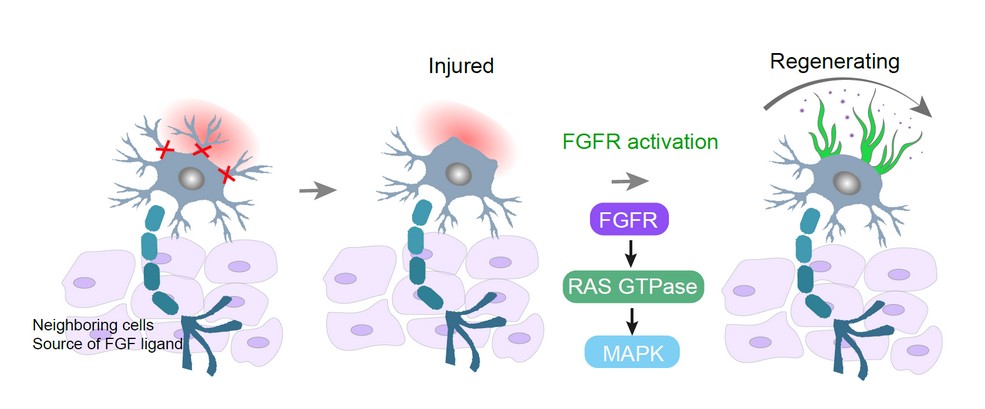
Research Summary: My research shows that different parts of neurons activate distinct repair programs after damage. It identifies key genes and a conserved signaling pathway that coordinates neuron–non neuronal cell communication during regeneration.
Researcher Spotlight
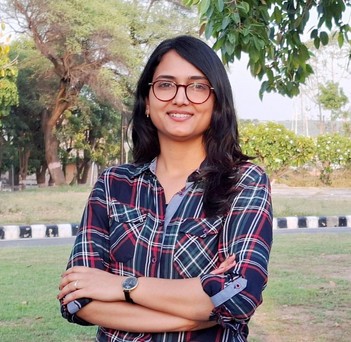
Dr. Pallavi Singh is currently working as a Research Scientist-I at the National Brain Research Centre, India. She is focused and persistent, approaching problems with curiosity and creativity, and draws strength from her close-knit family.
Linkedin: https://www.linkedin.com/in/pallavi-singh-667412360/
Twitter: (https://x.com/singhpallavi96)
Instagram: https://www.instagram.com/pallavi_singhrajput_
Lab: Dr. Anindya Ghosh Roy, National Brain Research Centre
Lab Twitter: https://x.com/GhoshRoyLab
Lab website: https://sites.google.com/view/theghoshroylab/home
Funding: Wellcome Trust India Alliance
What was the core problem you aimed to solve with this research?
How neurons respond to injury in a compartment specific manner? I was interested in how axons and dendrites two structurally and functionally distinct compartments activate different molecular pathways that ultimately determine whether neurons regenerate or undergo degeneration.
Neuronal repair is local, precise, and driven in a compartment specific manner.” – Dr. Anindya Ghosh Roy
How did you go about solving this problem?
I addressed this by utilizing a simpler model organism that enables in vivo visualization of neuronal injury and regeneration, along with large-scale genetic screening to systematically identify genes regulating repair processes. I combined a scalable neuronal injury model in C. elegans with large-scale genetics. First, I developed a high-throughput, laser-free method to reproducibly injure specific neuronal compartments, enabling systematic analysis at a scale not previously feasible. We then performed an unbiased genetic screen of ~825 genes to identify regulators of dendritic regeneration and degeneration. Finally, I integrated genetic, cellular, and functional analyses to map key signaling pathways and neuronal–non-neuronal cell interactions that control compartment specific neuronal repair.
How would you explain your research outcomes (Key findings) to the non-scientific community?
My research explores how nerve cells repair themselves after injury. We often think of neurons as single units, but in reality, different parts of the same neuron can respond to damage in very different ways. I found that these parts activate distinct “repair programs” , some promoting recovery while others lead to breakdown.
To understand this better, I developed a faster way to study nerve injury in a simple model system. This allowed me to examine many genes at once and identify those that control how neurons heal. From this, I discovered a key biological pathway that helps injured neurons regrow, and importantly, I found that neighboring support cells also play an active role in guiding this repair process.
Overall, the work shows that successful nerve repair is not driven by neurons alone; it depends on coordinated communication between neurons and surrounding cells, and that different parts of a neuron follow distinct rules when responding to injury.
What are the potential implications of your findings for the field and society?
For the field, this work provides a set of newly identified genes and signaling pathways that can serve as potential targets to enhance neuronal regeneration. It also introduces a scalable approach to studying neuronal repair, which can significantly accelerate discovery in this area.
For society, these insights bring us a step closer to developing strategies that could improve recovery after nerve injuries and neurodegenerative conditions, where the natural repair processes are often limited or fail.
What was the exciting moment during your research?
The most exciting moment in my research came during a late-night experiment when I was trying to solve a major bottleneck in my high-throughput study i.e. finding a faster way to induce neuronal injury. While existing laser-based methods were effective, they were very time consuming and expensive. During my exploration, I discovered that using a pulled glass capillary to gently twist the worm could reliably injure neurons and trigger a regenerative response comparable to the laser method, but nearly ten times faster. I was genuinely thrilled by this unexpected finding as this method was inexpensive, robust and reproducible. I knew this could help overcome key technical challenges in our neuronal regeneration studies. When I shared these results with my supervisor, Dr. Anindya Ghosh Roy, he was equally excited about this approach and its promise for accelerating our research.
Paper reference: Singh, M. Vasudevan,S. Dey,K. Selvarasu,S. Balakrishnan,D. Bassi, & A. Ghosh-Roy, The conserved fibroblast growth factor receptor–based signaling is required for dendrite regeneration, Proc. Natl. Acad. Sci. U.S.A. 123 (12) e2506886123, https://doi.org/10.1073/pnas.2506886123 (2026).
New Book Launched – Molecules, Mentors & Mindsets: Building Indian Biopharma
Buy your copy today: https://biopatrika.com/science-society/book-molecules-mentors-mindsets-building-indian-biopharma-biocon/
Book Launch: Molecules, Mentors & Mindsets: Building Indian Biopharma | Biocon Focus
Online Interactive Course on Immunology | Starts form June 2026 | Register Today
Online Interactive Course on Immunology | Starts form June 2026 | Register Today