


Research Summary: Expression of de novo designed 16 residue antimicrobial peptides, KG18 and VR18 conferred resistance in transgenic tobacco plants against the bacterial phytopathogen Pseudomonas syringae pv. tabaci that causes wildfire disease in tobacco without altering the plants’ innate immune response or metabolism.
Author Interview

Karishma Biswas is currently a Post-Doctoral Fellow at LV Prasad Eye Institute, Hyderabad working in collaboration with Prof. Anirban Bhunia at Bose Institute, Kolkata. This work is an integral part of her thesis work done at Bose Institute for her PhD degree entitled “Functional Characterization of Antimicrobial Peptides in Combatting Plant and Human Pathogens.” This work mainly focuses on studying the mechanism of action of the designed antimicrobial peptides against the plant pathogens and in vivo expression of these peptides in tobacco lines to develop resistance against plant disease- causing organisms.
Linkedin: www.linkedin.com/in/karishma-biswas-74920195
Institute: Prof. Anirban Bhunia, Bose Institute, Kolkata.
Website: https://sites.google.com/site/dranirbanbhuniaslab/home
What was the core problem you aimed to solve with this research?
In the Indian subcontinent, agriculture forms the backbone of both food security and the regional economy. However, the annual loss of crop yield due to diseases caused by plant pathogens poses significant challenges, deeply affecting farming communities and impacting the nation’s economic stability. The heavy reliance on chemical pesticides has further contributed to adverse effects on human health and the environment. In this study, we aim to address this concern by exploring the transgenic expression of KG18 and VR18 in tobacco plants and understanding the mechanism by which the inherent expression of these peptides provides protection to the plants from the deadly disease- causing organisms.
How did you go about solving this problem?
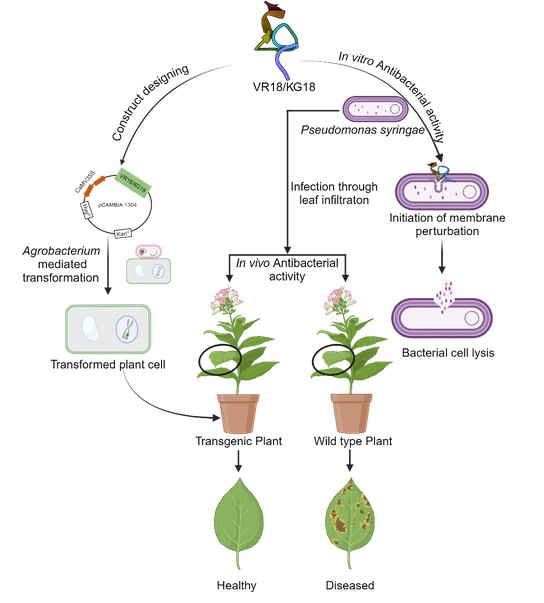
Our lab has been working with antimicrobial peptides for the last 15 years. Our expertise lies in structure- based de novo designing of peptides displaying broad spectrum activity against bacteria as well as fungal pathogens. Our previous studies demonstrated the effect of a 16- residue peptide, VG16KRKP, designed from Dengue virus fusion protein against a wide range of plant pathogens infecting rice, tomato, cabbage and tobacco. In this study, we delved deeper into how this antimicrobial peptide inhibited the growth of these pathogens. We hypothesized if the expression of these peptides in the plants could prevent the disease development in these plants. We adopted strategies in peptide designing to make the peptides plant protease stable, non- toxic to human and plant cells, as well as non- allergenic. Therefore, we designed two chimeric peptides, VR18 and KG18. Atomistic insight into the mechanism of action showed that these peptides fragmented the bacterial cell membrane and caused cell lysis. In plants, expression of these peptides delayed the disease progression and no disease symptoms were observed. We then investigated if the peptides interfered with the innate defense response of the plants on genetic level as well as the effect on the plant metabolism. To our surprise, the peptides did not alter these mechanisms and operated through an adaptive response in the transgenic plants.
How would you explain your research outcomes (Key findings) to the non-scientific community?
Agriculture is an integral part of the nation’s economy with 47% of the total population depending primarily on agriculture for livelihoods. The Food and Agriculture Organization of the United Nations (FAO) have reported a global loss of 40% of the agriculture annually due to plant diseases in 2020, emphasizing the significance of safeguarding plant health in eradicating hunger, reducing poverty, preserving biodiversity, and fostering economic development. Moreover, the development of antibiotic resistance in most pathogens is more alarming as the reliance on chemical pesticides have increased dramatically to overcome the situation. These chemicals have caused several neurological disorders in humans and also contribute significantly to land and water pollution. Plant biotechnologists are working vigorously to address these issues. In this regard, our group adopted an alternate strategy to express antimicrobial peptides, a probable substitute to conventional antibiotics in plants. Expression of these peptides in the plants can participate in the plant’s acquired immune response system and fight the pathogen invasion and hence the following infection. Moreover, the expression of these peptides does not alter the plant morphology and the innate defense system. This breakthrough study can be explored further for crop management reducing the socio- economic burden.
What are the potential implications of your findings for the field and society?
Our research is a proof of concept that directs the application of synthetically designed peptides in crop management. Application of this strategy in commercial crops will not only improve plant health but also reduce the burden on the economy caused by crop loss. Thousands of farmers lose their lives due to the losses they face for reduction in crop yield. Our study can pave the way to overcome these adverse situations. This study may be effective in improving food security globally. Reduction in the reliance on chemical pesticides will contribute significantly to improving human health as well as being environmentally detrimental.
What was the exciting moment during your research?
Our group has been performing basic research in the field of antimicrobial peptides and amyloids. We have always been aspiring to do translational research that could benefit society and can contribute to the nation’s well-being. Being a group specializing in Biophysics, taking up a project involving plant biology was challenging and equally exciting. We wrote a grant proposal and received the Indo- Sweden Research Grant (DST/INT/SWD/VR/P-02/2016), which motivated us that we were in the right direction. After pursuing my MSc degree in Biotechnology, I was looking for research opportunities in my field of study. I was immediately interested in this project and joined as a Junior Research Fellow funded by the grant. Based on our progress, we applied and received funding from the Science and Engineering Research Board (File No. EMR/2017/003457). Being funded by two reputed research bodies was not only motivational but also urged us to work hard in achieving the target.
Our first level of excitement was when we observed the callus carrying the construct with our peptides. However, we were very apprehensive about the differentiation of the callus into a full- grown plant. Tobacco plants take time to grow and with every passing day our expectations grow simultaneously. Our excitement peaked when we infected the transgenic plants with the bacteria and observed that there were no disease symptoms. Finally, we were content when our work was recognized and accepted for publication in a reputed peer- reviewed plant biology journal. It was our years of hardship that finally culminated into something eventful.
Paper Reference: Biswas K, Mitra S, Roy D, Roy S, Sarkar D, Son DH, Das R, Roy A, Senapati D, Ilyas H, Harikishore A, Biswas R, Chakrabarty S, Lee DK, Biswas I, Saha S, Kundu, Bhunia A (2025) Transgenic Tobacco Plants Expressing Synthetic Peptides: A Functional and Structural Analysis for Pathogen Resistance. Plant Biotechnology Journal 1-21.
Explore more
🎤 Career – Real career stories and job profiles of life science professionals. Discover current opportunities for students and researchers.
💼 Jobs – The latest job openings and internship alerts across academia and industry.
🛠️ Services – Regulatory support, patent filing assistance, and career consulting services.



Well done…..Keep up the good work……our blessings are always with you
Thanks for your support