
How Mycobacterial Lipids Drive Antibiotic Tolerance
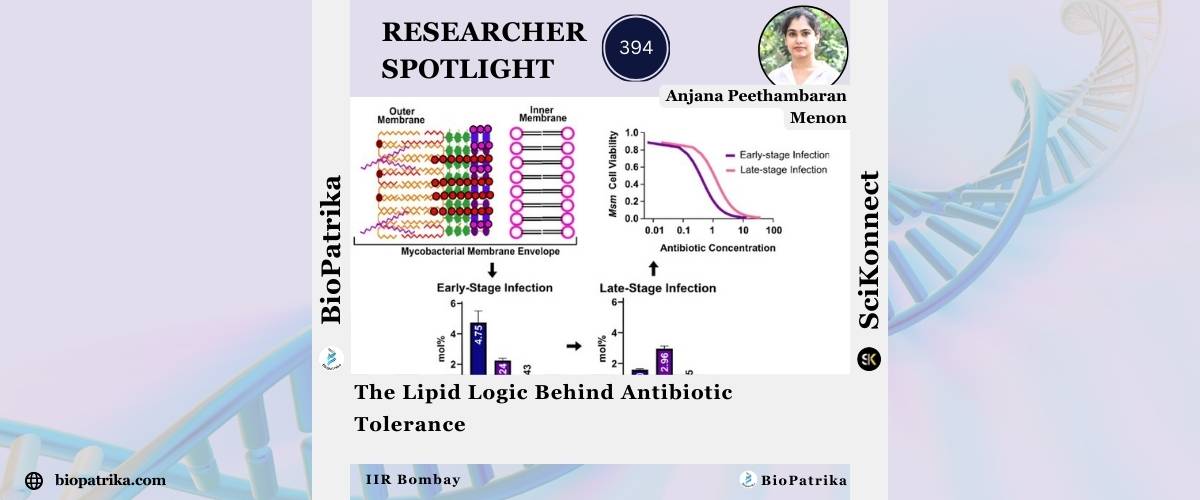
Research Summary: Our work reveals how Mycobacterial lipid remodelling and membrane dynamics alter envelope properties, reducing antibiotic penetration and promoting phenotypic tolerance, highlighting membranes as critical targets to overcome persistent infections.
Researcher Spotlight

Anjana Peethambaran Menon is a PhD scholar who embraces curiosity-driven research, observing nature’s intricate designs and letting scientific discovery unfold organically, rather than chasing predetermined outcomes.
Linkedin: www.linkedin.com/in/anjana-peethambaran-menon
Lab: Prof. Shobhna Kapoor, Indian Institute of Technology Bombay, Mumbai
Lab social media: https://x.com/MBCBLab_IITB,
Lab website: https://mbcbshk.wixsite.com/membrane-biophysics
What was the core problem you aimed to solve with this research? Our work addressed the limited mechanistic understanding of how lipidomic remodelling in Mycobacteria drives antibiotic tolerance. Previous studies in this field have not comprehensively examined lipid distributions with due consideration of lipid conformations, quantitative abundance, and their functional relevance to membrane dynamics and antibiotic susceptibility.

How did you go about solving this problem? We addressed this problem through a comprehensive lipidomic analysis that systematically accounted for lipid conformations, including variations in acyl chain length, degree of unsaturation, and head-group modifications, alongside quantitative evaluation of individual lipid subclasses. This represents a first-of-its-kind, in-depth assessment of membrane lipidomics in any species. By integrating system-level lipidomics with membrane biophysics, the study elucidated how dynamic lipid remodelling alters membrane organization, permeability, and antibiotic access, thereby enabling non-genetic survival under antibiotic stress.
How would you explain your research outcomes (Key findings) to the non-scientific community?
We found that Mycobacteria can survive antibiotic treatment at different stages of infection by changing the “fatty layers” that form their outer covering, rather than by becoming genetically resistant. As the infection progresses, the bacteria reorganize the types and amounts of fats in their membrane, making it thicker and harder for antibiotics to pass through. As a result, antibiotics become less effective, especially at later stages of infection.
Importantly, this survival strategy may not involve genetic mutation. Instead, the bacteria temporarily adapt their protective barrier to withstand treatment. Our findings show that the bacterial outer layer itself plays an active role in reducing antibiotic effectiveness, highlighting the need for future treatments that target these changes alongside conventional antibiotics.
“Antibiotic tolerance in Mycobacteria arises from lipid-driven membrane adaptations, pointing to novel strategies for effective treatment.” — Prof. Shobhna Kapoor
What are the potential implications of your findings for the field and society?
For the scientific field, our work shifts the focus from genetic resistance alone to the bacterial membrane as a dynamic and active driver of antibiotic tolerance. By demonstrating that systematic lipid remodelling and membrane reorganization can limit antibiotic entry without genetic mutation, the study highlights membrane lipidomics as a critical, yet underexplored, layer of antimicrobial response. This opens new research directions aimed at membrane-targeted therapies, improved drug design with better membrane penetration, and the use of lipidomic signatures as markers of tolerance or treatment response.
For society, these insights help explain why antibiotics sometimes fail even when bacteria are not genetically resistant, a major challenge in treating persistent infections such as tuberculosis. Understanding this adaptive, reversible tolerance mechanism can inform the development of more effective combination therapies that prevent bacteria from shielding themselves, potentially shortening treatment duration, reducing relapse rates, and limiting the emergence of true drug resistance.
What was the exciting moment during your research?
The most exciting moment of the research was recognizing that lipids are not merely static structural components, but that their conformational features can be directly used to infer membrane dynamics. When systematic changes in lipid chain length, degree of unsaturation, and head-group composition consistently aligned with alterations in membrane behaviour under antibiotic stress, it became clear that lipid conformations could serve as a powerful descriptor of membrane organization. This realization was particularly significant because such an approach had not been previously applied to study Mycobacterial membranes, marking a key conceptual advance in understanding antibiotic tolerance.
Paper reference: Menon AP, Lee TH, Aguilar MI, Kapoor S. Decoding the role of mycobacterial lipid remodelling and membrane dynamics in antibiotic tolerance. Chemical Science. 2024;15(45):19084-93. https://pubs.rsc.org/en/content/articlehtml/2024/sc/d4sc06618a
Explore more
🎤 Career – Real career stories and job profiles of life science professionals. Discover current opportunities for students and researchers.
💼 Jobs – The latest job openings and internship alerts across academia and industry.
🛠️ Services – Regulatory support, patent filing assistance, and career consulting services.