

Scientists Identify a Distinct Form of Inflammatory Bowel Disease Driven by Immune System Autoantibodies
Discovery links a long-known genetic risk factor to a specific disease mechanism and opens the door to targeted treatment
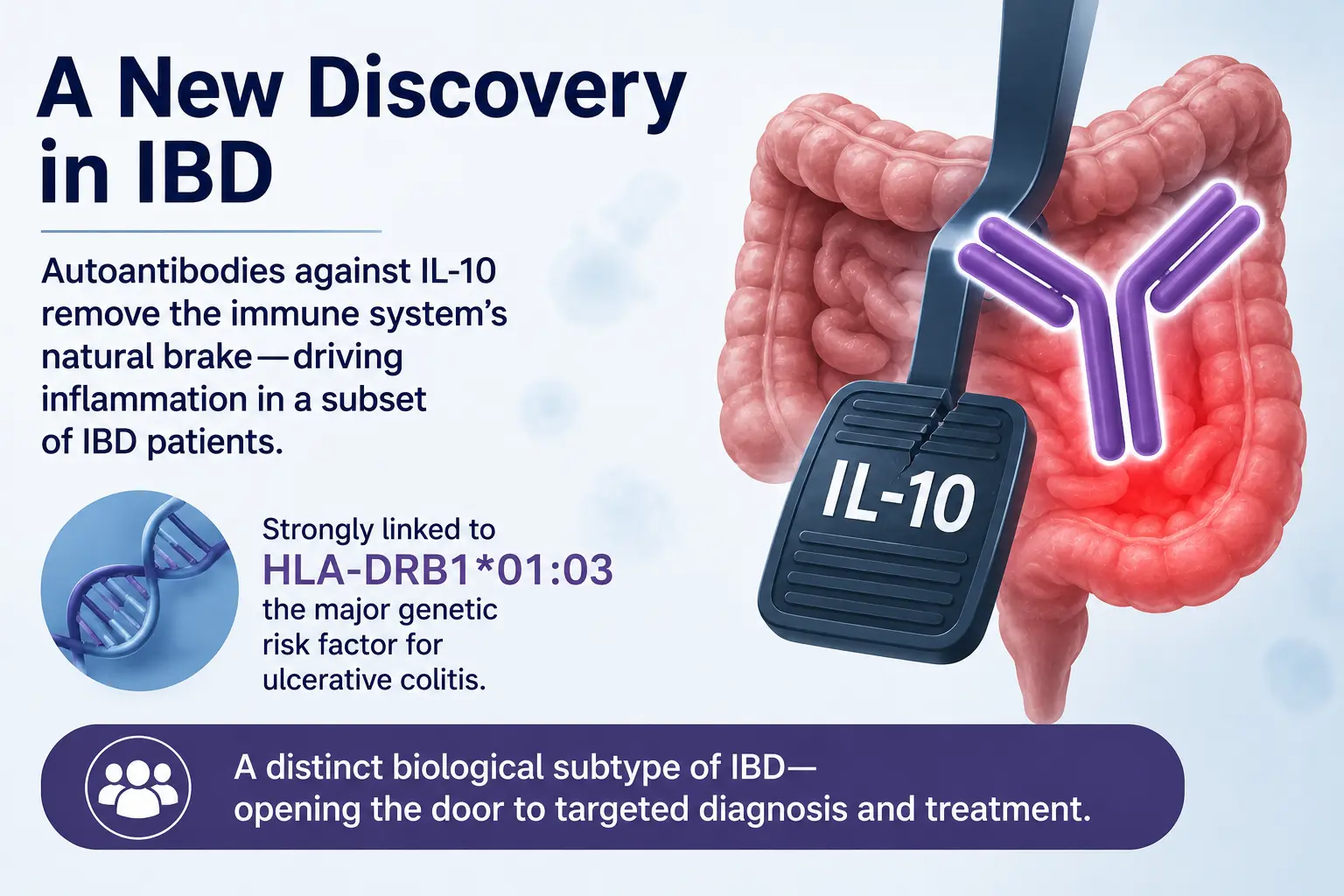
Researchers have uncovered what may be one of the most important advances in inflammatory bowel disease (IBD) research in decades: a biologically distinct subgroup of patients whose disease is driven by autoantibodies that disable one of the body’s most important anti-inflammatory pathways.
The study, published in the New England Journal of Medicine, analyzed more than 4,900 patients with IBD and identified a subgroup carrying neutralizing autoantibodies against interleukin-10 (IL-10), a key immune-regulating molecule that normally acts as a brake on inflammation.
The findings also solve a long-standing mystery in IBD genetics by revealing how one of the strongest known genetic risk factors for ulcerative colitis contributes to disease development.
Turning Off the Immune System’s Natural Brake
Inflammatory bowel disease, which includes Crohn’s disease and ulcerative colitis, affects millions of people worldwide and is characterized by chronic inflammation of the digestive tract.
For decades, researchers have known that IL-10 plays a crucial role in controlling inflammation. Rare inherited mutations affecting IL-10 signaling can cause severe forms of inflammatory bowel disease in young children, highlighting the pathway’s importance.
The new study shows that a similar effect can occur in adults through a completely different mechanism.
Researchers discovered that approximately 3.5% of patients with IBD carried autoantibodies capable of neutralizing IL-10. These antibodies were absent in more than 1,000 healthy controls.
By blocking IL-10 activity, the autoantibodies effectively remove one of the immune system’s key regulatory mechanisms, allowing inflammation to continue unchecked.
Laboratory experiments showed that patients with these antibodies exhibited exaggerated inflammatory responses and reduced functional IL-10 signaling, providing direct evidence that the autoantibodies are biologically active and disease-relevant.
Solving a 30-Year Genetic Mystery
The study also revealed a striking genetic association.
Patients carrying the autoantibodies were far more likely to possess a specific genetic variant known as HLA-DRB1*01:03, one of the strongest known genetic risk factors for ulcerative colitis.
The connection is particularly significant because this genetic association was first identified by Oxford researchers nearly three decades ago, yet the biological mechanism linking the gene to disease remained unclear.
The new findings suggest that HLA-DRB1*01:03 predisposes individuals to develop immune responses against IL-10, ultimately leading to chronic intestinal inflammation.
“This study provides the missing link between a well-known genetic variant and a newly discovered autoimmune mechanism targeting interleukin-10,” said Professor Holm Uhlig of the University of Oxford, one of the study’s senior authors.
Not One Disease, But Many
The discovery reinforces a growing view among researchers that inflammatory bowel disease is not a single condition but rather a collection of biologically distinct disorders that produce similar symptoms.
Current treatment strategies are largely based on clinical presentation and disease severity. However, patients often cycle through multiple therapies before finding an effective treatment, and many never achieve long-term disease control.
By identifying a specific subgroup of patients whose disease is driven by anti-IL-10 autoantibodies, researchers believe it may become possible to tailor treatment based on the underlying biology of an individual’s disease.
“This is the most exciting discovery in a lifetime specializing in IBD,” said Professor Simon Travis, Professor of Clinical Gastroenterology at the University of Oxford. “It means that we can now identify a group where we know what is causing the disease, and that creates a real opportunity to change how we manage this disease.”
Toward Precision Medicine for IBD
The findings could have immediate clinical implications.
Researchers suggest that a blood test could be developed to identify patients carrying anti-IL-10 autoantibodies. Such testing would allow clinicians to rapidly recognize this distinct disease subtype and potentially direct patients toward more targeted therapeutic strategies.
Future treatments may focus on eliminating the autoantibodies themselves or targeting the immune cells responsible for producing them.
Given that IBD affects around half a million people in the United Kingdom alone, researchers estimate that between 15,000 and 20,000 patients could belong to this newly defined subgroup.
Early identification could reduce disease complications, improve patient outcomes, and potentially decrease reliance on long-term biologic therapies, repeated hospitalizations, and surgery.
Lessons from Rare Diseases
The discovery also highlights the value of studying rare genetic disorders.
More than a decade ago, researchers identified inherited defects in IL-10 signaling as a cause of severe early-onset inflammatory bowel disease in children. Later, scientists discovered two children whose disease was caused not by genetic mutations but by autoantibodies that blocked IL-10.
Those rare observations ultimately helped uncover a disease mechanism now shown to affect thousands of patients worldwide.
“This discovery shows how the study of rare inherited disorders can shed new light on common diseases,” said Professor Sophie Hambleton of Newcastle University.
A New Era for IBD Research
Although additional studies will be needed to determine how best to treat patients with anti-IL-10 autoantibodies, the findings represent an important step toward precision medicine in inflammatory bowel disease.
Rather than viewing IBD as a single disease requiring broadly similar treatments, researchers are increasingly uncovering distinct biological pathways that drive inflammation in different groups of patients.
For a subset of patients, the cause may now be clear: the immune system has turned against one of its own most important anti-inflammatory molecules.
Reference
Interleukin-10 Autoantibodies and HLA-DRB1*01:03 in Inflammatory Bowel Disease. New England Journal of Medicine (2026).