



Salmonella Uses Quorum Sensing to Adapt and Cause Infection
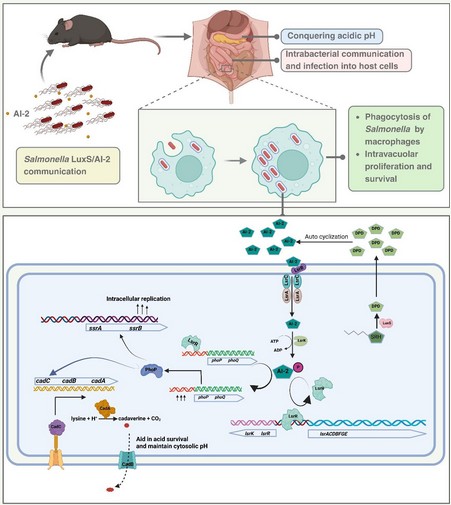
Research Summary: We uncovered a novel regulatory axis linking LuxS/AI-2 quorum sensing to acid stress adaptation, demonstrating that LsrR directly regulates PhoP/PhoQ, coordinating bacterial communication, stress responses, and Salmonella pathogenesis.
Researcher Spotlight
Dr. Anmol Singh is a microbiologist and IISc PhD graduate whose research on LuxS/AI-2 quorum sensing in Salmonella revealed key mechanisms governing bacterial communication, virulence, and host adaptation.
Linkedin- www.linkedin.com/in/anmol-singh-phd-654604267
Twitter- @anmolsingh82
Lab: Prof. Dipshikha Chakravortty, Indian Institute of Science, Bangalore
Lab social media: @DipaLab_IISc
What was the core problem you aimed to solve with this research?
Salmonella encounters highly acidic and hostile environments during infection, including the stomach, intestinal tract, and intracellular compartments of macrophages. While the LuxS/AI-2 quorum-sensing system is known to influence bacterial virulence, the molecular mechanisms by which it helps Salmonella adapt to these stressful conditions remained poorly understood. We aimed to determine whether AI-2 signaling contributes to acid stress survival and to identify the regulatory pathways connecting bacterial communication with stress adaptation, maintaining cytosolic pH, intracellular survival, and host colonization.
How did you go about solving this problem?
To address this question, we combined bacterial genetics, molecular biology, infection biology, and computational approaches. We generated Salmonella gene knockout strains in AI-2 production and sensing, and examined their ability to survive under acidic conditions and within macrophages. Using gene expression analyses, acid tolerance assays, and intracellular infection studies, we investigated how quorum sensing influences stress adaptation. We further employed structural modeling, molecular dynamics simulations, and DNA-binding assays to determine whether the quorum-sensing regulator LsrR directly controls the PhoP/PhoQ system. Finally, we validated our findings using mouse infection models to assess the contribution of AI-2 signaling to bacterial colonization and pathogenesis in vivo.
“This work uncovers a non-canonical regulatory mechanism by which LuxS/AI-2 quorum sensing modulates PhoP/PhoQ signaling, linking bacterial communication to stress adaptation and pathogenesis.” – Prof. Dipshikha Chakravortty
How would you explain your research outcomes (Key findings) to the non-scientific community?
Bacteria are not solitary organisms, they communicate with each other using chemical signals. We found that Salmonella uses one such signal, called AI-2, to detect stressful conditions and activate protective mechanisms. This communication helps the bacteria survive acidic environments, maintain bacterial cytosol pH, evade immune defenses, and establish infection. By uncovering how this signaling system controls key survival genes, our study reveals an important strategy that Salmonella uses to thrive within the host. Importantly, disrupting this communication system could represent a promising therapeutic approach for controlling Salmonella infections.
What are the potential implications of your findings for the field and society?
Our study uncovers a previously unknown link between bacterial communication and stress adaptation in Salmonella. By revealing how AI-2 quorum sensing regulates acid tolerance, intracellular survival, and host colonization, we provide new insights into the mechanisms that pathogens use to establish infection. These findings identify the LuxS/AI-2 signaling pathway as a potential therapeutic target. Rather than killing bacteria directly, disrupting their communication systems may reduce virulence and infection, offering an alternative strategy to combat bacterial diseases and potentially limit the development of antibiotic resistance.
What was the exciting moment during your research?
The most exciting moment was when we discovered that the quorum-sensing regulator LsrR directly binds to the phoP promoter. Until then, LsrR was primarily known for regulating the lsr operon. This finding revealed an unexpected connection between bacterial communication and stress-response pathways, providing a mechanistic explanation for how AI-2 signaling helps Salmonella adapt to hostile host environments and cause infection.
Paper reference: Singh A, Nair AV, Aroli S, Das S, Karmakar S, Rajmani RS, et al. (2026) LuxS/ AI-2 regulates phoP/phoQ by a non-canonical mechanism to enhance acid stress survival in Salmonella Typhimurium. PLoS Pathog 22(5): e1014244. https://doi.org/10.1371/journal. ppat.1014244. https://journals.plos.org/plospathogens/article?id=10.1371/journal.ppat.1014244
Human Gut Cells ‘Talk’ to Bacteria Using Their Own Chemical Language