


Scientists Discover a New Antibiotic Hidden in a 75-Year-Old Bacterial Workhorse
Revisiting a classic antibiotic producer reveals a new weapon against drug-resistant bacteria
At a time when antibiotic resistance is rapidly eroding the effectiveness of existing drugs, researchers have uncovered a promising new antibiotic from an unlikely source: a bacterium that has been studied for more than 75 years.
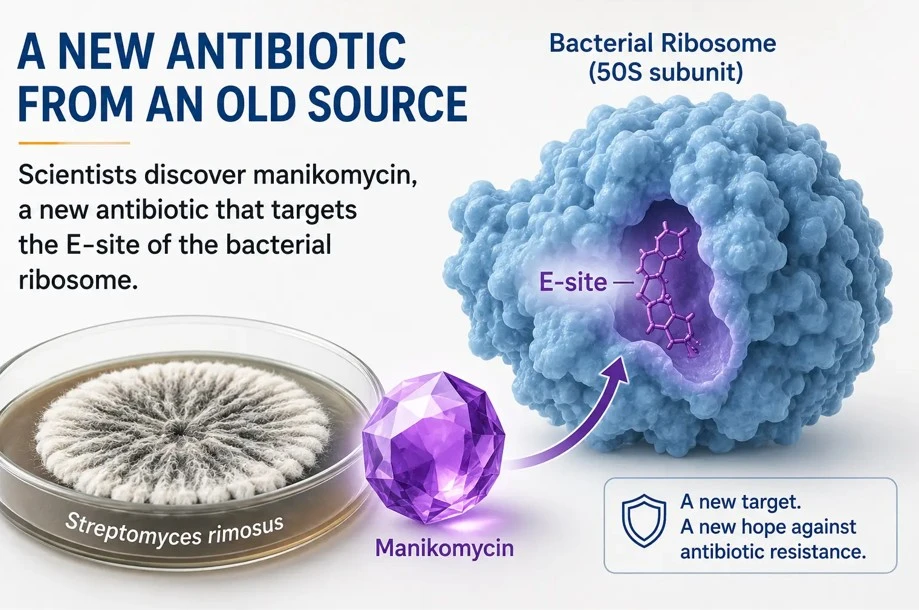
In a study published in Nature, scientists report the discovery of manikomycin, a previously unknown antibiotic produced by Streptomyces rimosus—the same soil bacterium that gave the world oxytetracycline, one of the most widely used antibiotics since the 1950s.
The finding challenges a long-held assumption in antibiotic discovery: that well-studied antibiotic-producing bacteria have little left to offer.
Instead, the study suggests that hidden chemical diversity may still exist within these microbial workhorses, waiting to be uncovered using more sophisticated analytical approaches.
Looking Beyond the Obvious
Most clinically important antibiotics discovered over the last century originated from naturally occurring compounds produced by bacteria and fungi. However, pharmaceutical researchers have increasingly moved away from natural-product screening because the same known molecules are often rediscovered repeatedly.
To overcome this challenge, researchers developed a fractionation strategy specifically designed to identify overlooked minor compounds that are normally masked by abundant, well-known antibiotics.
When the team applied this approach to cultures of Streptomyces rimosus, they expected to find oxytetracycline and related compounds.
Instead, they discovered an entirely new family of cyclic peptide antibiotics that they named manikomycins, after the Hindi and Punjabi word mani, meaning a precious gemstone.
A New Antibiotic Scaffold
Manikomycins belong to a rare class of molecules known as cyclic depsipeptides and possess an unusual chemical architecture.
The most abundant member, Manikomycin A, contains multiple D-amino acids—mirror-image versions of the amino acids commonly found in proteins—as well as unusual building blocks such as ornithine.
Genetic analysis revealed that the compound is assembled by a non-ribosomal peptide synthetase system, a specialized molecular assembly line capable of producing highly complex natural products.
Importantly, the structure represents an entirely new antibiotic scaffold, expanding the chemical space available for future antibiotic development.
A New Target on the Ribosome
Perhaps the most exciting aspect of the discovery is how the antibiotic works.
Many antibiotics kill bacteria by interfering with the ribosome, the molecular machine responsible for protein synthesis. However, most currently available ribosome-targeting antibiotics bind to sites that have already been extensively exploited, leading to widespread resistance.
Manikomycin takes a different approach.
Using biochemical studies, genetic experiments, and high-resolution cryo-electron microscopy, researchers found that the antibiotic binds to the E-site of the bacterial ribosome’s large subunit.
This site plays an important role in the movement of transfer RNAs (tRNAs) during protein synthesis but has remained largely unexplored as an antibacterial target.
By occupying this pocket, manikomycin blocks the entry of tRNA molecules into the E-site, disrupting the translocation process required for bacterial protein production.
To the researchers’ knowledge, manikomycin is the first antibiotic ever identified that specifically targets this region of the bacterial ribosome.
Why This Matters
The E-site differs significantly between bacterial and human ribosomes, giving manikomycin an important advantage.
Laboratory experiments showed that the compound has minimal effects on mammalian protein synthesis and does not exhibit toxicity toward cultured mammalian cells.
Equally important, existing ribosome-based resistance mechanisms found in clinical bacterial isolates do not protect against manikomycin.
The antibiotic also demonstrated activity against several multidrug-resistant Gram-negative pathogens, a group of bacteria that pose some of the greatest challenges in modern medicine.
“Because manikomycin targets a previously unexplored site on the bacterial ribosome, none of the known resistance mechanisms affecting currently used ribosomal antibiotics appear to block its activity,” the researchers noted.
Not Ready for the Clinic Yet
Despite its promise, manikomycin is still far from becoming a medicine.
Although the compound was well tolerated in mice, initial infection studies did not show therapeutic efficacy. Subsequent pharmacokinetic analysis revealed the likely reason: the molecule is rapidly cleared from the bloodstream and fails to achieve sufficient drug exposure.
The researchers believe these challenges can potentially be addressed through medicinal chemistry optimization.
The molecule’s structure appears amenable to modification, raising the possibility of improving its uptake, stability, and pharmacokinetic properties while retaining antibacterial activity.
Mining Old Microbes for New Medicines
Perhaps the broader lesson from the study is methodological rather than chemical.
Streptomyces rimosus has been investigated extensively since the mid-20th century and is considered one of the best-characterized antibiotic-producing bacteria in history.
Yet a completely new antibiotic remained hidden within it for decades.
The discovery suggests that many well-known microbial strains may still harbor unexplored compounds obscured by more abundant natural products.
As antibiotic resistance continues to rise worldwide, researchers may not need to search entirely new environments for the next generation of antibiotics. Some of the most promising candidates could already be sitting in laboratory collections, waiting to be rediscovered.
Reference
A natural depsipeptide antibiotic binds the E-site of the bacterial ribosome. Nature (2026).
DOI: 10.1038/s41586-026-10589-2