



Bendless-Mediated Ubiquitination Controls Blood Cell Development in Drosophila
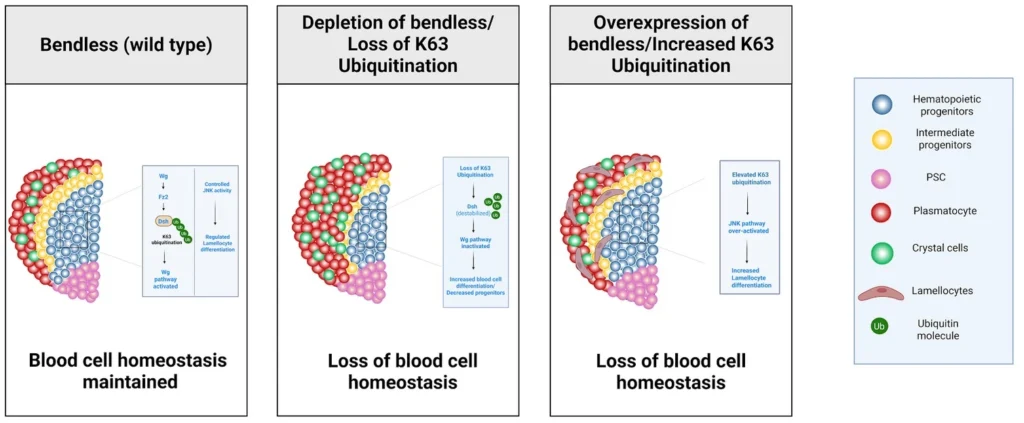
Research Summary: We show that Bendless-dependent K63 ubiquitination maintains lymph gland progenitors through Wingless signalling, while excess K63 activity activates JNK and drives lamellocyte differentiation.
Researcher Spotlight
Yash Sheregare studies ubiquitin-mediated signaling in Drosophila hematopoiesis, focusing on how progenitor maintenance and immune differentiation are balanced during development.
Linked In : https://www.linkedin.com/in/yash-sheregare2804
Twitter : https://x.com/YashSheregare1
Instagram : https://www.instagram.com/yash_sheregare
Lab: Dr. Rohan Khadilkar, Stem Cell & Tissue Homeostasis Lab, Cancer Research Institute, ACTREC
Lab website: https://scthlab.wixstudio.com/scthlab
What was the core problem you aimed to solve with this research?
The core problem that we aimed to solve with this work was to understand the role of K48 Polyubiquitination mediated by Bendless ( a E2 Ubiquitin conjugating enzyme) and its functional role in Drosophila larval blood cell hematopoiesis in the larval hematopoietic organ called as the Lymph gland. To understand, how K63-linked ubiquitination controls normal blood cell development in the Drosophila lymph gland was the central question we addressed.
How did you go about solving this problem?
Part of the research work involved using Drosophila genetic tools like the Gal4-UAS system to knockdown and or overexpress the key molecule Bendless in tissues specific manner in various subsets of larval lymph gland (hematopoietic organ) and understands how it affects the cell population dynamics of hemocytes, plasmatocytes, crystal cells and lamellocytes. We used whole fly mutants for Bendless and knock down and over-expression constructs made against Bendless and used Gal4 lines specific for different pools of cell populations in Lymph gland like Niche, Progenitors, differentiated cells and so on to understand how it affects homeostasis. Literature surveys helped us figure out how ubiquitination could affect various signaling pathways which lead us to understand how it could regulate key developmental signaling pathways like Wg and JNK.
“Bendless acts as a signaling switchboard that keeps progenitors balanced and triggers emergency hematopoiesis when needed.” – Dr. Rohan Khadilkar
How would you explain your research outcomes (Key findings) to the non-scientific community?
When it comes to proteins, I am sure that anyone who knows how important they are in various contexts in life. Proteins are vital in life, but few think about how cells regulate them. I think our research could be a mini lesson for anyone to learn and appreciate the regulation of proteins by ubiquitination and its role in developmental context. Ubiquitination is a protein-tagging system where different ubiquitin tags give different instructions — such as recycling, movement, repair, or immune signaling — helping cells stay organized and healthy. To explain to anyone, how a small evolutionary conserved protein called Ubiquitin can be associated with target proteins, can form different flavours of chains and mean different things to the cell. This research led to deciphering the role of Bendless,which is an enzyme that regulates Ubiquitination, in its absence it was affecting the localization of another key protein named Dsh which regulates the cell signaling and cell maintenance. While overexpressing Ben affected another signaling pathway namely JNK. In essence, too little Bendless lowers Wingless signals and drains progenitors; too much pushes stress signalling and makes emergency blood cells.
What are the potential implications of your findings for the field and society?
The study shows that ubiquitin tagging is not just for protein disposal but can fine-tune cell-fate decisions. This gives a new way to think about blood stem cell balance, immune stress responses, and possibly leukemia-linked signalling. For the field of Drosophila larval hematopoiesis, this study extends and supports finding of regulation of signaling in this tiny hematopoietic organ which is highly sensitive to environment and cellular signaling and how different signaling pathways can be regulated in a context specific manner..
What was the exciting moment during your research?
During the tenure of this project, the most exciting finding was when we appreciated that modulating Bendless by knocking down and overexpression led to changes in 2 key signaling pathways namely Wg signaling and JNK signaling. While knockdown Bendless, lead to affects in both expression of its receptor Fz2 and also its a key component of the signaling pathway, Dsh (Dishevelled). Dsh was known to be K63 polyubiquitinated in various developmental contexts in drosophila and mammals but its functional implications during Drosophila larval hematopoiesis was a question mark. Further, the most exciting moment was when my colleague Asfa Kamal also validated that restoring Wingless activity rescued the loss-of-progenitor phenotype, and when blocking JNK reversed the lamellocyte response. Those genetic rescues made the pathway logic feel complete.
Paper reference: Kamal A, Sheregare Y, Patkar C, et al. Bendless-mediated K63 ubiquitination modulates cellular signalling to regulate Drosophila hematopoiesis. Cell Communication and Signaling (2026). https://doi.org/10.1186/s12964-026-02887-z
New Book Launched – Molecules, Mentors & Mindsets: Building Indian Biopharma
Buy your copy today: https://biopatrika.com/science-society/book-molecules-mentors-mindsets-building-indian-biopharma-biocon/
Book Launch: Molecules, Mentors & Mindsets: Building Indian Biopharma | Biocon Focus