


Novel Silk Biomaterial Promotes Cartilage Regeneration in Osteoarthritis
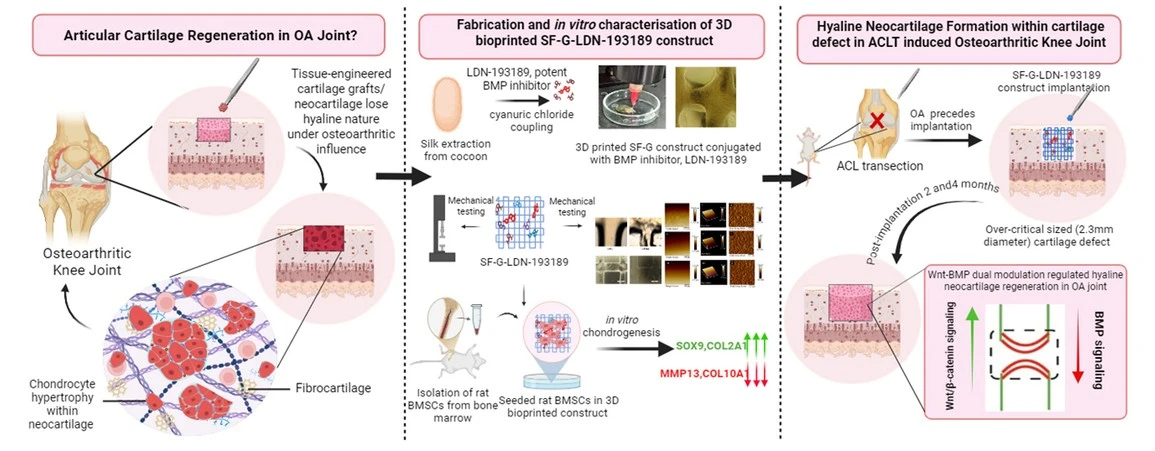
Research Summary: We reported the development of a novel silk fibroin-based biomaterial conjugated with a BMP signaling pathway inhibitor that regenerated the degraded cartilage in an osteoarthritic niche, a step closer to regenerative therapy for OA.
Researcher Spotlight
First author name: Sayeda Fauzia Iqbal, Nilotpal Majumder
Sayeda Fauzia Iqbal: Sayeda is a PhD scholar in the Department of Biological Sciences and Bioengineering at the Indian Institute of Technology Kanpur under the guidance of Prof. Amitabha Bandyopadhyay. She is deeply committed to the quest for cartilage regeneration therapies and to investigating the molecular mechanisms underlying them. Apart from research, she enjoys watching historical documentaries.
LinkedIn: https://www.linkedin.com/in/sayeda-fauzia-iqbal-6baba6156/?skipRedirect=true
ResearchGate: https://www.researchgate.net/profile/Sayeda-Iqbal
Lab: Prof. Amitabha Bandyopadhyay, Indian Institute of Technology Kanpur
Lab website: https://sites.google.com/view/ablab-iitk/home

Nilotpal Majumder: Nilotpal is a Ph.D. graduate from the Indian Institute of Technology Delhi under the guidance of Prof. Sourabh Ghosh. His thesis focused on developing chemically modified silk fibroin-based tissue-engineering platforms for immunoregenerative therapies in Osteoarthritis. He completed his B.Tech/M.Tech dual degree in Biotechnology from KIIT Deemed to be University, Bhubaneswar.
LinkedIn: https://www.linkedin.com/in/nilotpal-majumder-ph-d-30aaa7164/
Google Scholar: https://scholar.google.com/citations?hl=en&user=30T2clUAAAAJ
ResearchGate: https://www.researchgate.net/profile/Nilotpal-Majumder-2?ev=hdr_xprf
Lab: Prof. Sourabh Ghosh, Indian Institute of Technology Delhi
Lab website: https://web.iitd.ac.in/~sghosh08/
What was the core problem you aimed to solve with this research?
Osteoarthritis (OA) affects more than 500 million people worldwide, with its predicted burden increasing dramatically in the coming decade. Existing treatment modalities are limited to disease-modifying pharmacological agents aimed at pain management or surgical procedures (Unicompartmental or Total Knee Arthroplasty (TKA)) in extreme clinical scenarios. Apart from being expensive, TKA is often associated with serious deterioration of quality of life, with increased chances of infections and joint morbidity at the surgery site. Also, current tissue engineering strategies, such as microfracture and autologous chondrocyte implantation, have led to hypertrophy and a fibrocartilage phenotype when implanted in an osteoarthritic environment. Therefore, the primary objective should be to achieve permanent solutions, such as regenerating the degenerated articular cartilage at the inflamed joint site while immunomodulating the surrounding microenvironment.
How did you go about solving this problem?
The present study addresses the challenge by fabricating a chemically defined silk-based biomaterial (i.e. covalently conjugating the BMP signaling inhibitor LDN-193189 to silk fibroin) which supports the regeneration of articular cartilage within a severe OA-afflicted rat joint. It is hypothesized that by simultaneously upregulating pro-articular cartilage Wnt/β-catenin signaling, downregulating the pro-ossification BMP signaling pathway, and imparting immunomodulatory effects on the surrounding osteoarthritic niche. The inhibition of the BMP signaling pathway by our LDN-193189 silk fibroin gelatin 3D construct not only facilitated neo-cartilage formation but also demonstrated complete inhibition of key OA pathological drivers, including hypertrophic chondrocyte differentiation, fibrocartilage formation, and chronic inflammation. Thus, inspired by the tenets of developmental biology, our advanced tissue engineering strategy, utilizing an FDA-approved silk fibroin biomaterial, would serve as a stepping stone toward developing a permanent regenerative therapy for OA.
“Hundreds of materials have been shown to regenerate cartilage (in the short term), but none in the osteoarthritis context. Fauzia and Nilotpal built on our decade-long work to make it happen.” – Prof. Amitabha Bandyopadhyay, IIT Kanpur & Prof. Sourabh Ghosh, IIT Delhi
How would you explain your research outcomes (Key findings) to the non-scientific community?
Our team has developed a chemically modified biomaterial that can help regenerate the articular cartilage lost due to osteoarthritis. Our work stands as the world’s first commercially scalable, chemically defined biomaterial, demonstrating its potential to regenerate cartilage even in highly damaged arthritic joints. It can be preferred over total knee replacement surgery, which, most of the time, worsens joint mobility. This material is self-healing and does not need revision surgery. Once the cartilage regrows, the material dissolves completely, leaving healthy cartilage behind. It is well tolerated by the body and does not elicit an adverse immune response.
What are the potential implications of your findings for the field and society?
There are many biomaterials available that have been claimed to regenerate articular cartilage. However, none have been tested and proven effective when implanted in an osteoarthritic environment. Our study strengthens the idea that successful cartilage regeneration requires more than just a strong construct; it also requires immunomodulation and regulation of signaling pathways that drive cartilage repair and stall osteoarthritis progression. By combining silk fibroin-gelatin with sustained LDN-193189 release, our study shows that BMP inhibition can suppress hypertrophy, fibrocartilage formation, and inflammation while supporting articular cartilage regeneration in an osteoarthritic joint.
This work could have a significant impact on society by offering a permanent regenerative treatment strategy that helps repair damaged or lost cartilage rather than simply relieving symptoms. If successful in a human clinical trial, it may reduce pain, improve mobility and quality of life, and delay or even avoid the need for joint replacement surgery in people with chronic osteoarthritis, especially middle-aged individuals.
What was the exciting moment during your research?
We initially expected that a cell-laden construct would perform better at regenerating cartilage when implanted. However, contrary to our expectations, the acellular construct demonstrated superior effectiveness in promoting neocartilage formation. We observed that the cells responsible for ECM restoration were recruited from the host tissue rather than delivered within the scaffold. This led us to delve into whether, by providing only the right biological cues and sufficient mechanical support, the tissue could heal naturally.
Paper reference: Iqbal, S. F.#, Majumder, N.#, Kumar, B., Roy, C., Thaleshwari, S., Ghosh, S., & Bandyopadhyay, A. (2026). 3D Printed Silk Fibroin‐Gelatin Construct Targeting BMP Signaling for Articular Cartilage Regeneration Within a Full‐Thickness Cartilage Defect in a Surgically Induced Osteoarthritic Rat Knee Joint. Advanced Healthcare Materials, e71252. (#: equal contribution) Link: https://advanced.onlinelibrary.wiley.com/doi/10.1002/adhm.71252
Book Launch: Molecules, Mentors & Mindsets: Building Indian Biopharma | Biocon Focus