



K63 polyubiquitination: A molecular post-it note for signalling activation
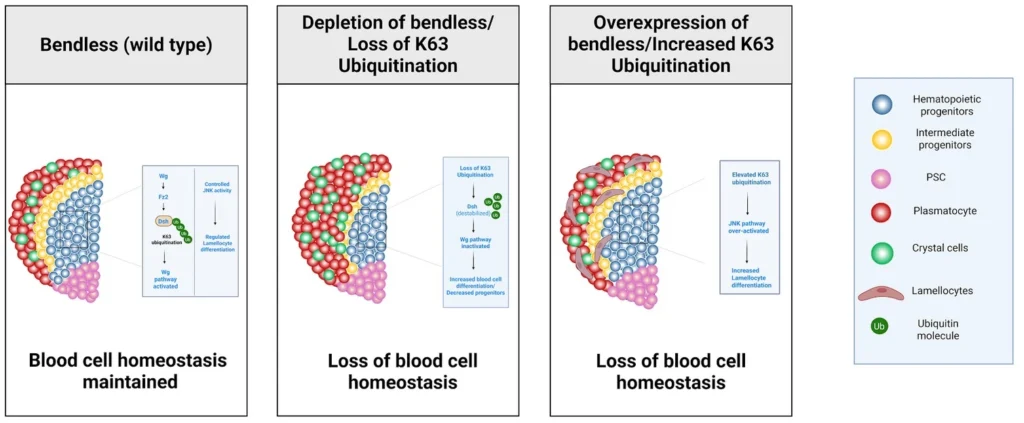
Research Summary: This study demonstrates that Bendless-mediated K63 polyubiquitination regulates key signaling pathways to preserve hematopoietic homeostasis in Drosophila, thereby ensuring an appropriate balance between progenitor maintenance and blood cell differentiation.
Researcher Spotlight
Asfa Kamal is a thoughtful, self-driven, and persistent researcher who values clarity, consistency, and growth in her work. She is regarded as a professional, cheerful and elegant lady who embraces growth and strives for excellence and is currently applying for PhD positions across the USA and Europe in RNA biology, stem cell biology, and neurobiology.
Linkedin: https://www.linkedin.com/in/asfa-kamal-9bb961406?
Twitter: Asfa Kamal 2 (@2_asfa) https://twitter.com/2_asfa?
Instagram: asfa_kamal_ https://www.instagram.com/asfa_kamal_?
Lab: Dr. Rohan Khadilkar, Stem Cell & Tissue Homeostasis Lab, Cancer Research Institute, ACTREC
Lab website: https://scthlab.wixstudio.com/scthlab
What was the core problem you aimed to solve with this research?
Ubiquitination is widely known in its role of targeting proteins for degradation; however, its non-degradative functions, especially K63-linked polyubiquitination are increasingly appreciated as critical regulators of cellular signaling. Despite this, the contribution of this specific modification on developmental processes like hematopoiesis has relatively remained underexplored.
In the context of Drosophila, the lymph gland serves as a well-established hematopoietic organ and provides an excellent model to study blood cell development and homeostasis. Although several signaling pathways governing hematopoiesis have been identified, the upstream mechanisms that fine-tune these pathways at the post-translational level remain poorly understood.
Against this backdrop, our central question in this study was: How does Bendless-mediated K63 polyubiquitination regulate signaling networks to maintain the balance between progenitor maintenance and differentiation during hematopoiesis?
How did you go about solving this problem?
To address this, we used the Drosophila lymph gland as an in vivo model system and focused on manipulating the function of Bendless, a conserved E2 ubiquitin-conjugating enzyme known to mediate K63-linked polyubiquitination.
We employed genetic strategies, including loss-of-function and targeted expression systems, to disrupt or modulate Bendless activity specifically within hematopoietic tissues. This enabled a direct assessment of its role in blood cell development.
Subsequently, we performed detailed phenotypic analyses using immunostaining and microscopy to evaluate changes in progenitor populations, differentiation patterns, and overall lymph gland architecture. In parallel, we analyzed alterations in key signaling pathways to examine how disruption of K63 polyubiquitination impacts intracellular signaling.
By integrating these approaches, we established a link between molecular perturbations in ubiquitination and developmental outcomes, especially the hematopoietic imbalance.
“K63 polyubiquitination is misregulated in leukemia and this study is an important step towards understanding its role in developmental hematopoiesis which was unexplored. “ – Dr. Rohan Khadilkar
How would you explain your research outcomes (key findings) to the non-scientific community?
Inside our body, cells constantly communicate with each other to decide when to grow, divide, or specialize. This communication is mediated by molecular signals that must be precisely controlled.
In our study, we demonstrate that cells use a special kind of molecular “tag”, specifically a small molecular modification, to regulate these signals without destroying the proteins involved. This tagging system functions as a switch or dial, modulating how strongly the signals are sent within the cell.
When this system does not work properly, blood cells in our model system i.e. Drosophila, either develops too early or in the wrong proportions. This disrupts the overall balance required for healthy tissue function.
In simple terms, we uncovered a hidden control mechanism that ensures blood cells are produced at the right time and in the right proportions.
What are the potential implications of your findings for the field and society?
Our study identifies Bendless-mediated K63 polyubiquitination as a key regulator of hematopoietic homeostasis, linking post-translational modification to the fine-tuning of signaling pathways that maintain the balance between progenitor maintenance and differentiation.
Importantly, disruption of this regulatory mechanism results in loss of cellular homeostasis and abnormal hematopoietic outcomes in Drosophila. Such imbalances, where progenitor cells either fail to differentiate appropriately or undergo uncontrolled expansion are characteristic hallmarks of hematological malignancies, including leukemia.
By elucidating how K63-linked ubiquitination modulates signaling within a developmental context, our work provides a conceptual framework for understanding how similar regulatory disruptions in higher organisms may contribute to leukemogenesis.
In the broader context, this study underscores that defects in signaling regulation, beyond genetic mutations alone, can drive disease progression. These insights highlight the potential of targeting regulatory mechanisms like ubiquitination to restore normal hematopoietic balance, offering promising avenues for therapeutic intervention in leukemia and related disorders.
What was the exciting moment during your research?
One of the most exciting moments in this project arose when we began to see consistent and pronounced hematopoietic defects upon disruption of Bendless function in the lymph gland. While initial observations revealed changes in progenitor maintenance and differentiation, it was unclear whether these represented indirect consequences or pointed towards a central regulatory mechanism.
A key turning point came when these phenotypes proved reproducible across experiments and started coinciding with alterations in major signaling pathways. This moment provided strong evidence that we were not just observing a peripheral effect, but rather uncovering a fundamental role of K63-linked ubiquitination in maintaining hematopoietic homeostasis.
What made this particularly striking was the realization that a post-translational modification; often underappreciated in developmental contexts, could exert such a profound influence on tissue-level organization and balance. In many ways, it felt like connecting two worlds of molecular regulation and developmental outcomes.
After months of genetic crosses, troubleshooting, and detailed analysis, seeing all the pieces come together into a coherent and biologically meaningful narrative was incredibly rewarding. It was that moment of clarity where the data stopped being just observations and started making biological sense.
Additionally, presenting this study at National and International conferences through both platform and poster sessions to an intellectually distinguished audience composed of students, faculty and leading experts in the field, and receiving their insightful feedback and appreciation, was an immensely gratifying experience.
Paper reference: Kamal, A.* & Sheregare, Y.*, et al. Bendless-mediated K63 polyubiquitination modulates cellular signalling to regulate Drosophila hematopoiesis. Cell Commun Signal (2026). https://doi.org/10.1186/s12964-026-02887-z. * – Equal first authors
New Book Launched – Molecules, Mentors & Mindsets: Building Indian Biopharma
Buy your copy today: https://biopatrika.com/science-society/book-molecules-mentors-mindsets-building-indian-biopharma-biocon/
Book Launch: Molecules, Mentors & Mindsets: Building Indian Biopharma | Biocon Focus