



New Study Reveals How Chromatin Architecture Drives Chronic Myeloid Leukemia Progression
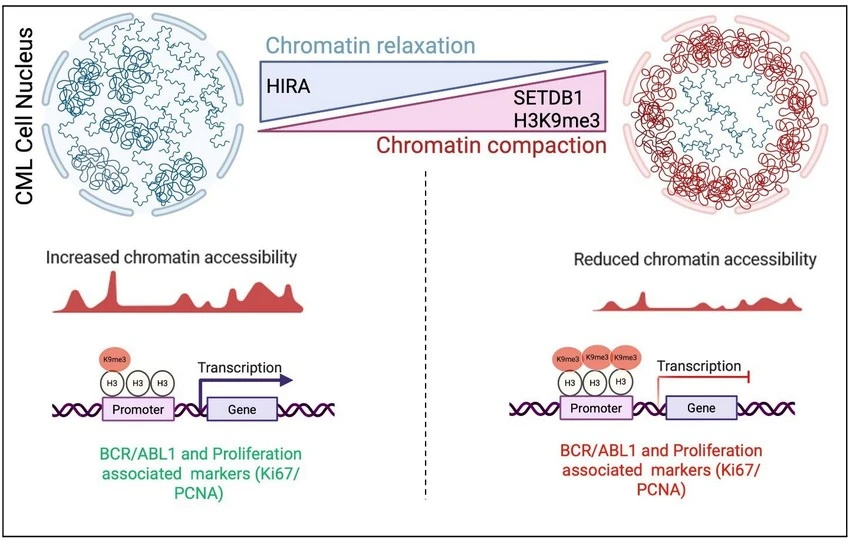
Research Summary: We identified a HIRA-SETDB1-H3K9me3 regulatory axis that controls chromatin architecture in chronic myeloid leukemia by preventing heterochromatin formation and maintaining transcriptionally active chromatin that promotes proliferation and disease progression.
Researcher Spotlight
Mayur Balkrishna Shirude is a PhD scholar at BRIC-Rajiv Gandhi Centre for Biotechnology, under the guidance of Dr. Debasree Dutta. His research investigates chromatin organization and epigenetic regulation in chronic myeloid leukemia.
Linkedin – www.linkedin.com/in/mayur-shirude-0912b9198
Twitter – https://x.com/MayurShirude3
Lab: Dr. Debasree Dutta, Rajiv Gandhi Centre for Biotechnology
Lab social media: https://rgcb.res.in/debasree
What was the core problem you aimed to solve with this research?
The central question our study addressed was how the histone chaperone HIRA regulates chromatin architecture in chronic myeloid leukemia (CML). Previous studies have shown that HIRA regulates hematopoiesis by modulating chromatin accessibility and thereby influencing the transcriptome of hematopoietic stem cells (HSCs). Interestingly, we observed elevated HIRA expression in CML patients as well as in the CML cell line K562, which prompted us to investigate its role in leukemic chromatin organization.
Through this study, we identified an epigenetic regulatory axis involving HIRA, SETDB1, and H3K9me3 that maintains chromatin in a transcriptionally active state and supports leukemia-associated gene expression programs.
How did you go about solving this problem?
We used a combination of microscopy-based and genome-wide approaches to understand chromatin architecture in leukemia cells. Techniques such as FRAP and FLIM-FRET helped us study chromatin dynamics and compaction, while ATAC-seq enabled us to examine changes in chromatin accessibility. One of our most striking early observations was that depletion of HIRA in K562 cells increased heterochromatin formation and caused its redistribution toward the nuclear periphery. This indicated that HIRA plays an important role in maintaining an open and transcriptionally active chromatin state in CML cells.
Further investigation showed that HIRA depletion increases the SETDB1 expression and consequently H3K9me3 mediated heterochromatin.
Interestingly, we also found that the HIRA-SETDB1-H3K9me3 axis modulates the expression of BCR-ABL, the key oncogenic driver of chronic myeloid leukemia (CML). These findings suggest that HIRA plays an important role in maintaining a transcriptionally active chromatin state in leukemia cells and raise the possibility that targeting HIRA-mediated chromatin regulation could represent a potential therapeutic strategy to inhibit CML progression.
“Chromatin status driving disease pathogenesis is a key outcome of this study, revealing new opportunities for epigenetic therapeutics.” – Dr. Debasree Dutta
How would you explain your research outcomes (Key findings) to the non-scientific community?
DNA inside the nucleus is packaged in a highly organized manner, and this organization plays an important role in determining which genes are turned on or off. In leukemia cells, we found that the protein HIRA helps maintain chromatin in a relaxed or “open” state, allowing genes that support cancer growth to remain active.
Our study showed that inhibiting HIRA causes a major reorganization of chromatin, shifting it from an open state to a highly compacted state. This change reduces the growth of leukemia cells and also decreases the expression of BCR-ABL, the major oncogenic driver of chronic myeloid leukemia (CML).
These findings suggest that HIRA plays an important role in maintaining the leukemic state and could potentially be explored as a therapeutic target in the future.
What are the potential implications of your findings for the field and society?
Our study highlights the importance of genome organization in leukemia progression. Traditionally, cancer research has focused mainly on genetic mutations, but our findings show that the physical organization of chromatin inside the nucleus also plays a critical role in regulating cancer-associated genes.
By identifying the HIRA-SETDB1-H3K9me3 axis as a regulator of chromatin architecture in CML, we provide new insight into how leukemia cells maintain their malignant state. Importantly, inhibition of HIRA reduced leukemic cell growth and suppressed BCR-ABL expression, suggesting that HIRA may have therapeutic potential.
Overall, our work contributes to the growing field of epigenetic cancer biology and may help guide the development of future chromatin-targeted therapies.
What was the exciting moment during your research?
One of the most exciting moments during this study came from our very first FRAP experiment. We initially hypothesized that HIRA might regulate chromatin architecture in CML cells, and to investigate this, we used H1.1-GFP as a proxy to monitor chromatin dynamics.
When we depleted HIRA in K562 cells expressing H1.1-GFP, we observed a striking redistribution of H1.1-GFP toward the nuclear periphery, while the interior of the nucleus showed very little signal. The stacked images of control and HIRA-depleted cells revealed a dramatic difference in chromatin organization. Further FRAP analysis showed reduced GFP recovery in HIRA-depleted cells, indicating increased chromatin compaction and reduced chromatin mobility.
That was the moment when we realized that HIRA might have a much more significant role in maintaining chromatin architecture than we initially anticipated. These observations raised many new questions and made the project increasingly exciting as the study progressed.
Paper reference – Shirude MB, Devarajan A, Sahu SA, Mukherjee A, Dutta D, HIRA-SETDB1-H3K9me3 axis regulates chromatin architecture in leukemia cells, Journal of Biological Chemistry (2026), doi: https://doi.org/10.1016/j.jbc.2026.113081
New Book Launched – Molecules, Mentors & Mindsets: Building Indian Biopharma
Buy your copy today: https://biopatrika.com/science-society/book-molecules-mentors-mindsets-building-indian-biopharma-biocon/
Book Launch: Molecules, Mentors & Mindsets: Building Indian Biopharma | Biocon Focus