

From Manual Logs to Live Data: IIT Gandhinagar Students Develop AI-Driven Platform to Modernise Gujarat’s Water and Energy Infrastructure
- Students from Indian Institute of Technology Gandhinagar built a real-time digital platform with Sardar Sarovar Narmada Nigam Limited to streamline water and energy data management.
- The platform enables live monitoring of hydro, solar, and pumping assets, improving decision-making and operational efficiency. Built-in validation and role-based access ensure accuracy and accountability.
- By linking water and energy data, it supports optimisation and sustainability in infrastructure management. The system offers a scalable model for digital transformation in public utilities.
Gandhinagar | April 22, 2026: In a significant example of applied engineering innovation, undergraduate students from the Indian Institute of Technology Gandhinagar have developed a real-time digital platform to streamline the monitoring and management of large-scale public infrastructure.
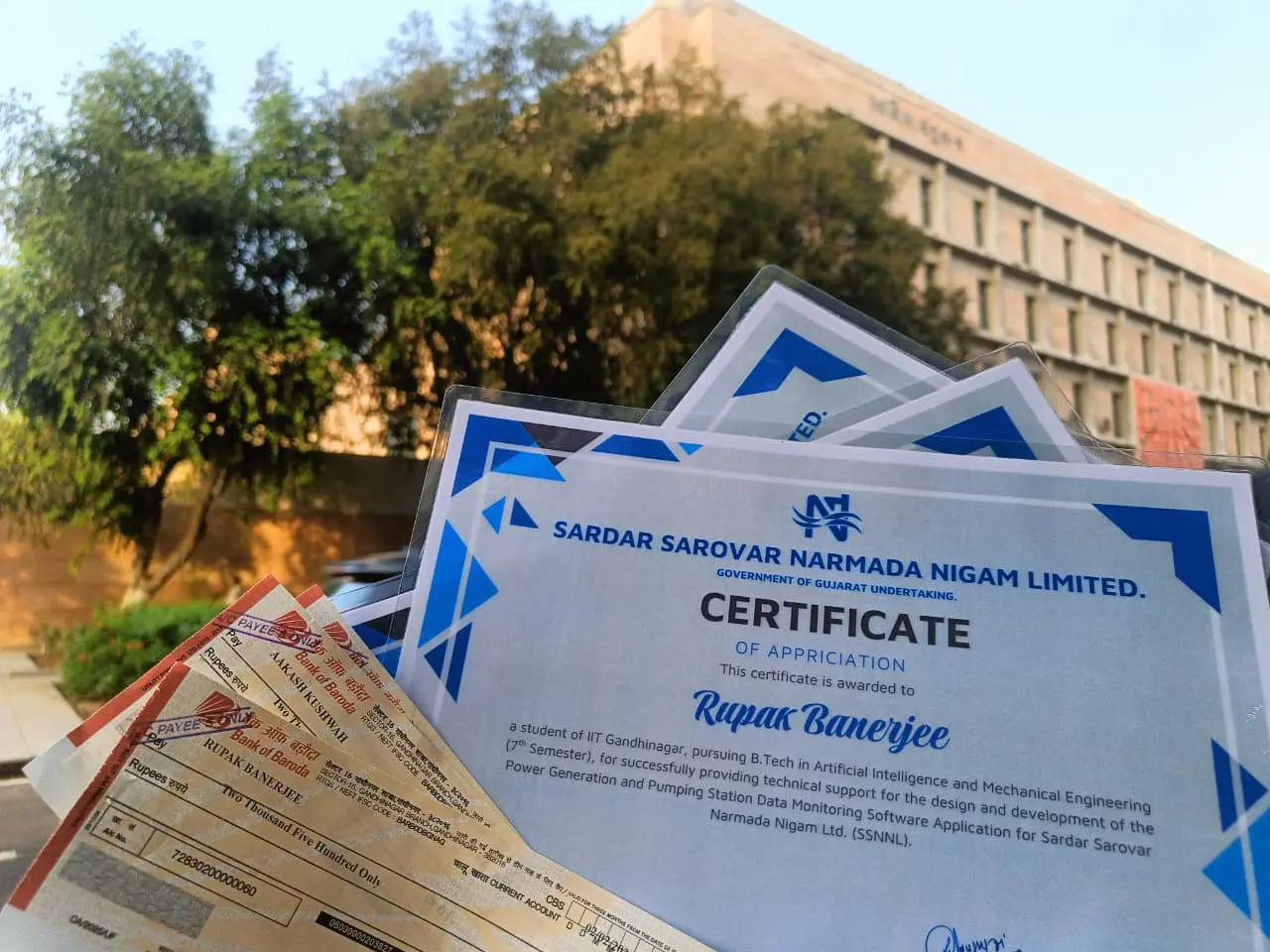
Created in collaboration with Sardar Sarovar Narmada Nigam Limited (SSNNL), the secure, web-based platform integrates real-time data from 53 hydro power stations, along with solar and pumping infrastructure, into a unified digital dashboard. The centralised system is a step towards transforming Gujarat’s critical water and energy network under the Sardar Sarovar Project.
Led by final-year undergraduate students Mr Rupak Banerjee and Mr Aakash Kushwah, the project focuses on addressing long-standing challenges in infrastructure management, including fragmented data systems, delays in reporting, and inefficiencies caused by manual data handling.
“During our interactions with field teams, we realised that engineers were spending a significant amount of time compiling and verifying data manually,” said Banerjee. “We wanted to build a system that not only reduces this effort but also supports faster and more informed decision-making.” By leveraging AI and data engineering, the duo aimed to bridge the gap between field-level operations and high-level administrative decision-making, reducing the traditional reliance on manual data collection.
Designed to align closely with SSNNL’s existing administrative framework, the platform adopts role-based architecture that ensures accountability at multiple levels, from field engineers and Sub-Divisional Officers to Chief Engineers and administrative authorities. Built-in validation mechanisms further reduce the risk of human error and data inconsistencies.
At a functional level, the system tracks and correlates complex datasets such as water discharge, electricity consumption, energy generation, and other hydroelectric units, in real time. By linking these datasets, the platform allows administrators to evaluate performance and identify inefficiencies that were previously difficult to detect.
The platform also generates insights at multiple levels-hourly, daily, and monthly, supporting both operational monitoring and long-term planning. “What used to take days of manual compilation can now be done in seconds. This not only improves efficiency but also allows engineers to focus more on maintaining infrastructure rather than managing data,” noted Kushwah.
Beyond operational efficiency, the system holds significance for sustainable resource management. By accurately tracking energy consumption in pumping systems and correlating it with water movement, the platform can help optimise energy use and improve water distribution to resource-sensitive regions.
The development process involved extensive engagement with SSNNL stakeholders, including field engineers and administrative officials, ensuring that the final system was technically robust, user-friendly, and practical for deployment in remote locations with varying levels of connectivity.
Reflecting on the experience, the team highlighted the importance of balancing innovation with usability. “In real-world systems, a solution must be reliable and accessible to users across different environments,” said the duo. Additionally, their scalable platform is highly customisable, allowing additional stations or datasets to be integrated without major changes to the system architecture.
Looking ahead, the team envisions incorporating Internet of Things (IoT)-based automated data collection, combined with advanced analytics and AI models, to enable predictive monitoring of infrastructure performance and more efficient, data-driven operations.
Banerjee and Kushwah credit IITGN’s interdisciplinary environment and growing engagement with industry and government partners for helping them craft a solution that intertwines engineering, data science, and applied research. “This project showed us that engineering can go beyond theory and directly contribute to systems that impact millions. That is what makes our innovation truly meaningful,” said Banerjee.
By converting fragmented operational data into actionable intelligence, the platform offers a scalable model that could be extended to other sectors, including power grids, transportation systems, and smart city networks.
As India continues to modernise its public utilities, initiatives like this demonstrate how digital technologies could enhance transparency, efficiency, and sustainability in large-scale infrastructure systems.
New Book Launched – Molecules, Mentors & Mindsets: Building Indian Biopharma
Buy your copy today: https://biopatrika.com/science-society/book-molecules-mentors-mindsets-building-indian-biopharma-biocon/
Book Launch: Molecules, Mentors & Mindsets: Building Indian Biopharma | Biocon Focus
Online Interactive Course on Immunology | Starts form June 2026 | Register Today
Online Interactive Course on Immunology | Starts form June 2026 | Register Today