

Career as a Scientist in Gene Therapy & CRISPR | AbbVie | Biopatrika
Career Konnect brings forward diverse and evolving career paths for life science professionals. In this edition, we feature Dr. Ishani Dasgupta, Senior Scientist at AbbVie, USA. With a strong background in microbiology, molecular biology, and gene therapy, her journey from India to Singapore and the United States highlights how interdisciplinary research, CRISPR technology, and translational science can shape impactful careers in drug discovery and immunology.
Career Konnect Interview
Q1. Ishani, could you walk us through your academic journey and how it led to your current role?
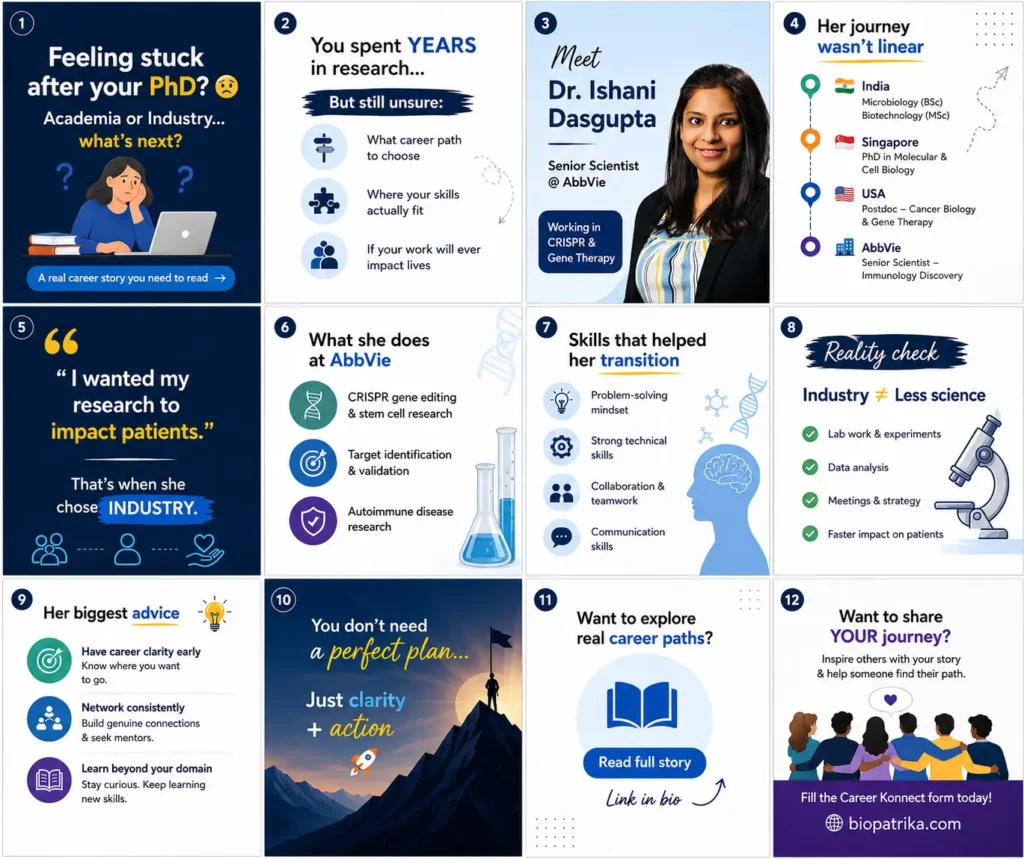
My academic journey began in India, where I completed my Bachelor’s in Microbiology and Master’s in Biotechnology. I then worked on microbial pathogenesis of Salmonella at the Indian Institute of Science, which strengthened my interest in research.
After that, I moved to Singapore for my PhD in molecular and cell biology. Following my PhD, I came to the United States for a postdoctoral position at UMass Chan Medical School, where I worked on signaling pathways involved in cancer and development.
Later, I transitioned into gene therapy research, where I used CRISPR-Cas9 to edit stem cells and study immune responses in disease models. This translational exposure ultimately led me to join AbbVie as a Senior Scientist, where I now work in immunology discovery, focusing on target identification and validation using CRISPR technologies.
Q2. What motivated your transition from academia to industry?
The decision to transition into industry was not sudden—it was something I had planned over time. After spending many years in academic research, I wanted to ensure that my work had a direct impact on patients.
While academic research is incredibly valuable, I was particularly drawn to translational science, where discoveries can be rapidly developed into therapies. Working in industry allows me to contribute to research that directly impacts patients suffering from autoimmune diseases, which is highly motivating.
Q3. What skills from your academic training helped you succeed in industry?
Technical expertise is essential, especially for research-based roles. My experience with molecular biology and gene editing techniques like CRISPR has been directly applicable to my current role.
Beyond technical skills, problem-solving and troubleshooting are critical. In research, experiments often fail, and learning how to navigate these challenges and move projects forward is an invaluable skill.
Collaboration is another important aspect. Industry environments are highly team-oriented, often involving cross-functional and multi-site collaborations. Communication and leadership skills are equally important, as they help in managing projects and working effectively with teams.
Q4. How did you approach the job application and interview process?
One of the most important aspects of the application process is maintaining a strong LinkedIn profile, as recruiters often use it as a primary screening tool.
After applying through job portals, the process typically begins with an HR screening, followed by a technical interview with the hiring manager. If shortlisted, candidates are invited for a full-day interview process, which includes a research presentation and multiple one-on-one interviews with team members.
Preparation is key—not only for presenting your work but also for asking thoughtful questions about the role and organization.
Q5. What visa pathways are relevant for transitioning into industry roles in the US?
I initially came to the US on a J-1 visa for my postdoc. Transitioning into industry required a change in visa status, as J-1 and academic H-1B visas are not suitable for industry roles.
I moved to an O-1 visa, which is designed for individuals with demonstrated expertise and contributions in their field. This requires evidence such as publications, citations, peer reviews, and recommendation letters from experts in the field.
Planning ahead and understanding visa pathways is essential for a smooth transition into industry.
Q6. What does a typical day in your role look like?
My day-to-day work is a combination of experimental research and meetings. I spend time in the lab conducting experiments related to gene editing and target validation.
In addition, there are frequent meetings with team members and collaborators to discuss project progress, align strategies, and plan next steps. Overall, it is a balanced mix of hands-on research and collaborative work.
Q7. How do you manage work-life balance?
Balancing work and personal life requires conscious effort, especially in demanding roles. I enjoy activities like dancing, traveling, and exploring new places.
I have also been actively involved in outreach activities, such as organizing events for women in science, which has been very fulfilling.
Even with a busy schedule, making time for personal interests and family is important for maintaining overall well-being.
Q8. What advice would you give to aspiring scientists?
Having clarity about your career goals can be very helpful, as it allows you to plan your path more effectively. Whether you choose academia or industry, aligning your skills and experiences with your goals is important.
Networking is another critical factor. Engaging with professionals, seeking mentorship, and learning about different career paths can provide valuable insights.
Ultimately, staying curious, proactive, and open to learning will help you navigate your career successfully.
Dr. Ishani Dasgupta’s journey highlights how strategic planning, strong scientific foundations, and a focus on translational impact can lead to fulfilling careers in industry. Her story emphasizes the importance of combining technical expertise with collaboration and adaptability to drive meaningful advancements in healthcare.
Interested in sharing your journey?
Interested in sharing your career journey or job insights?
Check this out and fill the form today:
https://biopatrika.com/career/career-konnect/reimagining-careers-in-life-sciences-career-konnect/
New Book Launched – Molecules, Mentors & Mindsets: Building Indian Biopharma
Buy your copy today: https://biopatrika.com/science-society/book-molecules-mentors-mindsets-building-indian-biopharma-biocon/
Book Launch: Molecules, Mentors & Mindsets: Building Indian Biopharma | Biocon Focus
Online Interactive Course on Immunology | Starts form June 2026 | Register Today
Online Interactive Course on Immunology | Starts form June 2026 | Register Today