
Career as a Preclinical Imaging Scientist after PhD | MRI Scientist at Calico | Biopatrika
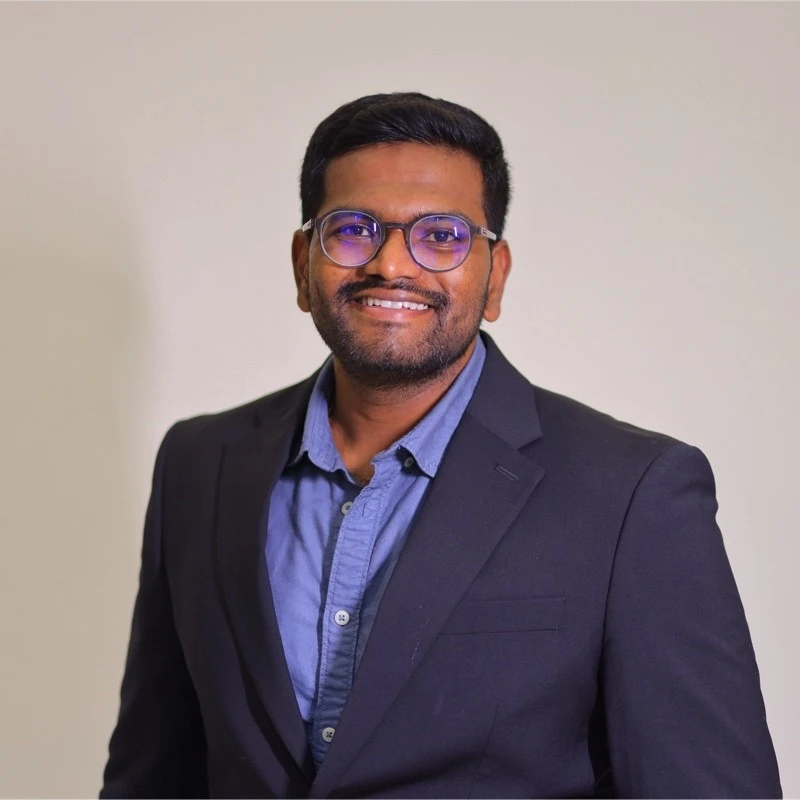
Career Konnect brings forward diverse and evolving career paths for life science professionals. In this edition, we feature Dr. Nishanth D. Tirukoti, Imaging Scientist at Calico Life Sciences, USA. With an interdisciplinary background spanning chemistry, biology, and MRI-based imaging, his journey from IISER Pune to the Weizmann Institute, MIT, and now industry highlights how combining diverse scientific skills can lead to impactful careers in preclinical research and translational science.
Career Konnect Interview
Academic journey and early interests
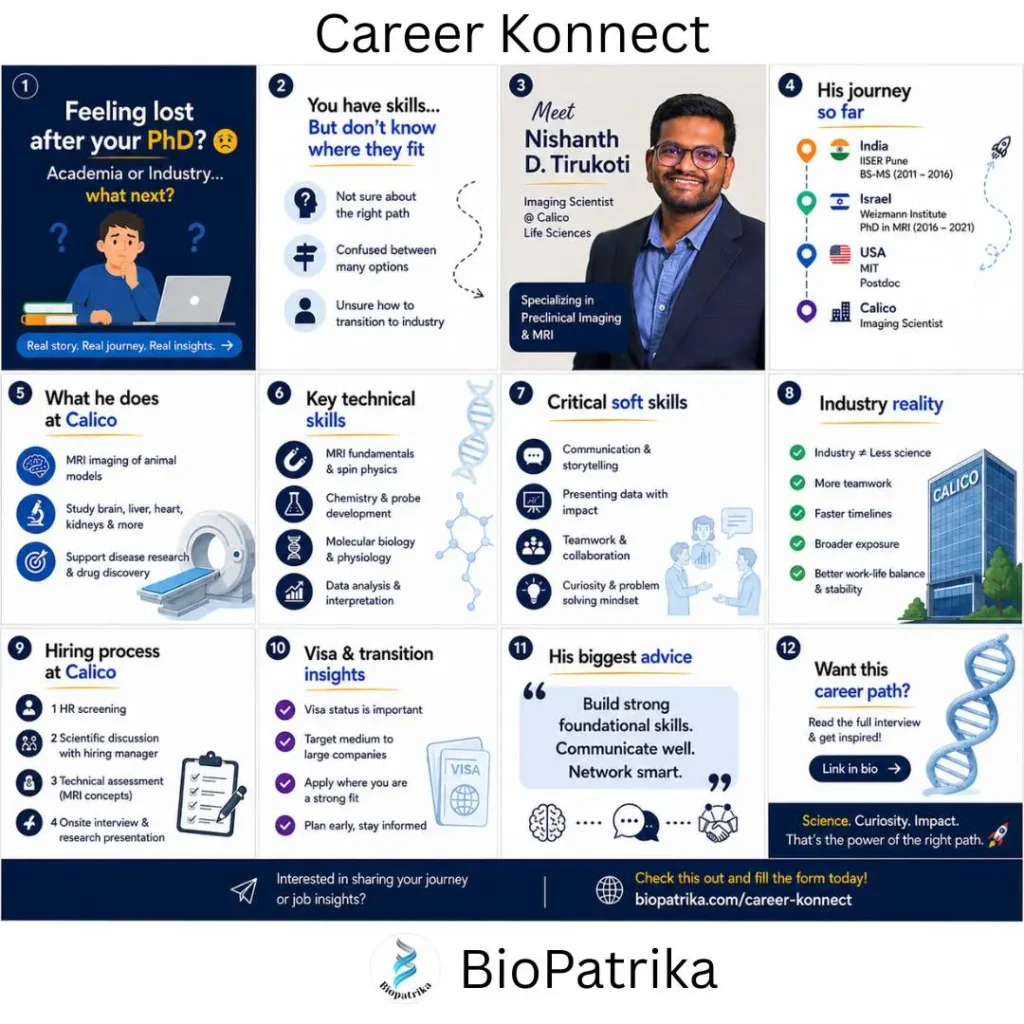
Nishanth Tirukoti’s journey into science began in Andhra Pradesh, India. After completing his schooling, he joined the integrated BS-MS program at IISER Pune, an environment that provided early exposure to research and interdisciplinary learning. During this period, he explored both chemistry and biology, gaining hands-on experience in synthesis under Professor Sriram Hotha and molecular biology techniques through research exposure at ICGEB. This early combination of disciplines laid the foundation for his future specialization.
Following his undergraduate training, Nishanth pursued a PhD at the Weizmann Institute of Science in Israel, where he focused on MRI-based research. His work involved designing chemical probes, testing them in animal models, and using MRI to study biological processes such as zinc detection in the brain. This phase was particularly transformative, as it integrated chemistry, biology, and imaging into a unified research approach.
Postdoctoral research and transition to industry
After completing his PhD, Nishanth moved to MIT as a postdoctoral researcher in the Department of Biological Engineering. Here, he expanded his expertise from chemical probes to biological sensors, working on neuroscience applications. This transition allowed him to deepen his understanding of biological systems while maintaining his strength in imaging technologies.
While academia provided strong training and intellectual independence, Nishanth was drawn toward translational research and real-world applications. This motivation eventually led him to explore opportunities in industry, culminating in his current role at Calico Life Sciences.
Role as an Imaging Scientist at Calico
At Calico, Nishanth works as a preclinical imaging scientist specializing in MRI. His role involves understanding the physics behind MRI, including spin physics, and applying these principles to biological systems. He works extensively with animal models, studying multiple organs such as the brain, liver, kidneys, and heart.
Compared to his academic work, which focused primarily on a single system, his industry role offers broader exposure to different biological questions and disease models. This diversity has enabled him to continuously learn new techniques and expand his scientific perspective.
Skills that shaped his career
Nishanth emphasizes that both technical and soft skills played crucial roles in his journey. From a technical standpoint, mastering MRI fundamentals was essential. His interdisciplinary training in chemistry and biology allowed him to approach biological problems with innovative imaging solutions.
Equally important were soft skills, particularly communication. The ability to present data clearly, explain its significance, and demonstrate its impact is critical in both academia and industry. He highlights that PhD training provides a valuable opportunity to develop these skills over time.
Industry hiring process and experience
Nishanth describes his hiring experience at Calico as transparent and structured. The process began with an online application, followed by an HR screening that covered his background, motivation, and visa status. This was followed by a detailed scientific discussion with the hiring manager.
A unique aspect of the process was a technical assessment focused on MRI fundamentals, testing his understanding of imaging principles. Finally, he participated in an onsite interview that included a research presentation and multiple one-on-one discussions. Overall, the process was rigorous but engaging, emphasizing both technical depth and communication ability.
Visa challenges and transition
As an international scientist, visa considerations played a significant role in Nishanth’s career transition. He initially entered the United States on a J-1 visa for his postdoctoral training and later transitioned to an O-1 visa based on his scientific achievements.
He highlights that visa-related challenges can impact job opportunities and advises candidates to target medium-to-large companies that are more likely to sponsor visas. Applying to roles where one is a strong fit is also critical to improving chances of success.
Importance of networking
Nishanth strongly emphasizes the importance of networking in today’s scientific landscape. He recommends attending conferences, career events, and industry meetups to build genuine connections.
Rather than relying solely on online networking, he suggests engaging in in-person interactions, understanding others’ work, and building meaningful relationships. These connections often open doors to opportunities that may not be visible through traditional application channels.
Academia vs industry: key differences
Reflecting on his experiences, Nishanth notes that academia offers greater independence, allowing researchers to explore problems deeply over extended periods. In contrast, industry operates with defined goals, timelines, and collaborative frameworks.
Industry roles involve working on multiple projects simultaneously and interacting with diverse teams, which broadens exposure and accelerates learning. Additionally, industry positions generally offer greater financial stability, which can be an important consideration for long-term planning.
Work-life balance and personal well-being
To manage stress and maintain balance, Nishanth prioritizes physical activity. He regularly spends time at the gym, plays badminton, and enjoys walking. These activities help him stay mentally and physically healthy despite the demands of scientific work.
Advice to aspiring scientists
Nishanth’s advice to aspiring scientists is straightforward: build strong foundational skills, both technical and communicative. He encourages students to make the most of their training period, actively network, and align their efforts with their long-term career goals.
Nishanth D. Tirukoti’s journey demonstrates how interdisciplinary training, strong fundamentals, and strategic career decisions can lead to successful transitions into industry. His story highlights the importance of adaptability, communication, and networking in building impactful careers in modern life sciences.
Interested in sharing your journey?
Interested in sharing your career journey or job insights?
Check this out and fill the form today:
https://biopatrika.com/career/career-konnect/reimagining-careers-in-life-sciences-career-konnect/
New Book Launched – Molecules, Mentors & Mindsets: Building Indian Biopharma
Buy your copy today: https://biopatrika.com/science-society/book-molecules-mentors-mindsets-building-indian-biopharma-biocon/
Book Launch: Molecules, Mentors & Mindsets: Building Indian Biopharma | Biocon Focus
To find best career opportunities, visit jobs.biopatrika.com