
Eclipsed Horizons: Unveiling The Dark Genome
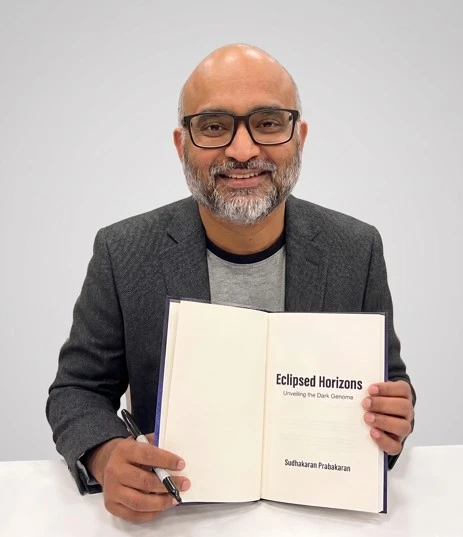
In an era when the human genome is increasingly viewed as a dynamic landscape rather than a static blueprint, Eclipsed Horizons: Unveiling the Dark Genome challenges one of biology’s most enduring assumptions—that the vast non-coding regions of our DNA are merely “junk.” In this thought-provoking book, Dr. Sudhakaran Prabakaran, computational biologist, entrepreneur, and pioneer in dark genome research, takes readers on a fascinating journey through hidden layers of genomic information that may influence human adaptation, disease, evolution, and even our future beyond Earth. Drawing upon cutting-edge discoveries, information theory, and evolutionary biology, the book invites both scientists and curious readers to reconsider what lies within the unexplored 98% of our genome. In this BioPatrika Book Insights interview, Dr. Prabakaran discusses the inspiration behind the book, the emerging science of the dark genome, and why these overlooked regions of DNA may hold some of biology’s most important secrets.
Buy book here: https://www.amazon.in/Eclipsed-Horizons-Unveiling-Dark-Genome/dp/1800618263
Could the Dark Genome Hold the Future of Human Adaptation? Insights from Eclipsed Horizons
- Your book challenges the long-standing idea that non-coding DNA is simply “junk DNA.” What first convinced you that these dark regions of the genome may hold far greater biological significance?
For most of molecular biology’s history, the genome was read through the central dogma — DNA makes RNA makes protein — and anything that didn’t fit was set aside as “junk.” That wasn’t carelessness; it was a genuine consensus, and a reasonable one given what the tools could see at the time. What changed my own thinking was a more specific observation. In 2014, working on mouse neurons, my colleagues and I found that proteins emerging from regions long classified as non-coding weren’t translational noise — they were under biological regulation. A cell doesn’t bother to regulate garbage. Regulation implies function.
Once you accept that, an evolutionary puzzle sharpens into focus. Evolution is famously economical; it does not tend to maintain vast, costly stretches of sequence for no reason across hundreds of millions of years. So either ~98% of our genome is an enormous accident that selection never bothered to clean up, or those regions are doing something we hadn’t learned to detect yet. The accumulating evidence — pervasive translation, regulatory RNAs, stress-responsive elements — kept pointing toward the second answer.
- One of the most fascinating ideas in the book is that the dark genome acts as an adaptive reservoir activated during environmental stress. Could you explain this concept in a way that general readers can easily relate to?
Think of it less like a blueprint and more like an emergency toolkit that stays in the cupboard until you actually need it. Under ordinary conditions, much of the dark genome is silent. But under stress — heat, oxidative damage, nutrient scarcity, the disruptions of an unfamiliar environment — cells appear to reach into these silent regions and start producing novel proteins and regulatory configurations they don’t normally make.
There’s a useful framing from evolutionary biology called “decanalization.” Normally the system buffers itself to stay stable; under extreme stress that buffering breaks down and previously hidden variation becomes visible. The dark genome behaves like a set of “if–then” statements written into our DNA: if these conditions arise, then deploy these latent solutions. The reason that matters is that adaptation doesn’t always have to wait for a lucky new mutation — some of the raw material is already there, held in reserve, waiting for the right trigger. That reframes “junk” from leftover debris into a library of conditional possibilities.
- You introduce the speculative concept of Homo minimus and space-adapted humans. How did science-fiction-like imagination help you communicate real scientific possibilities about human evolution and survival?
Homo minimus is an honest thought experiment, and I’m careful to flag it as speculative rather than smuggle it in as an established fact. The question behind it is serious: if humans ever have to live beyond Earth, what is the minimum viable genome that preserves our capacity to adapt? Using information-theoretic measures — Shannon entropy, Lempel–Ziv, Kolmogorov–Chaitin complexity — you can start asking which parts of the genome carry genuine information and which are truly redundant.
The science-fiction framing isn’t decoration; it’s a reasoning tool. By imagining a compressed, space-adapted human, you’re forced to confront a genuine paradox. The naïve move is to delete the “junk” to shrink the radiation target and metabolic burden. But if the dark genome is the adaptive reservoir, indiscriminate deletion would strip away exactly the machinery you’d need most in a hostile, unpredictable environment. So the imaginative scenario surfaces a real principle: optimal compression preserves high-information-density regulatory elements and discards only what’s genuinely redundant — much as viruses pack maximum function into minimal space through overlapping reading frames. The speculation is in service of a concrete idea about how biological information is organized.
- The book combines genomics, information theory, evolution, and cosmology. What were the biggest challenges in connecting these diverse scientific fields into one coherent narrative?
The hardest part was resisting the temptation to force a tidy unification. These fields have different standards of evidence and different vocabularies, and a reader can smell it when a connection is being asserted rather than earned. My approach was to let one through-line carry the structure — the idea of the genome as an information system built not only for present function but for future adaptation — and to be explicit about where I was on solid empirical ground versus where I was extrapolating.
Information theory turned out to be the natural connective tissue. If you treat the genome as a system that stores, compresses, and conditionally deploys information, then the molecular findings, the evolutionary logic, and even the cosmological framing of “dark” matter that exerts influence while eluding observation all become facets of one question rather than four separate stories. The discipline was in clearly labeling the speculative passages so the rigor of the core argument wasn’t diluted by the reach of the broader narrative.
- Many readers may wonder: if 98% of our genome has hidden functions, how might this reshape future research in medicine, evolution, or even personalized healthcare?
It shifts where we look for both the causes of disease and the levers to treat it. Protein-coding mutations tend to be binary — you get a working protein or you don’t. Regulatory variants in the dark genome more often cause quantitative shifts in expression, which is actually promising therapeutically, because a dial is easier to adjust than a broken switch. We already see this logic in the clinic: RNA-interference therapeutics like patisiran, enhancer-targeting strategies against oncogenes, and regulatory-variant testing that guides personalized drug dosing.
There’s also a large untapped target space. Novel open reading frames associated with human-accelerated regions show altered expression in conditions like schizophrenia and bipolar disorder, and the same elements appear in cancer biology. At NonExomics we’ve mapped hundreds of thousands of these dark proteins and thousands of disease associations, including across rare diseases that have few conventional targets. I’d add a note of caution, though: many of these elements evolved as stress-responsive emergency systems, so manipulating them outside their natural regulatory context could have unintended effects. The opportunity is real, but it demands careful functional validation.
- Your writing balances academic rigor with accessible storytelling. Who did you primarily write this book for — scientists, students, or curious general readers — and what do you hope each audience takes away from it?
I wrote it for the curious reader who is willing to think, whether or not they have formal training — and I tried not to condescend to either end of that spectrum. For general readers, I want the takeaway to be a change in intuition: that the genome is not a finished blueprint but a dynamic, responsive archive, and that “junk” was a label of ignorance rather than a verdict. For students and scientists, I’d hope it works as an invitation — the dark genome is genuinely underexplored, the tools to study it are improving fast, and there’s serious work to be done, including the unglamorous computational problem of detecting these elements in the first place.
What I tried to avoid is the false choice between rigor and accessibility. The ideas are demanding, but they don’t require jargon to be understood, and a non-specialist who follows the argument should come away able to question it intelligently. That’s the point — I’d rather equip readers to scrutinize the thesis than ask them to take it on faith.
- If readers remember just one transformative idea after finishing Eclipsed Horizons: Unveiling The Dark Genome, what would you want that message to be?
That what we dismissed as junk may be a prepared genome — a reservoir of latent possibility holding the whispered solutions to challenges we haven’t faced yet, here on Earth and possibly beyond it. The deeper shift is letting go of the assumption that “we couldn’t read it” meant “it isn’t there for a reason.” If readers leave with a healthy suspicion of that assumption, and a sense that biology’s most interesting frontier is the part we long ignored, the book has done its job.
About book author: Sudhakaran Prabakaran, Ph.D. is CEO and Co-founder of NonExomics Inc. and Associate Teaching Professor at Northeastern University. A computational biologist with a Ph.D. from the University of Cambridge and postdoctoral training at Harvard Medical School, he pioneered research into the “dark genome” — decoding previously unknown open reading frames (nORFs) in the human genome for drug discovery in cancer, schizophrenia, and bipolar disorder. His work has yielded six patent applications and been featured in Science, Bloomberg, and Inside Precision Medicine. He authored Eclipsed Horizon: Unveiling the Dark Genome (World Scientific Publishing, 2026) and has mentored over 50 students and researchers across Cambridge, Northeastern, and international institutions.
NonExomics: https://nonexomics.com/