


Hidden Diversity of Foraminifera Along the Indian Coastline Revealed
On World Environment Day (June 5), this study highlights the hidden diversity of foraminifera along the Indian coastline and underscores their growing importance as bioindicators for monitoring ecosystem health, environmental change, and coastal sustainability.
Research Summary: There lies a complete scientific knowledge gap about the biology of Foraminifera, a single-celled eukaryotic marine protist. My research focuses on using integrated morphological and molecular systematics to resolve cryptic genetic diversity of these protists in the Indian marine environments.
Researcher spotlight
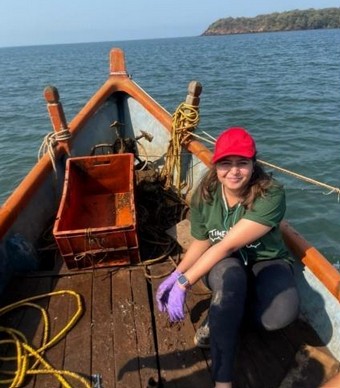
Vaishnavi Dixit is a Ph.D. Researcher at Agharkar Research Institute, Pune, exploring interdisciplinary applications of benthic foraminifera as proxies for biomonitoring across the Indian coastal environment
Linkedin: https://www.linkedin.com/in/vaishnavi-dixit-753755136
Twitter: https://x.com/vaishnavimdixit
Lab: Dr Tushar Kaushik, Scientist-D, Agharkar Research Institute, G.G Agarkar Road, Pune, 411007
What was the core problem you aimed to solve with this research?
Foraminifera are among the most widely used microfossils for reconstructing past marine environments and monitoring present-day ecological change. However, many foraminiferal groups contain cryptic species, making accurate species identification and taxonomy particularly challenging. This taxonomic uncertainty can affect biodiversity inventories, ecological assessments, and paleoenvironmental reconstructions. The challenge has become even more significant with the rise of high-throughput approaches such as environmental DNA (eDNA) metabarcoding, frequently being used in non-invasive next-generation Biomonitoring surveys. While these techniques can rapidly assess biodiversity, many foraminiferal sequences remain “unassigned” or “unknown” because comprehensive, morpho-molecular validated reference databases are still lacking. Indian foraminiferal taxa remain particularly under-represented in global repositories such as WoRMS (World Register of Marine Species) and BFR2 (Benthic Foraminifera Ribosomal Reference database) due to the limited availability of integrative molecular and morphological studies. Of Foraminifera, a calcareous genus Ammonia, is the most commonly occurring and ecologically important benthic foraminifera along the Indian coastline, exemplifies these challenges. Extensive morphological variability, ecophenotypic plasticity, and cryptic diversity have long complicated its taxonomy. Our study was aimed to address this gap by generating robust molecular and morphological reference data, resolving species boundaries, and enriching international databases with validated Indian records to support future biodiversity assessments, paleoenvironmental studies, and next-generation biomonitoring approaches.
How did you go about solving this problem?
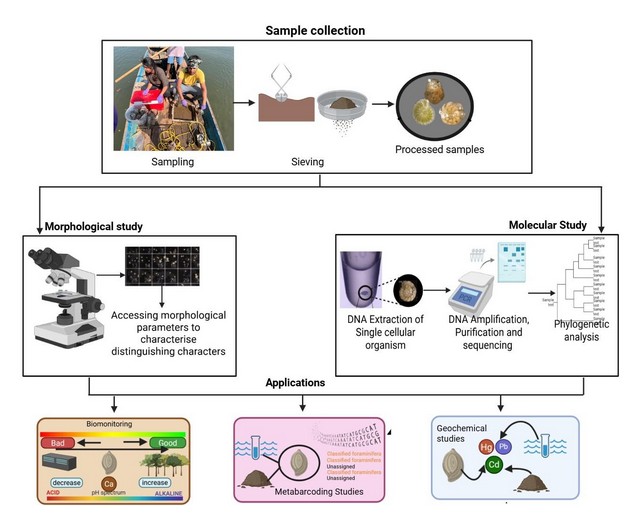
To address this challenge, we adopted an interdisciplinary approach that combined field ecology, micropaleontology, morphometrics, molecular biology, and biogeography. Between 2021 and 2025, we conducted extensive sampling across coastal locations spanning the Arabian Sea and the Bay of Bengal, encompassing a wide range of environmental settings. Alongside specimen collection, we recorded in-situ environmental parameters to understand how ecological conditions influence species distributions. Individual foraminifera were examined using microscopy and scanning electron microscopy (SEM) to document detailed shell characteristics. DNA sequence data was generated using 18S rRNA gene fragment, one of the most widely used molecular barcode in foraminiferal systematics, and compared these sequences with globally available records to determine evolutionary relationships, biogeography, and species distinction. To objectively evaluate morphological variation, we measured numerous shell characters and applied advanced multivariate statistical approaches to identify the most reliable diagnostic features. Beyond species identification, we established a taxonomically validated regional reference dataset for this ecologically important group of calcareous foraminifera by linking morphology, DNA sequences, environmental parameters, and biogeographic occurrence. This allowed us to document biogeographic provinces along the Indian coastline and their ecological preferences.
“As Indian estuaries face escalating pressures from climate change and human activities, our interdisciplinary research is reducing error in databases and helping in building complementary morphological and molecular reference libraries for Indian foraminifera. These foundational resources will support the development of next-generation coastal biomonitoring tools for assessing and managing estuarine ecosystem health.” — Dr Tushar Kaushik, PI
How would you explain your research outcomes (Key findings) to the non-scientific community?
Changes in marine environments can significantly affect sensitive ecosystems such as mangroves, mudflats, seagrass beds, and coral-associated habitats, which in turn influence fisheries, aquaculture, tourism, coastal livelihoods, and the well-being of communities dependent on coastal waters. These single-celled protists are among the most abundant and ecologically important microorganisms in coastal environments, responding rapidly to changes in salinity, temperature, oxygen availability, pollution, and other environmental pressures. As a result, foraminifera, inhabiting estuarine and shallow-marine environments, often provide an early biological signal of environmental stress and ecosystem disturbance. While some foraminiferal species are cosmopolitan and thrive across a broad range of conditions, others are highly specialized or endemic to specific habitats and regions. Consequently, habitat degradation, climate-driven environmental shifts, and increasing anthropogenic pressures can alter their distribution, abundance, and community composition, providing direct evidence of ecosystem change. Because foraminifera are widely used in environmental monitoring and paleoenvironmental reconstruction, the reliability of these interpretations depends on accurate species identification, and may introduce error in datasets built on foraminifera. However, many foraminiferal groups contain morphologically similar or cryptic species that are difficult to distinguish using traditional approaches alone. Therefore, refining taxonomy and enriching databases are essential for strengthening biodiversity assessments, environmental monitoring, paleoenvironmental reconstructions, and the development of robust biomonitoring tools for coastal ecosystems.
What are the potential implications of your findings for the field and society?
Our study contributes one of the first comprehensive, taxonomically validated molecular and morphological reference datasets for Indian coastal Ammonia. By generating 18S rRNA gene sequences linked directly to detailed morphological descriptions and ecological information, we have strengthened the reference inventory available for species identification and biodiversity assessments. These validated records enrich international databases such as GenBank, BFR2, and other global biodiversity repositories, helping to improve the representation of Indian foraminiferal diversity in worldwide datasets. An equally important outcome of this work is the identification of key diagnostic morphological characters that allow reliable species recognition. The integrative taxonomic framework developed in this study provides researchers with practical tools for distinguishing not just Ammonia but other foraminiferal species more accurately, thereby improving taxonomic consistency across ecological, micropaleontological, and biomonitoring studies. The molecular reference data generated through this research will also support next-generation biodiversity assessment techniques such as environmental DNA (eDNA), metabarcoding, and shotgun sequencing. By filling important gaps in the existing databases, our study lays the groundwork for faster, more reliable, and large-scale monitoring of coastal biodiversity and ecosystem health. Looking ahead, the integration of taxonomically validated molecular, morphological, ecological, and biogeographic datasets can provide a strong foundation for the development of artificial intelligence (AI) and machine learning (ML)-based biodiversity assessment surveys. Such systems could enable automated species identification, biodiversity forecasting, habitat suitability modelling, and early detection of environmental change. Ultimately, these advances can strengthen environmental monitoring, support evidence-based coastal management, and improve our ability to conserve vulnerable marine ecosystems in a rapidly changing world.
Beyond academia, these findings may support evidence-based coastal management and conservation planning. Improved taxonomic resolution can strengthen the scientific reliability of environmental impact assessments and studies relevant to Coastal Regulation Zone (CRZ) policy frameworks, estuarine conservation, fisheries sustainability, and ecosystem restoration initiatives along the Indian coastline.
What was the exciting moment during your research?
Every stage of this research journey was exciting and deeply rewarding for me, from collecting samples under the scorching coastal sun with the help of kind-hearted local communities to carefully transporting and processing them back in the laboratory. One of the most memorable moments was observing living foraminifera specimens under the microscope, appearing like tiny yellow gems within the sediment samples. Equally exciting was seeing successful PCR bands on the gel after long hours of field and laboratory work, where the effort finally transforms into meaningful scientific data.
This research journey taught me the importance of patience, persistence, and consistency, especially while working across challenging field conditions and detailed laboratory analyses. I remain sincerely grateful to my principal investigator, Dr Tushar Kaushik, for his constant guidance and encouragement, and to the Anusandhan National Research Foundation (ANRF) for providing the support and resources that made this work possible.
Paper reference: Dixit, V., Kaushik, T., Jape, R., & Dhupkari, A. (2026). Molecular systematics, morphometric distinction, and biogeography of four Ammonia (Foraminifera) species occurring along the Indian coastline. Marine Micropalaeontology, 102581. https://doi.org/10.1016/j.marmicro.2026.102581.
Kaushik, T., & Dixit, V. (2025). Ammonia nigami sp. nov., a new rotaliid benthic foraminifer from coastal Odisha, east coast of India, Bay of Bengal. Micropalaeontology, 71(3). https://doi.org/10.47894/mpal.71.3.03
New Book Launched – Molecules, Mentors & Mindsets: Building Indian Biopharma
Buy your copy today: https://biopatrika.com/science-society/book-molecules-mentors-mindsets-building-indian-biopharma-biocon/
Book Launch: Molecules, Mentors & Mindsets: Building Indian Biopharma | Biocon Focus