



How a Muscle Protein Regulates Metabolism and Protects Against Diabetes
Research Summary: MyHC-slow, a muscle contractile protein, is vital for metabolism. Its loss triggers insulin resistance and diabetic symptoms, which can be restored by activating the NRF2 pathway via sulforaphane treatment.
Researcher Spotlight
Dr. Jaydeep Sharma recently completed his PhD at the Regional Centre for Biotechnology (RCB), Faridabad, under the supervision of Prof. Sam J. Mathew. He currently serves as a Research Associate at RCB. Throughout his doctoral studies, Jaydeep focused his research on muscle biology, metabolism, and disease mechanisms.
Linkedin: https://www.linkedin.com/in/jaydeep-sharma-b9130b1a5/
Twitter: https://x.com/Jaydeep_Sharma_
Instagram: https://www.instagram.com/jaydeep_sharma
Lab PI name: Prof. Sam J Mathew, Regional Centre for Biotechnology, Faridabad
Lab social media: https://x.com/SamMathew_RCB
What was the core problem you aimed to solve with this research?
Type 2 diabetes has become a massive global health problem, where lifestyle changes like physical inactivity and unhealthy diet play a huge role. We know that people who lead a sedentary lifestyle and are physically inactive tend to lose a specific type of muscle fibers called the slow fibers. These slow muscle fibers are fatigue-resistant and are responsible for maintaining posture. The slow fibers contain a special protein called MyHC-slow, which is a tiny motor inside the muscle cells that helps with muscle contraction. So, we had an interesting puzzle: if slow muscle fibers are so important for our health and energy utilization, and diabetes patients lose these muscle fibers, does the MyHC-slow protein have any role in all of this? Surprisingly, nobody had studied this before.
This was the exact gap we tried to fill. We wanted to understand whether losing this protein could actually contribute to diabetes and poor metabolic health, and if so, could we do something about it?
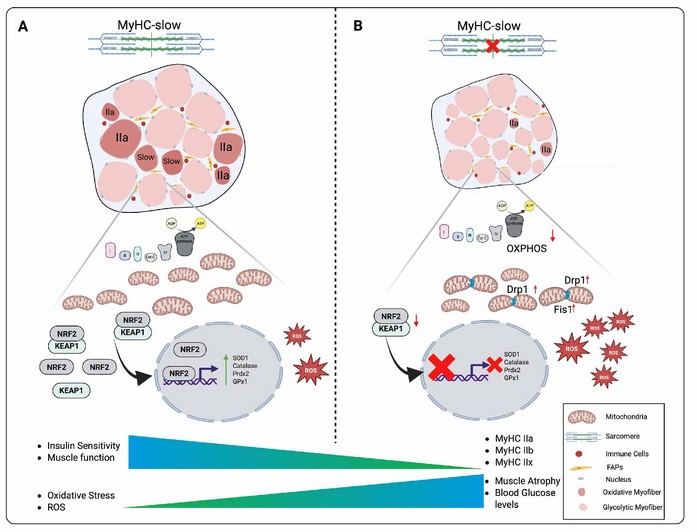
(B) The absence of MyHC-slow results in reduced oxidative phosphorylation levels and increased mitochondrial fission in the myofibers, leading to increased ROS generation, muscle atrophy, altered MyHC proportions, and significant reduction in NRF2, GLUT4, and mitochondrial function, causing reduced insulin sensitivity and elevated blood glucose levels.
How did you go about solving this problem?
To address this critical gap, we generated a skeletal muscle-specific MyHC-slow knockout mouse model using genetic techniques, which allowed us to precisely study the consequences of loss of MyHC-slow exclusively in the skeletal muscle, without affecting other tissues.
To decode the underlying molecular mechanisms, we comprehensively profiled protein expression changes in such knockout mouse muscle, combined with biochemical assays to validate key changes in signaling pathways.
This integrative approach led us to identify the NRF2 antioxidant signaling pathway to be suppressed in the MyHC-slow knockout muscle, driving oxidative stress and mitochondrial dysfunction. We subsequently demonstrated that pharmacological activation of NRF2 using a molecule called sulforaphane successfully rescued the metabolic and muscular defects, establishing NRF2 as a promising therapeutic target.
“This study redefines how the muscle and contractile proteins in the muscle contribute to maintaining whole body metabolism.” – Prof. Sam J Mathew
How would you explain your research outcomes (Key findings) to the non-scientific community?
This study shows that a muscle protein called myosin heavy chain-slow (MyHC-slow), which helps muscles contract, is also essential for maintaining healthy metabolism. We discovered that MyHC-slow is not just responsible for muscle movement, but also critical to maintain blood sugar levels. When we removed this protein in mice, their muscles weakened, and the mice developed diabetes-like symptoms including high blood sugar and insulin resistance.
We found the root cause of these effects was the shutdown of a protective system inside cells called the NRF2 pathway, causing toxic free radicals called Reactive Oxygen Species to build up in the muscle cells. Remarkably, a natural compound found in broccoli called sulforaphane was able to reactivate this protective system and reverse most of the harmful effects of loss of MyHC-slow in mice. This opens up a promising new avenue to treat diabetes.
What are the potential implications of your findings for the field and society?
Our findings carry significant implications both scientifically and clinically. We have established a novel mechanistic link between the skeletal muscle and metabolic homeostasis, redefining the role of structural contractile proteins beyond mechanical function.
From a clinical perspective, our study identifies the NRF2 signaling pathway as a viable therapeutic target for combating insulin resistance and type 2 diabetes, particularly in individuals experiencing muscle loss due to a sedentary lifestyle or aging.
Furthermore, the demonstrated efficacy of sulforaphane, a naturally occurring phytochemical, in rescuing metabolic defects offers a promising, accessible, and translatable therapeutic strategy.
At a societal level, these findings underscore the critical importance of preserving muscle health through an active lifestyle as a preventive measure against the growing global diabetes epidemic.
What was the exciting moment during your research?
There were several truly exciting moments throughout this journey. The first breakthrough came when we observed, for the first time, a dramatic rise in blood glucose levels in our MyHC-slow knockout mice. Discovering that the loss of a contractile protein could directly impair glucose metabolism was completely unexpected and surprising.
The second profound moment was unravelling how the loss of a sarcomeric structural protein like MyHC-slow could cascade into mitochondrial dysfunction. This was remarkable because it unravelled an entirely novel concept that MyHC-slow is not only a mechanical protein but is fundamentally critical for slow myofiber identity, formation, and metabolic integrity.
Paper reference: Sharma, Jaydeep, et al. “The skeletal muscle slow myosin heavy chain regulates mammalian metabolic homeostasis through the NRF2 pathway.” Science Advances 12.23 (2026): eaed2478. 10.1126/sciadv.aed2478
Check BioPatrika Youtube channel here: https://www.youtube.com/channel/biopatrika