



Salt-Inducible Kinase Emerges as a Promising Immunotherapy Target for Ovarian Cancer
Research Summary: Using an all-human high-throughput drug repurposing screen, we identified salt-inducible kinases (SIKs) as negative regulators of T cell function in the immunosuppressive milieu of ovarian cancer. SIK inhibition or depletion in T cells upregulates anti-tumor immunity and improves survival in immunotherapy-resistant preclinical models.
Researcher spotlight
Dr. Arindam Ray went to Jawaharlal Nehru Centre for Advanced Scientific Research (JNCASR), Bangalore to do his PhD under the supervision of Prof. Maneesha S. Inamdar. He explored the role of conserved organellar mechanisms such as mitochondrial dynamics and endosomal protein sorting in blood progenitor homeostasis and lineage choice using the Drosophila hematopoietic system. He joined Dr. Laurie H. Glimcher’s lab at Dana-Farber Cancer Institute, Harvard Medical School in 2022 as a Postdoctoral Research Scholar to study tumor immunology in solid tumors and leukemia.
Linkedin | Twitter | Instagram
Lab: Prof. Laurie H. Glimcher, Dana-Farber Cancer Institute, Harvard Medical School
What was the core problem you aimed to solve with this research? Ovarian Cancer is almost always unresponsive to immunotherapy due to a highly immunosuppressive microenvironment. Ovarian Cancer patients often develop ascitic fluid in the peritoneal cavity that constitutes a liquid microenvironment for the tumor. Previous work from this lab showed that cell-free ascites can drastically downregulate T cell function and contribute to immunotherapy failure. The mechanisms that drive T cell dysfunction in ascites remain incompletely understood. Also, the all-too-common failure of drugs that show efficacy in preclinical studies but unfortunately do not work in the clinic requires the development of assays that mimic the tumor in its native microenvironment.
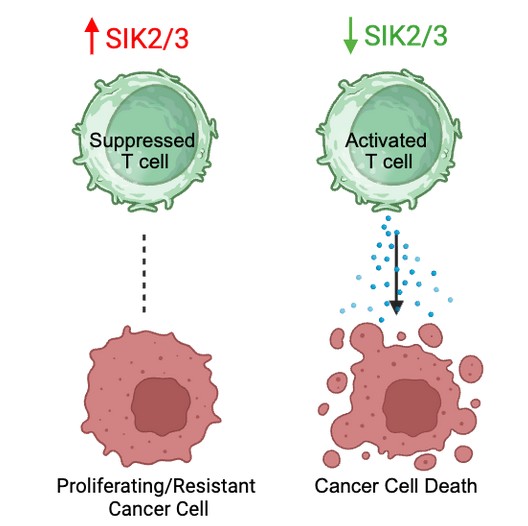
How did you go about solving this problem? We developed a high-throughput ELISA-based platform by leveraging the immunosuppressive features of patient-derived ascites to identify small-molecule drugs that could reverse T cell dysfunction in ovarian cancer. Using this top-down approach, we narrowed down to a few candidates that consistently improved T cell function in ascites-rich microenvironment ex vivo. To validate our findings in vivo, we used preclinical mice models of ovarian cancer that harbor the same mutations as observed in patients. YKL-05-099, a potent SIK inhibitor significantly slowed down ovarian tumor growth. Also, when combined with standard-of-care immunotherapies such as immune checkpoint inhibition, SIK inhibitor remarkably improved survival in ovarian tumor-bearing mice. To further validate our findings at the genetic level, we conditionally deleted the Sik genes in mice T-cell compartment. This approach also led to similar outcomes as knockout mice showed better survival compared to control mice that had normal expression of Sik genes in T cells.
“SIK inhibitors hold translational promise in treating human ovarian cancer.” – Dr. Han Dong & Dr. Laurie H. Glimcher
How would you explain your research outcomes (Key findings) to the non-scientific community? A very high percentage of ovarian cancer cases undergo relapse following frontline therapies and become refractory. Ovarian cancer has a hostile, immune-cold microenvironment that deactivates anti-tumor immune response. Developing an effective immunotherapy that provides long-lasting benefits against ovarian cancer remains a challenge.
T cells are primary actors of anti-tumor immunity in ovarian cancer. However, the liquid microenvironment of ovarian cancer, also known as ascites, dampens T cell response. We identified a novel drug target, Salt-Inducible Kinase (SIK), which when inhibited pharmaceutically leads to re-potentiation of T cells in ovarian tumors. SIK inhibition impedes ovarian cancer progression in mice models and improves survival in a T-cell-dependent manner.
What are the potential implications of your findings for the field and society? High grade serous ovarian cancer is the deadliest of all gynecologic cancers, affecting more than 2,50,000 women globally each year. It’s imperative to develop therapies that benefit these patients, especially in the advanced or refractory stage when the patients stop responding to any therapy. This work unravels a new mechanism of immunosuppression in ovarian cancer and opens the door for testing SIK inhibitor in the clinic as an immunotherapeutic against ovarian cancer. Moreover, cell-based therapies targeting Sik genes merits further investigation in the context of ovarian cancer. Additional research is required to dissect the role of SIK in B cell- and myeloid-dependent anti-tumor immunity in ovarian cancer.
What was the exciting moment during your research? The most exciting moment for me was to observe the effect of SIK inhibitor on T cell activation in malignant ascites. A previous work from the lab showed that ovarian cancer ascites is highly immunosuppressive (Song et al., Nature, 2018). Dr. Han Dong, who initiated this project performed the drug screening to identify candidates that can be repurposed to treat ovarian cancer by activating T cell response. When we validated the primary screen hits, we observed that T cells do not undergo functional inactivation in the ascites when treated with a potent SIK inhibitor YKL-05-099. This finding was reproduced using mice splenic T cells, human T cells from healthy donor PBMC, and T cells from patient ascites. The other exciting observation was to find that the drug significantly reduced tumor growth in mice. When we dissected the mice treated with the drug, we found much smaller tumors and less ascites compared to the untreated mice. This was fascinating!
Paper reference: Dong, H., Ray, A., Rotter, L.K. et al. Inhibition of salt-inducible kinases reprograms T cells and antitumor immunity in ovarian cancer. Nat Immunol (2026). https://www.nature.com/articles/s41590-026-02512-8
Research briefing:
https://www.nature.com/articles/s41590-026-02513-7
Check BioPatrika Youtube channel here: https://www.youtube.com/channel/biopatrika