



EPHA2/Ephrin-B1 signaling promotes recurrence and poor prognosis in oral cancer
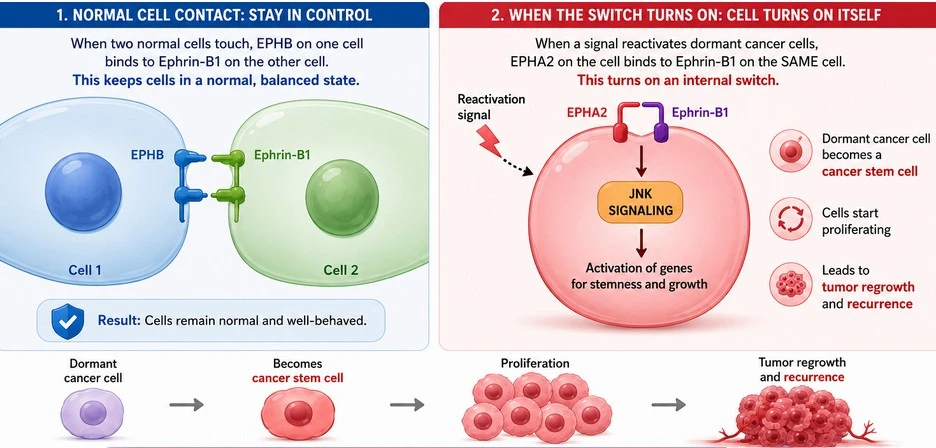
Research Summary: Unexpectedly, in oral cancer, a cis interaction between the ligand and receptor within the same cell activates JNK-mediated reverse signaling, enriching cancer stem cells and promoting recurrence and poor prognosis.
Researcher Spotlight
Reshma Raj R is a graduate student at BRIC-Rajiv Gandhi Centre for Biotechnology, Thiruvananthapuram. Her research has uncovered the role of Eph/Ephrin signaling in regulating cancer stem cells and driving recurrence and poor prognosis in oral cancer through studies involving cancer cell lines, mouse models, and patient samples. Beyond her research pursuits, she enjoys painting, watching movies, and spending quality time with her family.
LinkedIn: www.linkedin.com/in/reshma-raj-r-b37806307
Instagram: reshma_raj_rajan
Lab: Dr. Tessy Thomas Maliekal, BRIC-Rajiv Gandhi Centre for Biotechnology
What was the core problem you aimed to solve with this research?
Oral cancer has a high mortality rate in India, due to high recurrence caused by a small subset of quiescent cancer stem cells residing in the body even after conventional therapies. So, it is important to identify the pathways regulating these cells to eradicate cancer. Although ligands like Ephrin-B1 are implicated in poor prognosis, their molecular mechanisms are unknown. We elucidated the molecular mechanism of Ephrin-B1-mediated oral cancer recurrence.
How did you go about solving this problem?
We identified Eph/Ephrin signaling as one of the major pathways in oral cancer stem cells through proteomic and phosphoproteomic analyses, which highlighted EPHA2 and Ephrin-B1 as key molecules. The interaction of EPHA2 and Ephrin-B1 was confirmed by co-immunoprecipitation and proximity ligation assay (PLA), while their Subsequent activation was confirmed by biochemical assays. In vitro kinase assays further confirmed that EPHA2 directly phosphorylates Ephrin-B1 to initiate pathway activation. FRET facilitated photoswitching, and PLA revealed that EPHA2 and Ephrin-B1 interact in a cis manner within the same cell. The experiments with deletion mutants confirmed that the FN3 domain of EPHA2 interacts with Ephrin-B1. The extreme limiting dilution analysis confirmed the functional significance of this pathway in enriching cancer stem cells. Further, orthotopic mouse models and primary oral cancer samples were used to validate the role of this interaction and signaling in oral cancer recurrence.
“Although Ephrin-B1 was considered tumor-suppressive, we uncovered a unique cis-interaction underlying poor prognosis and oral cancer recurrence.” – Dr. Tessy Thomas Maliekal
How would you explain your research outcomes (Key findings) to the non-scientific community?
In a normal cell, EPHA2 and Ephrin-B1 of neighboring cells interact. But, in oral cancer, an abnormal interaction between these two proteins within the same cancer cell enriches the cancer stem cells. This interaction activates a unique pathway that increases the chances of the cancer coming back and leads to worse outcomes for patients. Since normal stem cells use EPHB2-mediated Ephrin-B1 signaling, targeting the EPHA2–Ephrin-B1 pathway may provide a new and more selective treatment approach for oral cancer.
What are the potential implications of your findings for the field and society?
- Abnormal interaction between EPHA2 and Ephrin-B1 within the same cell enriches cancer stem cell population in oral cancer.
- This interaction activates a unique reverse signaling to enrich cancer stem cells.
- This interaction uses a different structural domain of the EPHA2 receptor for interacting with Ephrin-B1 ligands.
- This unique EPHA2/Ephrin-B1 signaling in oral cancer stem cells, relying on the distinct structural domain of the receptor, can be used as an appropriate therapeutic target since normal stem cells rely on EPHB2/Ephrin-B1 signaling.
What was the exciting moment during your research?
When we performed the Proximity Ligation Assay to examine the interaction between EPHA2 and phosphorylated Ephrin-B1, we observed distinct red PLA foci predominantly localized to the cell membrane in regions lacking cell–cell contact. These findings, for the first time, clearly demonstrated that the interaction between these molecules happens in a cis manner, which was very exciting.
Paper reference: Raj, R. R., Datta, N., Krishnan, U. S., Shanmugam, G., Louis, J. M., Jeyaram, R. D., . . . Maliekal, T. T. (2026). EPHA2-Ephrin-B1 cis-interaction drives an oncogenic reverse signaling, leading to the recurrence of oral cancer. Cell Commun Signal, 24(1). doi:10.1186/s12964-026-02788-1. https://link.springer.com/article/10.1186/s12964-026-02788-1